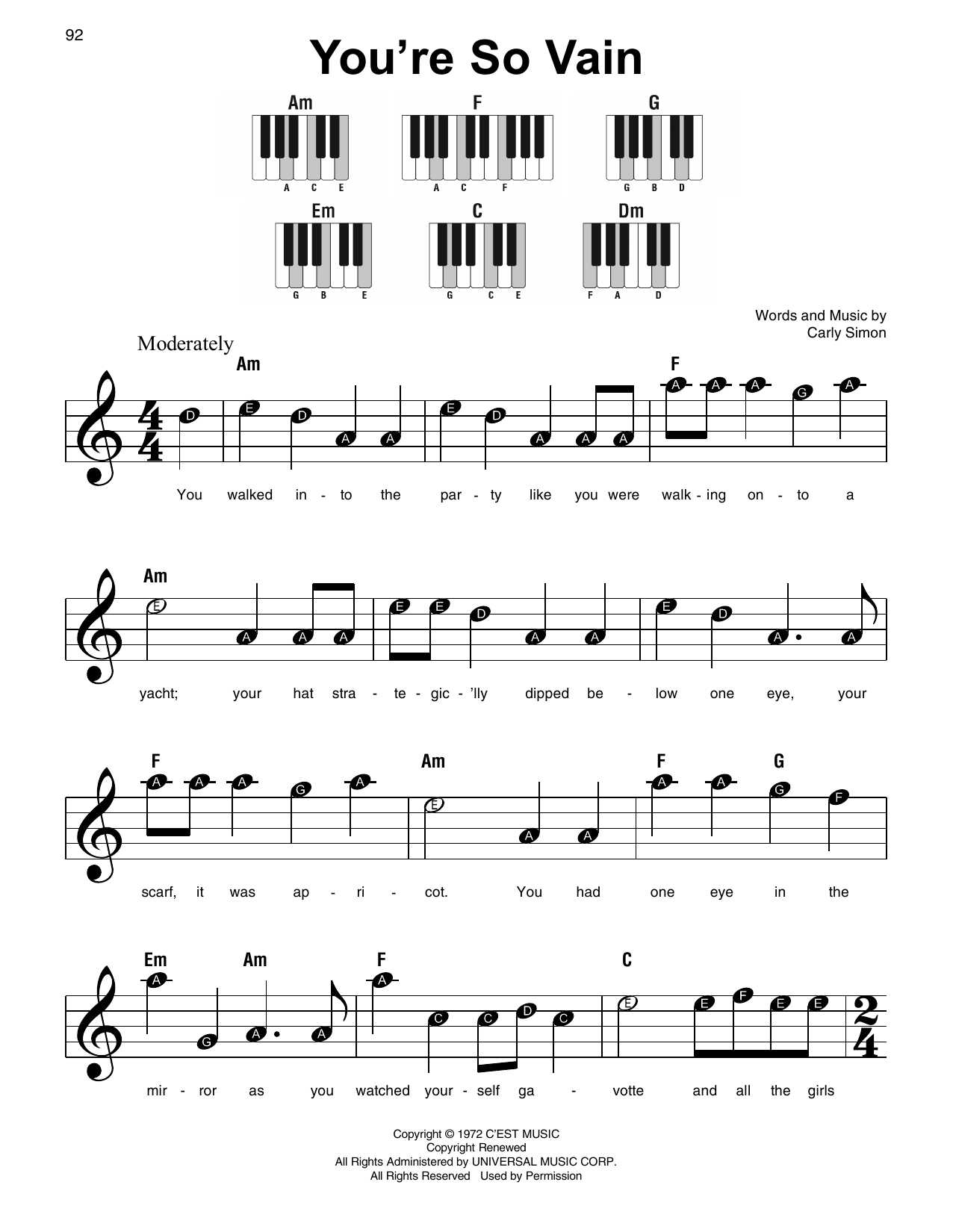
It starts with that low, growling bass line. Klaus Voormann—the same guy who designed the Beatles' Revolver cover—plucks a note that feels like a secret being whispered in a dark hallway. Then comes the whisper: "Son of a gun." For over fifty years, You're so vain by Carly Simon has been the ultimate Rorschach test for music fans. Everyone thinks they know who it’s about. Honestly, most people are wrong.
The song isn't just a hit; it's a cultural monument to the "Me Generation." Released in late 1972 on the album No Secrets, it hit number one on the Billboard Hot 100 in early 1973 and stayed there for three weeks. It’s biting. It’s sophisticated. It’s incredibly petty in the best possible way.
The Warren Beatty Obsession
Let’s get the big one out of the way. Yes, it is about Warren Beatty. But only partially.
For decades, Simon played a high-stakes game of "cat and mouse" with the media. She’d drop a hint, then pull it back. In 2015, while promoting her memoir Boys in the Trees, she finally cracked. She confirmed to People magazine that the second verse—the one about the "scarf, it was apricot"—is definitely about Beatty.
He knew it, too. Simon has famously joked that Warren actually called her to thank her for the song. Talk about proving the point of the chorus. But here’s where it gets complicated. Carly has been very clear that the song is a composite. It’s a "mosaic" of three different men. Warren is just one piece of the puzzle. The rest? Those names are still mostly locked in a vault, though the breadcrumbs are everywhere if you know where to look.
Why the Mick Jagger Theory Refuses to Die
If you listen closely to the backing vocals during the chorus, you’ll hear a very distinct, gravelly British accent. That’s Mick Jagger. He happened to be at the studio (Trident Studios in London) when Carly was recording. He walked in, hopped on the mic, and didn't even want credit.
Naturally, people assumed the song was about him. It makes sense, right? The swagger, the jet-set lifestyle, the "yacht" mentioned in the lyrics. But Simon has consistently denied it’s Mick. She says they were just friends, though the chemistry on that track is undeniable. Having the guy people think the song is about sing backup on the song about someone else is a level of power move we rarely see in modern pop. It’s brilliant. It’s chaotic. It’s very 1972.
Deconstructing the Lyrics: More Than Just a Diss Track
The song is a masterclass in songwriting because it uses specific, luxury imagery to paint a picture of emptiness.
"You walked into the party like you were walking onto a yacht."
Think about that line. It’s not just saying the guy is arrogant. It’s saying he treats every room like he owns the ocean. The "gavotte" mention is another classic Carly touch. A gavotte is an old French folk dance that became a formal court dance. By saying he "watched himself gavotte," she’s calling him a performer in his own life. He’s not living; he’s staging a production where he is the only star.
The "clouds in my coffee" line is perhaps the most famous. It sounds poetic, almost psychedelic. The story goes that Carly was on a plane and saw the reflection of the clouds in her coffee cup. Her friend (or a lover, depending on which version of the story you hear) told her it looked like "clouds in my coffee." To her, it became a metaphor for things that look beautiful but are actually just shadows—illusions that disappear when you try to touch them.
The 50-Thousand Dollar Secret
In 2003, Simon auctioned off the "secret" of the song's subject for a charity event. Dick Ebersol, the then-president of NBC Sports, won with a bid of $50,000.
The catch? He had to sign a confidentiality agreement.
He was allowed to know the name, but he couldn't tell a soul. He did let one hint slip: the name contains the letter "E." A few years later, Simon added that it also contains an "A" and an "R." This set off a firestorm of speculation.
- Mick Jagger? Has an E, A, and R.
- Warren Beatty? Has an E and A and R.
- David Geffen? This was a popular theory because he was the head of her label (Elektra) and she was reportedly annoyed with him. But he doesn't have an "R."
- James Taylor? Her husband at the time. He has the letters, but Carly has always said it wasn't him. She adored him then.
The Production Magic of Richard Perry
We can’t talk about why You're so vain by Carly Simon still sounds so good without mentioning Richard Perry. He was the "it" producer of the early 70s. He pushed Carly to be bolder.
Initially, the song was a slow, introspective folk ballad called "Bless You, Ben." It was soft. It was nice. It was boring. Perry told her to pick up the tempo. He brought in the big guns. You’ve got Jim Gordon on drums—the man who played on "Layla." You’ve got Jimmy Ryan on guitar.
The result was a record that bridged the gap between the confessional singer-songwriter era and the high-gloss pop of the mid-70s. It’s a "big" sounding record. It feels expensive. It feels like the Saratoga races and the private jets it describes.
The Misconception of "Vain"
There is a weird irony at the heart of the song. By writing a song about a man’s vanity, Carly Simon created a piece of art that required her to be just as self-focused. You have to be pretty confident to tell someone, "You probably think this song is about you."
It’s a paradox. If the song is about him, he’s right to think so, which technically means he’s not being "vain" in that specific instance—he’s just being accurate. But that’s the trap. The song isn't just about his ego; it's about her realization that she was just an accessory in his life.
She was "the wife of a close friend" or just another girl at the party. The song is her taking the power back. It’s her saying, "I see you."
Why It Still Matters Today
In the age of Instagram and TikTok, vanity is our primary currency. We all watch ourselves "gavotte" in the front-facing camera. You're so vain by Carly Simon was the first "main character energy" anthem.
It predicted a world where everyone is the star of their own movie, often at the expense of the people they’re actually with. When you hear that chorus now, it doesn't feel like a relic of the 70s. It feels like a comment on the guy at the next table who is ignoring his date to check his likes.
How to Listen Like an Expert
To truly appreciate the depth of the track, you need to look past the "who is it about" gossip.
- Listen to the Bass: Focus entirely on Klaus Voormann's opening for the first 30 seconds. It sets the tension.
- The Jagger Harmony: Turn up the volume on the final chorus. Jagger’s voice starts to bleed through more clearly, creating a weird, haunting double-tracked effect with Simon.
- The Orchestration: Notice the strings. They don't just "pad" the song; they swell and retract like the tide. It’s incredibly cinematic.
The mystery is the marketing, but the music is the substance. Whether the "other" names are David Cassidy, Cat Stevens, or some guy named Benny from her college days doesn't really change the emotional weight of the performance. It’s a song about the moment you realize the person you adore is actually just in love with a mirror.
If you want to dive deeper into this era of music, start by listening to the rest of the No Secrets album. It’s often overshadowed by the lead single, but tracks like "The Right Thing to Do" show a much more vulnerable side of Simon that provides a necessary contrast to the sharp edges of "You're So Vain."
Study the lyrics of the third verse again. "I had some dreams, they were clouds in my coffee." It’s the most honest line in the song. It admits that she wasn't just a victim of his vanity; she was a participant in the fantasy. That’s the real human element that keeps the song on the radio 50 years later. It’s not just a finger-pointing exercise. It’s an admission of a shared delusion.
Check out the 1987 live version from Martha’s Vineyard. Her voice is deeper, more weathered, and she sings it with a smirk that suggests she’s still enjoying the fact that we’re all still guessing. The secret is the one thing she’ll never truly give away, and honestly, that’s exactly why we’re still talking about it.



