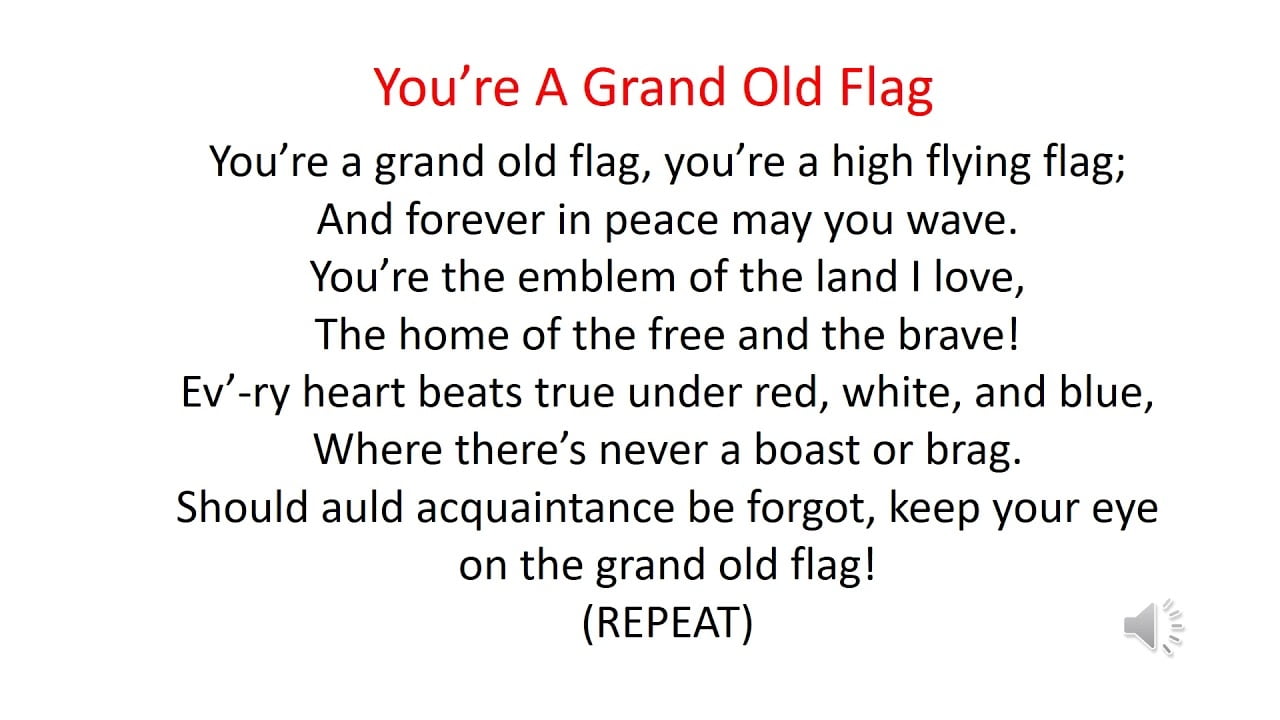
Everyone knows the tune. It’s that jaunty, unmistakable march that shows up at every Fourth of July parade, elementary school pageant, and baseball game. But honestly, most people get the You're a Grand Old Flag lyrics a little bit wrong, or at the very least, they don’t realize the song was born out of a massive controversy that forced a title change.
George M. Cohan was a powerhouse. He basically invented the modern American musical. Back in 1906, he was working on a show called George Washington, Jr., and he needed a showstopper. He found it, but not before he accidentally offended a whole lot of Civil War veterans. It's kinda wild how a song we now consider the peak of "safe" patriotism started out as a PR nightmare for its creator.
The "Grand Old Rag" Scandal
When the song first debuted in an out-of-town tryout in Hartford, Connecticut, it wasn't called "You're a Grand Old Flag." Cohan originally titled it "You're a Grand Old Rag."
That sounds crazy now, right? Calling the American flag a "rag" seems like a one-way ticket to getting canceled, even in 1906. But Cohan wasn't trying to be edgy or disrespectful. He had actually met a Civil War veteran—a member of the Grand Army of the Republic—who was holding a carefully folded, tattered flag. The old soldier reportedly looked at the flag and whispered to Cohan, "She's a grand old rag."
Cohan thought it was poetic. He thought it captured the grit and the sacrifice of the men who fought to keep the country together. He was wrong about how the public would take it.
The audience in 1906 absolutely hated the word "rag." They didn't see it as a tribute to a weathered battle flag; they saw it as an insult to the national symbol. The backlash was instant. Newspapers jumped on it, and patriotic societies were up in arms. Cohan, being a savvy businessman who wanted his show to actually make money, realized he’d stepped in it. He quickly swapped "Rag" for "Flag," and a legendary anthem was saved from the scrap heap of history.
Breaking Down the You're a Grand Old Flag Lyrics
If you look at the verses, not just the chorus everyone hums, you see Cohan’s genius for "borrowing" from other famous tunes. He was a master of the musical mashup long before that was a thing.
The Famous Chorus
The chorus is what sticks. It's short, punchy, and uses a very specific rhythm that mimics a military march.
"You're a grand old flag, You're a high-flying flag And forever in peace may you wave. You're the emblem of The land I love, The home of the free and the brave."
Notice how he sneaks in a direct nod to "The Star-Spangled Banner" at the end? He does that throughout the song. It’s a technique called "quoting," where a composer uses snippets of other well-known melodies to trigger a subconscious emotional response in the listener. It makes the song feel familiar even the very first time you hear it.
The Verses You Never Hear
Hardly anyone sings the verses anymore, which is a shame because they set the stage. The lyrics mention "Every heart beats true 'neath the Red, White and Blue," which is standard patriotic fare, but then Cohan goes into this weirdly specific bit about "Where there's never a boast or brag."
It’s a very 1900s sentiment—the idea that American greatness is quiet and sturdy. Of course, the irony is that the song itself is a huge, loud, brassy boast. That’s just Cohan. He was the king of Broadway bravado.
He also weaves in "Auld Lang Syne" in the musical bridge. If you listen closely to the melody right after the chorus, you’ll hear it. "Should auld acquaintance be forgot, keep your eye on the grand old flag." It’s a weird lyrical choice if you think about it too hard, but in the context of a fast-paced musical, it works. It links the idea of national loyalty to the idea of old friendships.
Why the Song Stuck When Others Faded
There were hundreds of patriotic songs written during the Tin Pan Alley era. Most are totally forgotten. Why did this one survive?
For one, it’s physically impossible to stay still when it’s playing. The tempo is usually around 120 beats per minute—the standard walking pace for the U.S. Army. It triggers a physical response. You want to march.
Secondly, it’s simple. The You're a Grand Old Flag lyrics don't use complex metaphors. They don't require a deep understanding of political theory. It’s "The land I love" and "The home of the free." It hits the lizard brain of national identity.
Also, George M. Cohan was the first person to really package patriotism as entertainment. Before him, national songs were usually hymns or very serious, somber affairs. Cohan made patriotism fun. He made it something you could dance to in a theater while eating popcorn. He turned the flag into a pop culture icon.
The Cultural Legacy of a 1906 Hit
It's pretty amazing that a song written before the first World War, before the invention of the television, and before the Great Depression is still a staple.
It was the first song from a musical to sell over a million copies of sheet music. Think about that. In 1906, there was no Spotify. If you wanted to hear a song at home, you had to buy the paper and play it on your piano. A million people liked this song enough to go to a store, carry home a piece of paper, and learn how to play it themselves.
It eventually became a centerpiece of the 1942 movie Yankee Doodle Dandy, where James Cagney played Cohan. That movie cemented the song for a new generation during World War II, which is probably why your grandparents know it just as well as you do.
Fun Facts You Can Use to Impress People
- The Auld Lang Syne Link: As mentioned, the song literally tells you to keep your eye on the flag instead of forgetting "auld acquaintance."
- First Million-Seller: It wasn't just a hit; it was a financial juggernaut.
- The Military Connection: It’s one of the few non-military-composed songs that is regularly played by official military bands during ceremonies.
- Cohan’s Ego: Cohan actually played the lead role in the play he wrote the song for. He was the writer, director, producer, and star. Talk about a triple threat.
Getting the Lyrics Right (Finally)
If you're planning on performing this or just want to be the person who knows the right words at the next gathering, here is the breakdown of the most common mistakes.
Most people say "You're a grand old flag," then "You're a high-flying flag." Don't mix up the "high-flying" and the "grand old." Also, remember it’s "emblem of," not "symbol of."
It seems like a small distinction, but "emblem" has a more heraldic, formal weight to it.
How to Use This Knowledge
If you’re a teacher, a performer, or just a history buff, understanding the context of the You're a Grand Old Flag lyrics changes how you hear the song. It’s not just a dusty old anthem. It’s a survivor of a PR blunder. It’s a piece of Broadway marketing genius.
To really appreciate it, try listening to the original 1906 recordings (you can find them in the Library of Congress archives online). They are scratchy, fast, and full of that old-school energy that made Cohan a legend.
Next Steps for the History Buff:
- Check out the Library of Congress digital collection for the original sheet music covers—they are beautiful examples of early 20th-century graphic design.
- Watch James Cagney’s performance of the song in Yankee Doodle Dandy to see how the choreography was intended to look.
- Compare the lyrics to Cohan's other big hit, "Over There," to see how his style of patriotic songwriting evolved as the country headed into WWI.
The song is a snapshot of an America that was just starting to realize its own cultural power. It’s loud, it’s a little bit repetitive, and it’s unashamedly proud. Whether you find that charming or a bit much, you can’t deny it’s a masterclass in songwriting that stands the test of time.



