It’s the song that kills at every fourth of July parade. You know the one. It’s loud, it’s fast, and it makes you want to wave a tiny plastic flag until your arm hurts. But here’s the thing: the grand old flag lyrics we belt out today aren't exactly what George M. Cohan wrote back in 1906. Not even close, really.
If you’ve ever fumbled the words between "high flying flag" and "emblem of the land I love," don't sweat it. You're part of a century-long tradition of lyrical evolution. Most people think this song was just a generic burst of patriotism, but it actually started with a chance encounter between a songwriter and a Civil War veteran. It wasn't even called "You’re a Grand Old Flag" at first.
The Civil War Vet and the "Grand Old Rag"
George M. Cohan was a powerhouse. The guy basically invented the modern musical comedy. One day, he’s sitting next to a veteran of the Battle of Gettysburg. This old soldier is holding a carefully folded, tattered American flag. The vet looks at Cohan and says, "She’s a grand old rag."
Cohan loved that. He thought it was poetic.
So, he went home and wrote "You’re a Grand Old Rag." When the song debuted in the musical George Washington, Jr., the audience actually liked it, but the press? They lost their minds. Critics and patriotic groups thought calling the flag a "rag" was a massive insult. They didn't care about the veteran's sentiment; they cared about the optics. Cohan, being a savvy businessman who didn't want his show boycotted, swapped "rag" for "flag" almost immediately.
That one-word change shifted the entire tone of the grand old flag lyrics. It went from a gritty, personal tribute to an idealistic national anthem.
Why the Lyrics Stick in Your Head
There’s a reason this song is a "march." Cohan was obsessed with rhythm. The song is written in a brisk 2/4 time. It’s designed to make you move.
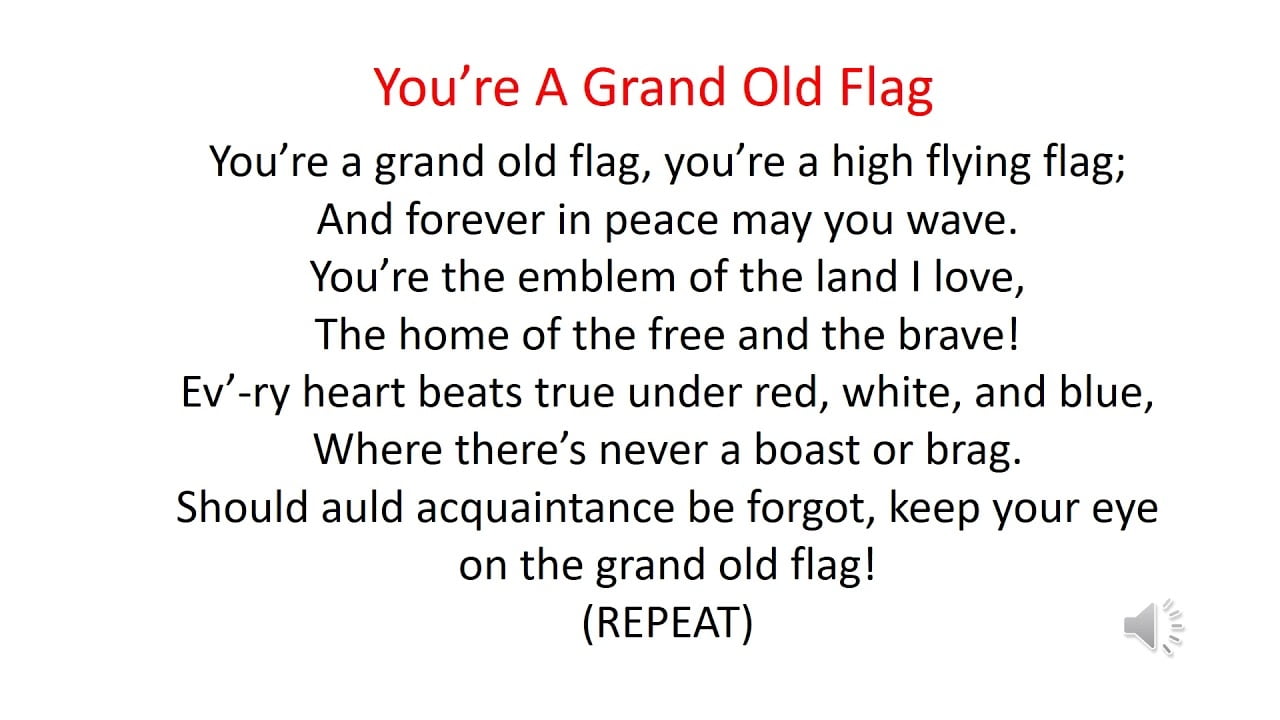
"You're a grand old flag, You're a high flying flag And forever in peace may you wave."
It’s simple. It’s punchy.
But look closer at the middle section. "You're the emblem of the land I love, the home of the free and the brave." Sound familiar? It should. Cohan was a master of "borrowing." He intentionally wove bits of "The Star-Spangled Banner" and "Auld Lang Syne" into the melody and lyrics to create a sense of instant nostalgia. He wanted people to feel like they’d known the song their entire lives, even the first time they heard it.
Most of us only know the chorus. In reality, the full version has verses that set the stage. The verses talk about "the kitchen of a mansion" and "the spirit of '76." Hardly anyone sings those anymore. We’ve collectively decided as a culture that the chorus is the only part that matters.
The Weird History of the "Don't Forget" Line
One of the most misinterpreted parts of the grand old flag lyrics is the closing line: "Should auld acquaintance be forgot, keep your eye on the grand old flag."
It’s a weird mashup.
Cohan is basically saying that even if everything else changes—even if old friends are forgotten—the flag remains the constant. It’s a bit heavy for a song kids sing in elementary school, right? But Cohan lived in a time of massive immigration and rapid industrial change. He was selling a specific brand of American identity that was tied to symbols because the people themselves were so diverse.
Why We Still Sing It in 2026
Honestly, the song is a bit of a relic. Some of the language is dated. The sentiment is unapologetically bold in a way that makes some modern listeners a bit twitchy. Yet, it persists.
It persists because it’s one of the few songs that successfully bridges the gap between folk music and theater. It’s catchy. It’s incredibly hard to sing "You're a Grand Old Flag" without accidentally smiling. It’s also short. In an era of short attention spans, a song that gets its point across in about 90 seconds is gold.
Variations and Common Mistakes
You’ll hear people sing "Every heart beats true 'neath the Red, White and Blue." That’s the standard. But back in the early 20th century, different regions had their own "local" versions. Some schoolhouses would swap out lines to mention their own states.
The biggest mistake? The "High flying flag" vs "High flying rag" debate. While Cohan changed the title, some early sheet music still circulated with the original lyrics. If you find an original 1906 printing that says "Rag," hold onto it. It's worth a fortune to collectors.
The rhythm also trips people up. Cohan meant for the word "flag" to be held longer than most people hold it today. We tend to rush through it. If you listen to early recordings from the 1910s, the tempo is actually a bit more stately than the frantic pace we use at baseball games now.
How to Actually Use This Knowledge
If you’re a teacher, a performer, or just a history nerd, don't just memorize the chorus. Understanding the "Grand Old Rag" origin story changes how you perform the song. It adds a layer of grit to what is usually just a "shiny" tune.
- Check the Source: If you’re performing this for an event, look up the 1906 sheet music. The piano arrangement is much more syncopated than the modern "marching band" style. It’s got a ragtime feel—fitting, given the original title.
- Contextualize the "Rag" line: When teaching the song to kids, tell them about the veteran. It turns a lesson about lyrics into a lesson about empathy and respect for history.
- Mind the Tempo: Don’t let it turn into a race. The power of the lyrics comes from the beat. If you go too fast, the words "emblem of the land I love" just turn into a mushy sound.
- Explore the Verses: Read the first verse. It sets up a narrative about a conversation. Without it, the chorus is just a list of compliments to a piece of fabric. With it, the song is a story about a human connection.
The grand old flag lyrics aren't just a set of instructions for a parade. They are a snapshot of 1906 New York—a mix of theater, politics, and a genuine, if slightly messy, love for the country. Next time you hear it, listen for the "Auld Lang Syne" melody hidden in the background. It’s Cohan’s little wink to the audience, reminding us that even as we look forward, we’re always carrying the past with us.



