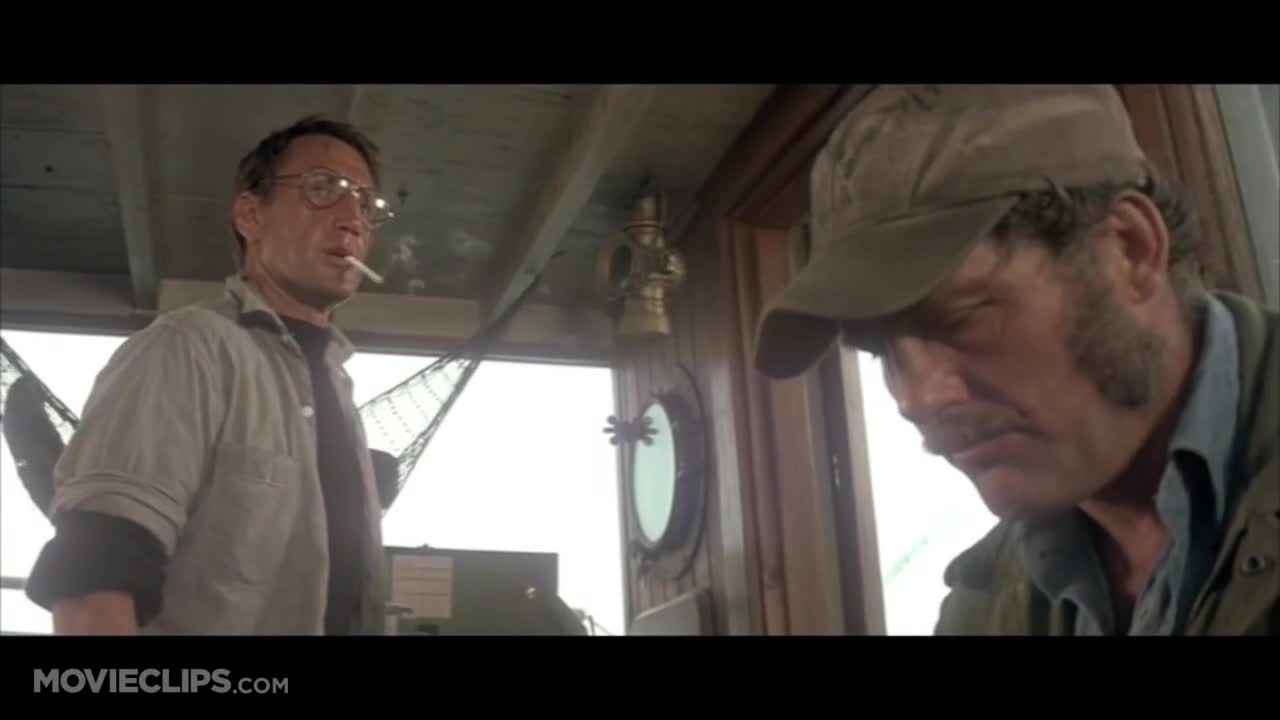
Roy Scheider wasn’t even supposed to say it. That’s the thing about the most famous movie lines in history—half the time, they’re just some guy riffing on set because the production is falling apart. If you’ve ever watched Jaws and felt that chill when the Great White finally makes its debut, you know the line. It’s the moment Brody, stunned and smelling like chum, backs into the cabin and tells Quint, "You're gonna need a bigger boat."
Except, most people don't say it like that. They say, "We’re going to need a bigger boat."
It’s a tiny distinction, sure. But it changes the entire vibe of the scene. In the actual film, Chief Martin Brody is shifting the blame. He’s looking at Quint—the grizzled, obsessive shark hunter—and basically saying, "This is your problem, man. You’re the one who thought this little tub could handle a monster." It’s a moment of pure, unadulterated realization that they are completely outmatched.
The Secret History of You’re Gonna Need a Bigger Boat
To understand why this line exists, you have to understand how miserable it was to film Jaws in 1974. Steven Spielberg, who was only 27 at the time, was way over budget. The mechanical shark, nicknamed Bruce, almost never worked. It sank. It exploded. It got tangled in seaweed. Because the shark was constantly broken, the crew had to find ways to build tension without actually showing the damn fish.
The "bigger boat" line was actually an inside joke among the crew long before it was caught on film. According to screenwriter Carl Gottlieb, the support barge used to hold the lighting equipment and craft services was way too small. It was constantly swaying, and the equipment was always at risk of falling into the Atlantic. The crew started jokingly telling the producers, "You’re gonna need a bigger boat" every time something went wrong.
Roy Scheider, being a smart actor, started ad-libbing the phrase into different scenes throughout the shoot. Most of them were cut. But the one that stayed in? That one was perfect.
Why the Misquotation Stuck
We do this a lot with movies. "Luke, I am your father" (never said). "Play it again, Sam" (never said). We collective-memory our way into a version of the line that feels more inclusive. By saying "We're going to need a bigger boat," we turn it into a universal metaphor for being overwhelmed. It's used in boardrooms. It’s used by tired parents. It’s used when you realize your IKEA desk has 400 more screws than you expected.
But in the context of the movie, the "You" is vital. It highlights the friction between the three men on the Orca. You’ve got the city cop who hates the water, the arrogant oceanographer, and the salty sea captain. They aren't a team yet. They’re just three guys on a floating coffin.
The Engineering Nightmare Behind the Scene
Let’s talk about that boat, the Orca. It wasn't just one boat. The production used two different versions. One was a functional boat, and the other was a "prop" boat designed to sink and be manipulated by divers.
The scene where the line is delivered happens right after the "Pop-up" scare. This is a masterclass in editing by Verna Fields. You see Brody tossing chum into the water, looking bored. He’s complaining about the smell. Then, the shark’s head rises out of the water behind him. It’s huge. It looks like a prehistoric nightmare.
- The Scale: The mechanical shark was 25 feet long.
- The Boat: The Orca was roughly 29 feet long.
- The Math: When you realize the predator is nearly as large as your only means of survival, the humor of the line hits harder.
Spielberg originally wanted to show the shark more often, but the mechanical failures forced him to adopt a Hitchcockian approach. He used the yellow barrels to track the shark's movement. He used John Williams’ iconic score. Honestly, the shark being broken was the best thing that ever happened to that movie. If we had seen Bruce the Shark in every scene, he would have looked like a big rubber toy. Instead, we got the psychological dread of what was under the water.
How the Line Became a Cultural Swiss Army Knife
It’s rare for a movie line to transcend its genre so completely. You don’t need to have seen Jaws to understand what someone means when they say it. It has become shorthand for "our current resources are insufficient for the magnitude of this problem."
In 1975, Jaws created the summer blockbuster. Before this, movies didn't "open wide" across the country. They trickled out. But Jaws was an event. It changed the way Hollywood marketed films, and it changed the way we talk.
Think about the sheer variety of ways this line is applied today:
- Business and Tech: When a startup realizes their servers can't handle a sudden spike in traffic.
- Politics: When a candidate realizes they’ve vastly underestimated their opponent's ground game.
- Climate Change: Scientists have literally used the phrase in papers regarding the inadequacy of sea walls.
- Memes: From The Office to The Simpsons, the line has been parodied so many times that the parody is sometimes more famous than the source.
The Nuance of Roy Scheider’s Delivery
Watch Scheider’s face. He doesn’t scream it. He doesn't make a big dramatic gesture. He says it with a cigarette dangling out of his mouth, eyes wide, backing away slowly. It’s the delivery of a man who has just looked into the eyes of God and realized God is a 3-ton eating machine.
Scheider was often the "grounded" element in these high-concept movies. While Robert Shaw was chewing the scenery (in the best way possible) as Quint, and Richard Dreyfuss was being the frantic intellectual, Scheider was the everyman. His reaction is our reaction.
The Legacy of the Orca
There’s a reason people are still obsessed with the boat itself. Recently, there have been efforts to recreate the Orca for fans and film historians. The original boat was left to rot on a backlot at Universal Studios and eventually broken up. It’s a tragedy for film buffs.
But the spirit of the boat—that cramped, bloody, sinking vessel—lives on every time someone realizes they’re in over their head.
If you’re a fan of the film, or if you’re just someone who likes trivia, you should know that the "bigger boat" line wasn't the only ad-lib. Much of the banter between the three leads was refined on the fly. This gave the movie a naturalistic feel that most modern CGI-heavy blockbusters lack. You feel the sweat. You smell the diesel. You believe they are out there in the middle of the ocean because, well, they actually were. Spielberg insisted on filming in the actual Atlantic Ocean off Martha’s Vineyard, rather than a tank. It was a logistical disaster that made for a cinematic masterpiece.
How to Use This Knowledge
The next time you’re at a bar and someone says, "We're going to need a bigger boat," you have a choice. You can be the "actually" person (use this power wisely) and point out that it’s "You're gonna need a bigger boat."
Or, you can just appreciate the fact that a crew member’s complaint about a crappy barge in 1974 became one of the most recognizable pieces of English dialogue in the 20th century.
Actionable Insights for Movie Buffs:
- Watch the Scene Again: Pay attention to the blocking. Brody never stops moving backward until he hits the cabin door.
- Listen for the "You": Notice how it separates Brody from the responsibility of the hunt.
- Context Matters: Use the line when the stakes are high, but the solution is clearly too small. It loses its punch if you use it for a minor inconvenience.
- Check Out "The Shark Is Broken": If you really want to dive deep, look up the stage play written by Robert Shaw’s son, Ian Shaw. It’s all about the behind-the-scenes drama of filming Jaws and the origins of these iconic moments.
The line works because it’s true. Sometimes, the problem really is bigger than the boat. And sometimes, you just have to hope you have enough barrels to keep the monster on the surface long enough to get a shot off.



