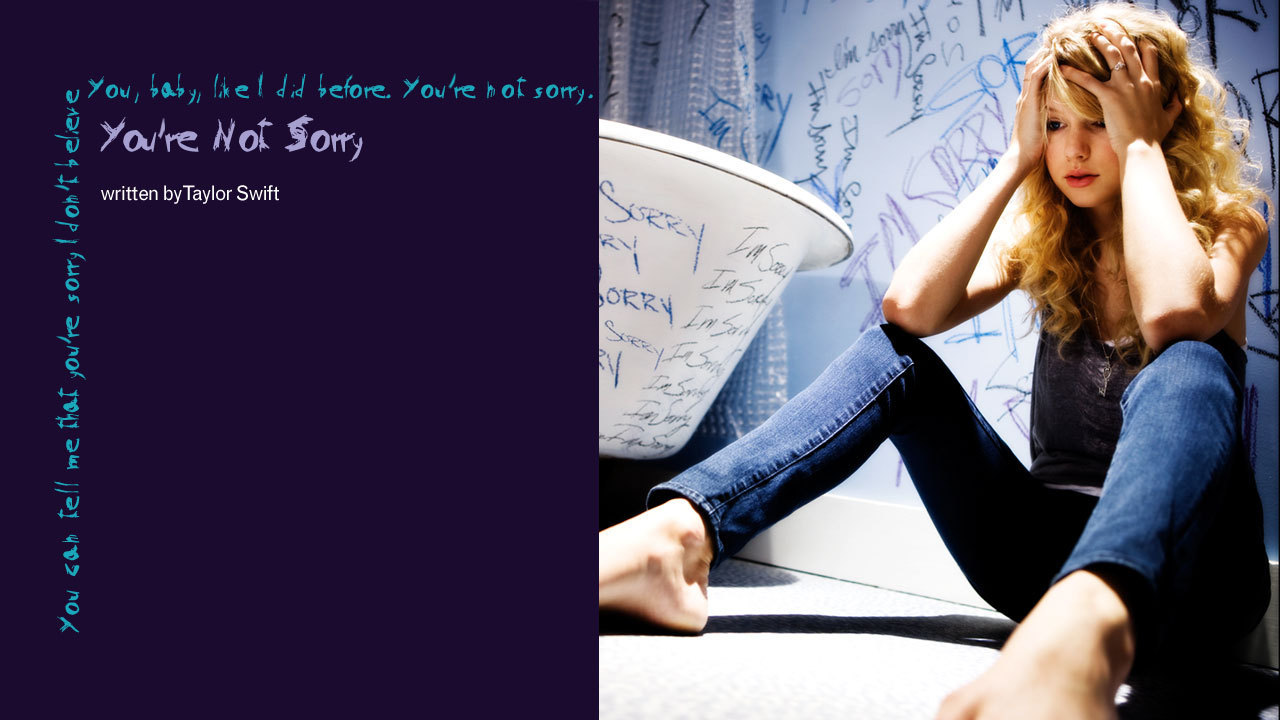
It was 2008. Taylor Swift was still the girl with the tight curls and the acoustic guitar, but something was shifting. She wasn’t just singing about white horses and teardrops on guitars anymore. She was getting angry. When Fearless dropped, track 11 hit like a bucket of ice water. You’re Not Sorry wasn't a ballad about pining away; it was a gritty, piano-driven realization that the person you love is actually a master of the "empty apology."
Honestly, we’ve all been there. You’re sitting on the floor, phone in hand, watching a text bubble pop up that says "I'm so sorry," but you know it’s a lie. It’s the kind of apology that functions as a band-aid on a bullet wound. Swift captured that specific brand of exhaustion perfectly.
The song isn't just a relic of the late 2000s country-pop crossover era. It’s a psychological profile of a dying relationship. It’s about the moment the rose-colored glasses shatter and you realize that "sorry" is just a word used to buy more time.
The Story Behind the Song: Who Was Taylor Actually Singing About?
Fans have spent over a decade dissecting the liner notes. Back in the day, Swift used to hide secret messages in her lyric booklets using capitalized letters. For You’re Not Sorry, the secret message was "She can keep you."
The popular theory? It’s about Joe Jonas.
The timeline fits. They broke up in a notorious 27-second phone call in October 2008, right before the album was released. But if you look closer at the lyrics, it feels less like a sudden breakup and more like a slow erosion of trust. It’s about someone who kept coming back, making promises, and then breaking them again. It’s the "last straw" song. Swift has mentioned in interviews that the song came from reaching a breaking point where you simply stop believing the person standing in front of you.
She realized that the apologies weren't about repentance. They were about control. They were about keeping her on the hook.
The Anatomy of an Empty Apology
Why does this song still resonate? Because the "faux-pology" is a universal human experience. In psychology, there’s a term for what Swift is describing: "hoovering." It’s when a person tries to "suck" you back into a toxic cycle by saying exactly what you want to hear, without any intention of changing their behavior.
Swift nails the lyrics here. She talks about how she’s been "looking at the phone" and "waiting by the door." She was vulnerable. She gave them the power. Then comes the shift.
"You can tell me that you're sorry / But I don't believe you baby like I did before / You're not sorry, no, no, no, no."
It’s the repetition of "no" that does it. It’s her convincing herself as much as she’s telling him. It’s a refusal to be gaslit. In a world where we’re often told to forgive and forget to "be the bigger person," this song is a radical act of saying: No, your apology isn't enough because it isn't real.
The Musical Shift: From Piano to Rock
If you listen to the original 2008 version versus You’re Not Sorry (Taylor’s Version), you can hear the growth in her vocal control, but the raw spite is still there. The song starts with a somber piano melody. It feels lonely. But as the drums kick in and the electric guitar swells, it transforms into a power anthem.
It mirrors the emotional journey of the lyrics. You start sad. You end empowered.
Why the "Taylor’s Version" Update Changed the Narrative
When Swift began her re-recording project, You’re Not Sorry was one of the tracks fans were most curious about. Re-released in 2021 on Fearless (Taylor's Version), the song took on a new layer of meaning.
In 2008, she was a teenager dealing with a high school-esque breakup. In 2021, she was a mogul reclaiming her life’s work from people who—in her view—had betrayed her. Suddenly, "You’re Not Sorry" wasn't just about an ex-boyfriend. It felt like it could be about Scott Borchetta or Scooter Braun. It became a song about professional betrayal and the hollow apologies of the music industry.
The production on the re-recording is crisper. The strings are more cinematic. It’s no longer a country song; it’s a dark pop masterpiece. It proves that a well-written song can evolve as the artist does.
Breaking Down the Most Savage Lyrics
There are lines in this song that are just... brutal. Let's look at a few.
"You had me crawling for you / And standing on my feet again." This perfectly describes the roller coaster. One day you're devastated, the next you're trying to find your confidence, only for them to knock you back down.
"You don't have to call anymore / I won't pick up the phone." The ultimate power move in 2008 was refusing to answer a call. In the age of "Do Not Disturb" and "Read Receipts," this feels even more poignant.
"Looking so innocent / I might believe you if I didn't know." This is the crux of the song. It’s about the "wolf in sheep’s clothing" trope. It’s the realization that the person you loved has a "mask" they wear, and you’re the only one who has seen what’s underneath it.
The Cultural Impact: It’s Not Just a Song, It’s a Boundary
We talk a lot about "setting boundaries" today. In 2008, we didn't really have that vocabulary in the mainstream. We just called it "being over it."
You’re Not Sorry taught a generation of young listeners that you don't have to accept an apology just because it was offered. You are allowed to look at someone’s track record and decide that their words no longer have value. That’s a massive lesson for a 19-year-old to be teaching her peers.
It’s often compared to White Horse, which appears earlier on the same album. While White Horse is about the sadness of realizing a fairy tale isn't real, You’re Not Sorry is the anger that follows that realization. It’s the active stage of grief.
How to Tell if Someone Truly Isn't Sorry
If you find yourself relating to this song a little too much lately, it might be time for a reality check. Real apologies require three things that the person in Swift's song clearly lacked:
- Validation: They acknowledge exactly what they did and how it hurt you, without making excuses.
- Repentance: They show genuine remorse (not just "I'm sorry you feel that way").
- Change: They don't do the thing again.
If they are missing the change, then they are "not sorry." They are just sorry they got caught, or sorry they are losing the benefits of having you around.
Actionable Steps: Moving On When the Apology is Fake
So, what do you do when you realize the person in your life is the living embodiment of this song?
- Stop the Back-and-Forth: The song is about the "last time." Make it the actual last time. Stop explaining your hurt to someone who is committed to misunderstanding you.
- Audit the Patterns: Don't look at the apology in isolation. Look at the last six months. Has the behavior changed? If the answer is "no," the apology is a tool, not a sentiment.
- Find Your Own Closure: Swift didn't get closure from the guy. She got it by writing a hit song and moving on. Sometimes, closure is just the decision to stop asking questions.
- Reclaim Your Space: Whether it’s deleting the number or just taking a break from social media, create a physical and digital barrier.
The legacy of You’re Not Sorry isn't just about Taylor Swift's dating life. It’s a blueprint for emotional self-defense. It reminds us that our trust is earned, not owed. If someone spends their "last chance" and then asks for another, you have every right to walk away.
Don't wait for them to finally mean it. They probably won't. Just turn the volume up, scream the lyrics, and realize that you’re better off without the fake "sorries" cluttering up your life.



