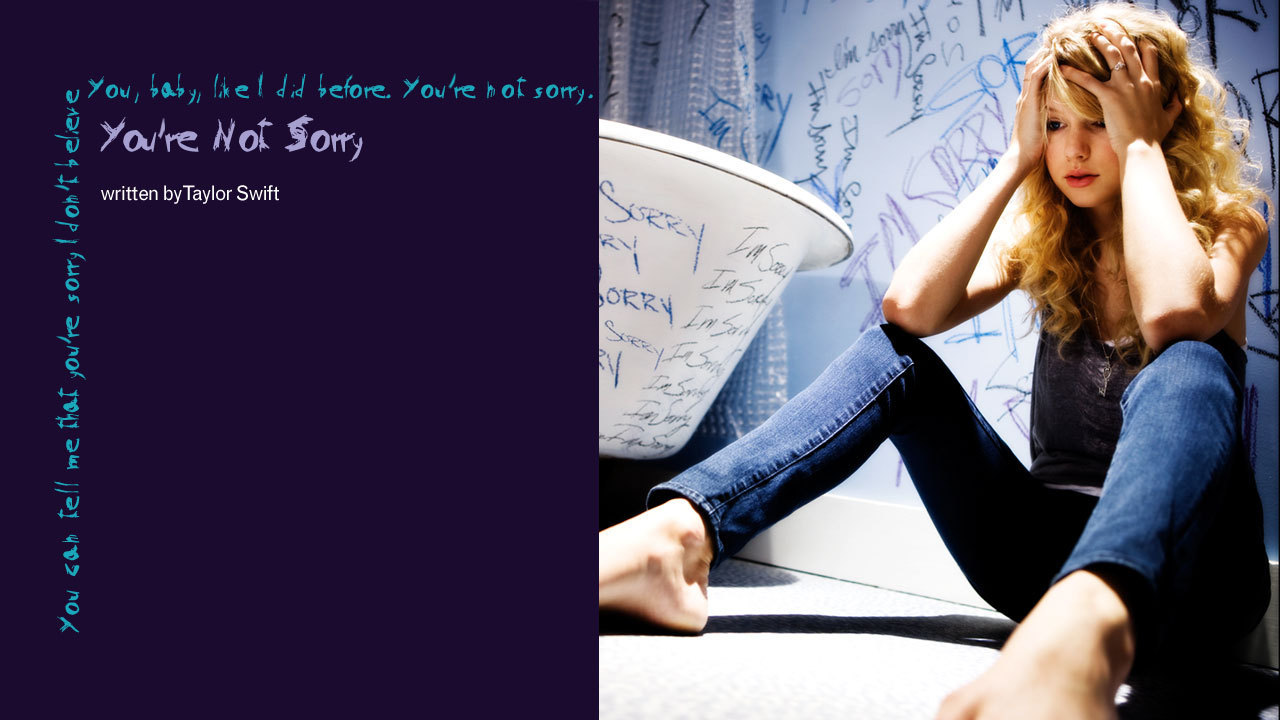
Taylor Swift was just eighteen when she dropped "You're Not Sorry." It’s the ninth track on Fearless, an album that turned her from a country-pop darling into a global phenomenon. Honestly, in the grand scheme of the "Swiftian" cinematic universe, people often skip over this one to get to the radio giants like "Love Story" or "You Belong With Me." That’s a mistake. While those songs are about the dizzying highs of teenage romance, You're Not Sorry Taylor Swift is where the steel in her spine first started to show. It isn't just a breakup song; it’s a "shut the door and lock it" song.
Most fans know the lore. This was the era of Joe Jonas and the infamous 27-second phone call, though Taylor has stayed relatively quiet about exactly who inspired this specific track. What matters more than the "who" is the "how." How does a teenager capture that specific, crushing realization that an apology is actually just a manipulation tactic? She wrote it alone. No co-writers. Just Taylor and a piano, realizing that someone’s "sorry" had become a repetitive, meaningless sound.
The Raw Production of You're Not Sorry Taylor Swift
Listen to the original 2008 version versus the 2021 Taylor’s Version. There’s a shift. In 2008, you hear the breathy, slightly wounded vocals of a girl who is literally in the middle of the fire. The piano is heavy, almost funereal. When the drums kick in for the chorus, it feels like a physical push-back. It’s dramatic. It’s moody. It’s exactly how a betrayal feels when you’re eighteen and your world is collapsing.
Then you have the Taylor’s Version. Her voice is richer, more controlled. She isn't crying anymore; she’s reporting from the future. The strings in the 2021 recording are sharper, thanks to the maturation of her touring band and the production tweaks by Christopher Rowe. It’s fascinating because the song transforms from a cry for help into a cold statement of fact. You're not sorry. I know it now.
The song actually had a pretty big moment on CSI: Crime Scene Investigation back in the day. Remember that? Taylor played a character named Haley Jones, and a remix of the song—the "CSI Remix"—was used in the episode. It stripped away some of the country twang and added this eerie, atmospheric layering that proved the song could exist outside the Nashville bubble. It was a hint of the genre-blurring she’d do years later on Reputation.
Why the Lyrics Still Sting
"You can tell me that you're sorry / But I don't believe you baby like I did before."
It’s a simple line. But it hits because it addresses the death of trust. Most breakup songs are about the pain of missing someone. This one is about the exhaustion of dealing with someone. It’s the "last straw" anthem. Swift captures that tipping point where the excuses stop working. She uses the metaphor of a "shining armor" that has turned out to be fake, a theme she’d revisit in "White Horse."
If you look at the bridge, the intensity ramps up. "You had me crawling for you honey and it never would've gone away." That’s dark. It’s a level of emotional honesty about power dynamics in a relationship that most pop stars weren't touching in 2008. She’s admitting she was at her lowest, and the other person took advantage of it.
The Evolution of the Live Performance
If you were lucky enough to see the Fearless Tour, you saw the theatrics. Taylor would sit at a glittery back-to-back piano, her hair covering her face, banging out those chords. It was high drama.
Then came the Speak Now World Tour, where she mashed it up with Justin Bieber’s "One Less Lonely Girl" or her own "Apologize" covers. But the real standout was the Eras Tour. When she pulled "You're Not Sorry" out as a surprise song on the piano, the crowd went feral. Why? Because for a lot of people, this song was their first introduction to the idea that you don’t have to accept an apology. You can just leave.
The Technical Side of the Track
Musically, the song is actually quite sophisticated for a solo-written teen track. It’s in the key of E♭ minor. That’s a "sad" key. It feels heavy and grounded. The chord progression mostly follows a vi-IV-I-V pattern, which is a staple in pop, but the way she lingers on the minor chords gives it that brooding, gothic country feel.
- Tempo: 67 BPM (slow, deliberate, like a march).
- Instrumentation: Piano-driven, with power-ballad drums and a heavy string section.
- Key: E♭ minor (switching to G♭ major in the chorus for that "lift" of realization).
Misconceptions and Fan Theories
A lot of people mix this up with "Back to December." They’re polar opposites. "Back to December" is Taylor apologizing. You're Not Sorry Taylor Swift is Taylor refusing to hear another word.
There’s also a subset of fans who think this song was a precursor to "All Too Well." While the latter is much more descriptive and narrative-heavy, you can see the seeds of that songwriting style here. She’s focusing on the small details—the phone calls, the "looking in the eyes"—to build a case against her ex.
Is it about Joe Jonas? Probably. Is it about some guy in Nashville we’ve never heard of? Maybe. Does it matter? Not really. The genius of her writing is that it feels like it’s about your ex. That guy who texted you at 2:00 AM saying he’s changed when you know damn well he hasn’t changed a bit.
The Impact on Taylor’s Career
This song helped cement Fearless as a diamond-certified record. It wasn't just the hits that carried the album; it was the "deep cuts" that fans obsessed over. "You're Not Sorry" reached the Top 20 on the Billboard Hot 100 purely on digital sales back when that was a much harder feat to pull off. It proved that her audience was listening to the whole story, not just the singles.
It also gave her the confidence to keep writing solo. When you have a hit that you wrote by yourself in your bedroom, you don't feel the need to rely on the "hitmakers" in Los Angeles as much. You trust your own pen.
Actionable Takeaways for the Modern Listener
If you’re revisiting this track or hearing it for the first time, there are a few things you should do to really "get" the experience.
Compare the versions. Put on high-quality headphones. Listen to the 2008 original first. Pay attention to the vocal strain. Then flip over to You're Not Sorry (Taylor's Version). Notice how the piano sounds more resonant and how her lower register has developed. It’s a masterclass in how a singer’s relationship with their own work changes over a decade.
Watch the CSI episode. If you can find the clips of Taylor’s guest spot on CSI (Season 9, Episode 16, "Turn, Turn, Turn"), do it. It’s a time capsule of 2009 Taylor. Seeing the song used in a gritty crime drama context changes how you hear the lyrics. It’s not just a "girl song"; it’s a tension-builder.
Analyze the bridge. If you’re a songwriter or a casual fan, look at how she structures the bridge. She moves from the external (what he’s doing) to the internal (how she felt "crawling"). This is the secret sauce of her songwriting—the shift from the "you" to the "me."
Check out the "Speak Now" tour mashups. There are plenty of grainy YouTube videos of Taylor performing this song during the 2011 tour. She often mixed it with "Apologize" by OneRepublic. It shows her influences at the time and how she was trying to bridge the gap between Nashville and Top 40 radio.
Ultimately, "You're Not Sorry" stands as a testament to the moment Taylor Swift stopped being just a "fairytale" writer and started becoming a realist. She realized that sometimes, there is no happy ending, and the most powerful thing you can say is "none of this is true." It’s a hard lesson to learn at eighteen, but it makes for a hell of a song.



