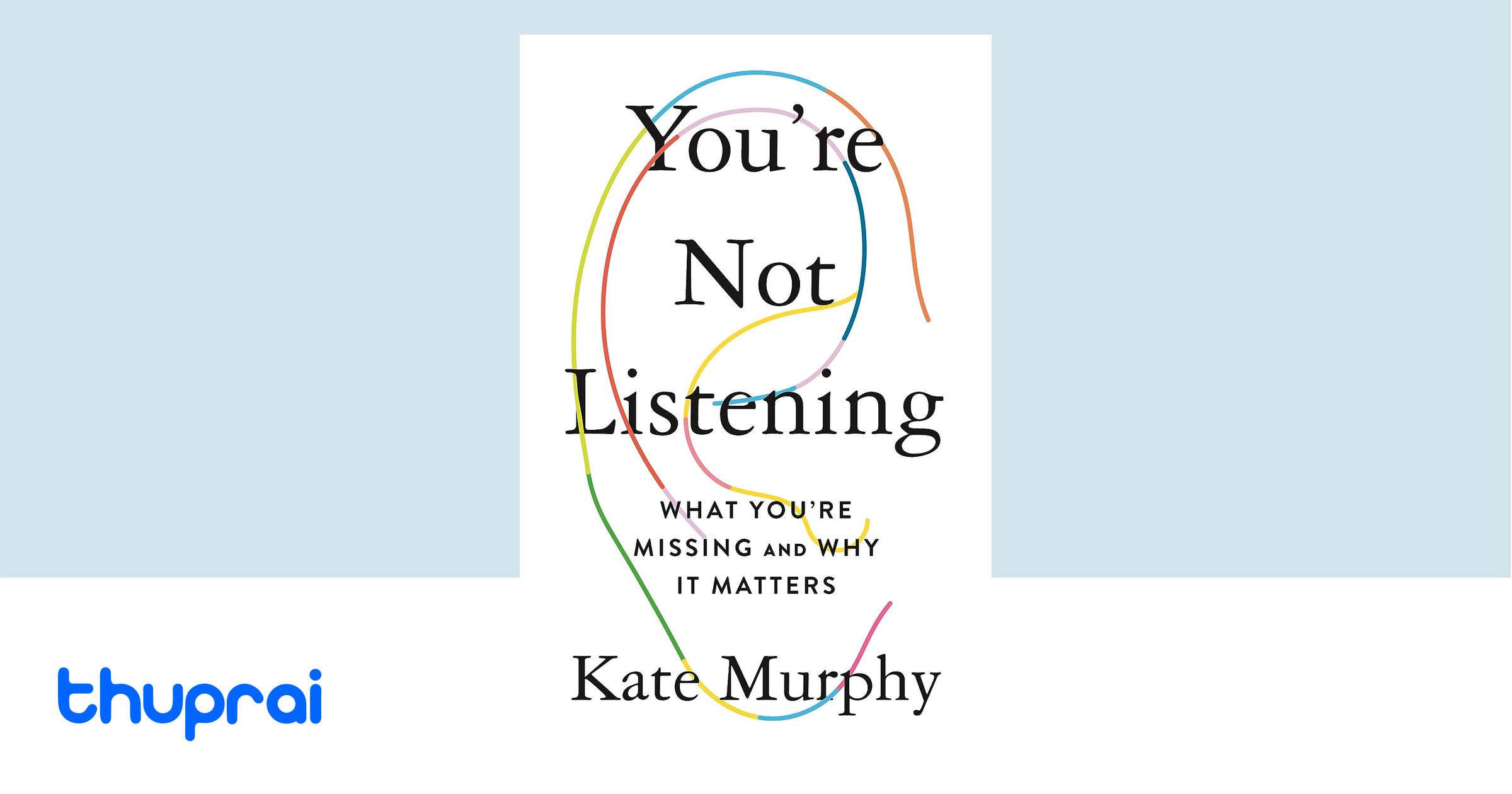
We are all loud. Between the endless notifications on your phone, the performative rants on social media, and that one coworker who uses every meeting to stage a one-man show, silence has become a rare commodity. It’s exhausting. And honestly, it’s making us lonely. That’s the central, stinging nerve Kate Murphy hits in You’re Not Listening: What You’re Missing and Why It Matters. This isn't just another self-help book about communication tips or "active listening" hacks you'd find in a corporate HR manual. It’s an indictment of how we’ve forgotten how to actually connect.
Most of us think we listen. We don't. We just wait for our turn to speak.
The reality is that listening is a physiological and psychological feat. Murphy, a contributor to The New York Times, spent years interviewing everyone from CIA interrogators to focus group moderators to understand what it actually means to hear someone. She found that we are currently living through a listening crisis. We have more ways to broadcast our thoughts than at any point in human history, yet we feel less understood than ever before. It’s a weird paradox.
The Science of Sound and Silence
Listening isn't just about your ears. It’s a whole-brain activity. When you truly listen to someone, your brain waves actually begin to mirror theirs. Scientists call this "neural coupling." It’s basically the closest thing we have to a superpower. If I’m telling you a story about a stressful flight and you’re truly locked in, your brain starts firing in the same patterns as mine. We become synchronized.
But that sync-up is getting harder to achieve. Why? Because we’re distracted. We’ve become addicted to the "efficiency" of digital communication. You can’t "neural couple" with a text message. You need the inflection, the pauses, and the micro-expressions that only happen in real-time conversation. Murphy points out that the average person speaks at about 125 to 150 words per minute, but our brains can process about 400 to 800 words per minute. That "listening gap" is where the trouble starts.
In that extra space, your brain starts wandering. You start thinking about what’s for dinner. You check your watch. You formulate a clever retort to prove how smart you are. By the time you tune back in, you’ve missed the emotional subtext of what the other person was saying. You heard the words, but you didn't hear the meaning.
The Problem with the "Support Response"
One of the most eye-opening parts of You’re Not Listening involves the work of sociologist Charles Derber. He describes two types of responses in conversation: the shift response and the support response.
The shift response is the conversation killer.
- Friend: "I’m so stressed at work lately."
- You: "Me too! My boss has been on my back all week."
You just shifted the spotlight to yourself. It feels like you’re relating, but you’re actually hijacking. A support response, on the other hand, keeps the focus on the other person. Something like: "I'm sorry to hear that. What’s been the most stressful part?"
It sounds simple. It’s incredibly difficult to do in practice because we have an ego-driven itch to be the protagonist of every story. We want to be the one with the advice, the one with the similar experience, the one who knows best. Murphy argues that by shifting the focus back to ourselves, we lose the opportunity to learn something new.
Why We Are Afraid of What Others Have to Say
Listening is vulnerable.
If you truly listen to someone, especially someone you disagree with, you run the risk of having your mind changed. That’s terrifying for most people. We prefer the safety of our echo chambers where everyone agrees with us. Murphy notes that we often "listen" only to find flaws in the other person's logic so we can dismantle it. That’s not listening; that’s a debate.
She spends time talking to professional listeners—people whose jobs depend on getting information out of others. Take CIA interrogators or high-stakes hostage negotiators. They don't get results by shouting or dominating the conversation. They get results by being the most attentive person in the room. They use "minimal encouragers"—those little "mhmms" and "I sees"—to keep the other person talking. They know that the more someone talks, the more they reveal.
The "Closeness-Communication Bias"
Here is a weird fact: we are often worst at listening to the people we love the most. Murphy calls this the "closeness-communication bias."
Because you’ve known your spouse or your best friend for ten years, you think you know what they’re going to say before they say it. You stop paying attention because you’ve already filled in the blanks. You’ve put them in a box. This is why couples often drift apart; they stop being curious about each other. They assume the map they have of the other person is still accurate, even though people change every single day.
To fix this, you have to treat the people you know well like strangers. You have to approach the conversation with a "beginner's mind." You have to assume there is something about them you don't know yet.
Modern Distractions are Physical Barriers
It’s not just our brains; it’s our environment.
The presence of a smartphone on a table—even if it’s turned off and face down—reduces the quality of a conversation. It’s a physical signal that someone else, or something else, could interrupt at any moment. It creates a "shallow" environment. Murphy suggests that our constant connectivity has made us intolerant of the pauses and silences that are necessary for deep thought.
We rush to fill the silence. But silence is often where the most important realizations happen. When you ask someone a tough question and they go quiet, that’s not a failure. That’s the sound of them actually thinking. If you jump in to "save" them from the silence, you’ve just killed the breakthrough.
Actionable Steps to Become a Better Listener
If you’re feeling like your relationships are a bit surface-level or you're just tired of the noise, you can actually train yourself to hear better. It takes work. It's a muscle.
- Stop the "Shift Response" Cold. Next time someone tells you something about their life, don't share a similar story about yours. Not for at least five minutes. Ask two follow-up questions instead. This is harder than it sounds.
- Check Your "Listening Gap" Activity. When you realize your brain is drifting during a conversation, don't judge yourself. Just notice it and gently pull your attention back to the speaker’s tone and body language. What are they saying with their hands?
- The Phone Stays Away. Not on the table. Not in your lap. In your pocket or in another room. The physical absence of the device changes the energy of the interaction.
- Listen for the "Unsaid." Often, people talk about the "what" when they really want to talk about the "how" it made them feel. If someone is complaining about a long line at the grocery store, they might actually be saying they feel invisible or disrespected. Look for the emotion behind the data.
- Embrace the Silence. When a conversation hits a lull, let it sit there for a few seconds. See what happens. Often, the other person will offer up something much deeper once they realize you aren't going to interrupt them.
Listening is an act of generosity. In a world that is constantly trying to sell us something or get us to "like and subscribe," giving someone your undivided attention is one of the most valuable things you can offer. Kate Murphy’s You’re Not Listening isn't just a book; it’s a plea for us to start seeing each other again.
Start by staying quiet. Just for a second. You might be surprised at what you finally hear.
Practical Next Steps
- Identify one person in your life you've been "glossing over" (a spouse, a parent, a long-term colleague).
- Schedule a 20-minute conversation with them where your only goal is to learn something about their current internal state that you didn't know before.
- Use open-ended questions like "How did that feel?" or "What was that like for you?" rather than "Yes/No" questions.
- Watch for their reaction when you truly stay focused on them—the shift in their energy is usually immediate and visible.