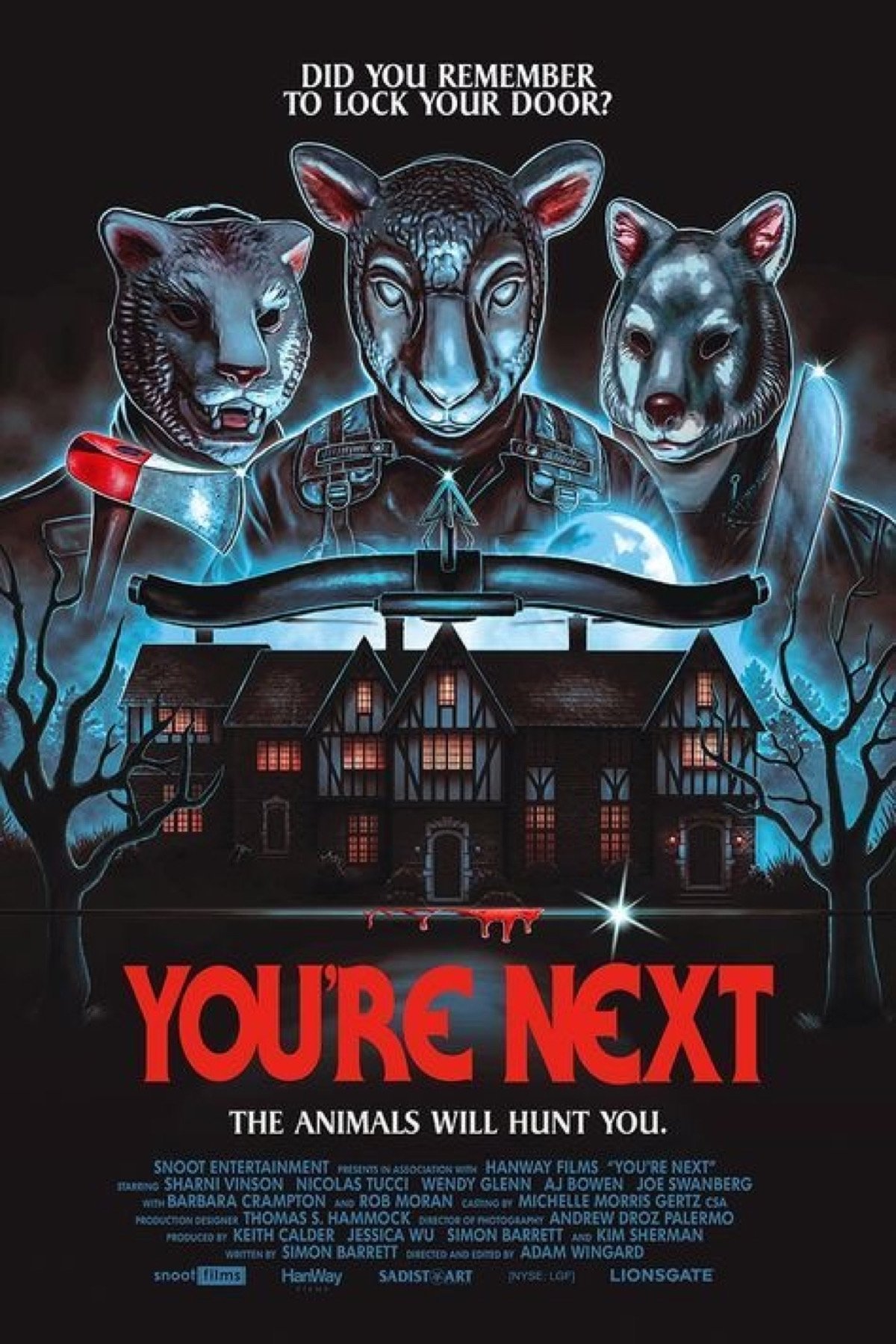
Movies usually play it safe. You know the drill. A family or a group of friends goes to a remote house, something goes bump in the night, and everyone screams until the "Final Girl" barely escapes by the skin of her teeth. But You're Next isn't interested in that tired old dance. It’s meaner. It's smarter. Honestly, it’s one of the few horror films from the early 2010s that actually holds up under a microscope because it treats its protagonist like a person with a functioning brain rather than a walking trope.
Directed by Adam Wingard and written by Simon Barrett, this film sat on a shelf for a couple of years after its 2011 TIFF debut before Lionsgate finally dropped it in 2013. That delay could have been a death sentence. Instead, it gave the movie a sort of cult-like aura before it even hit wide release.
The Survivalist Pivot You Didn't See Coming
Most people remember the masks. The lamb, the tiger, and the fox. They’re creepy, sure. But the real meat of You're Next is Erin, played by Sharni Vinson.
Think about your average slasher. Usually, the lead spends forty minutes crying in a closet. Erin? She hears a crossbow bolt shatter a window and immediately starts securing the kitchen. Why? Because she grew up on a survivalist compound in the Australian outback. It’s such a simple, elegant piece of character writing that fixes the "why don't they just fight back" problem that plagues the genre.
The Davison family—the wealthy, bickering targets of the film—are basically useless. They represent a specific kind of upper-class dysfunction where siblings hate each other more than they fear the killers outside. It’s awkward. It’s darkly funny. When the arrows start flying during dinner, the transition from "passive-aggressive family bickering" to "absolute carnage" happens in a heartbeat.
It Isn't Just a Slasher; It's a Satire
If you watch closely, the movie is poking fun at indie mumblecore culture. Wingard cast a bunch of his director friends, like Joe Swanberg and Ti West, just to kill them off in increasingly creative ways.
There is a specific kind of cynicism here. It’s not "torture porn" like Saw or Hostel. It’s more of a deconstruction. You have these killers who think they’ve planned the perfect heist, and then they run into a woman who knows how to make a lethal trap out of a blender and some wood planks.
The pacing is frantic. It moves.
One minute you’re watching a slow-motion sequence set to Dwight Twilley Band’s "Looking for the Magic"—a song that will haunt your dreams after this—and the next, you’re watching a character get their head turned into a DIY art project. The repetition of that song on a loop is a masterclass in using sound to build localized insanity. It grounds the viewer in the house. You feel trapped because the music won't stop, just like the characters.
Why the "Final Girl" Trope Changed Here
Usually, the survival of a horror lead feels like luck. They tripped at the right time. The killer slipped on a banana peel.
In You're Next, Erin’s survival is earned through sheer, calculated competence. She isn't a superhero. She gets hurt. She’s terrified. But she is tactical. When she starts setting traps, the movie shifts from a "hide and seek" horror film into a "siege" movie. It shares more DNA with Home Alone—the R-rated, traumatizing version—than it does with Friday the 13th.
Critics at the time, including those at The Hollywood Reporter and Variety, noted that the film felt like a breath of fresh air because it didn't take itself too seriously while still being genuinely tense. It didn't need a massive CGI budget. It needed a basement, some wire, and a protagonist who wasn't afraid to get her hands very, very dirty.
The Impact of Low-Budget Innovation
Wingard and Barrett were working with limited resources. That’s often where the best horror happens. When you can’t afford a digital explosion, you have to make the sound of a machete hitting a door frame sound like the end of the world.
The cinematography uses a lot of handheld movement. It’s shaky, but not nauseating. It feels like you’re a frantic guest at the worst dinner party in history. This "mumblegore" aesthetic—a term coined to describe this specific wave of lo-fi horror—proved that you could have high stakes without a blockbuster price tag.
- Practical Effects: The gore is mostly practical, which gives it a tactile, gross-out quality that CGI just can't mimic.
- The Script: Barrett’s dialogue captures that specific brand of sibling rivalry where even in a life-or-death situation, they can't stop taking shots at each other's career choices.
- Subversion: Every time you think the movie is going left, it goes right. The "twist" regarding who is actually behind the masks is revealed mid-way through, rather than at the very end. This changes the tension from "who is doing this?" to "how is she going to kill them?"
A Masterclass in Tone Management
Kinda crazy how it balances humor and horror. One second, a guy is dying with a bolt in his forehead, and the next, his brother is complaining about how long it's taking him to die. It’s morbid. It’s also very real. People are weird when they’re in shock. They say stupid things.
You're Next captures that absurdity. It understands that horror is often just a hair’s breadth away from comedy. If the movie were played 100% straight, it might have felt like just another bleak home invasion flick. By leaning into the dark humor of the Davison family’s incompetence, it becomes something much more memorable.
The movie also handles its setting perfectly. A giant, creaky mansion in Missouri. It’s the kind of place that feels cold even when the lights are on. The production design used the space to create layers of depth; you’re always looking into the background of the shot, wondering if a mask is peeking around a corner.
The Legacy of the Lamb Mask
You see the masks every Halloween now. They’ve become iconic. Simple plastic animal masks bought at a grocery store turned into symbols of calculated, cold-blooded violence.
The industry took notice, too. Adam Wingard went on to helm massive projects like Godzilla vs. Kong, but you can see the roots of his style here. The way he uses color—lots of deep reds and oppressive shadows—and his rhythmic editing style started with these smaller, grittier projects.
It’s also worth mentioning the sheer physical performance of Sharni Vinson. She did a lot of her own stunts. When she’s jumping through a window or swinging an axe, you feel the weight of it. There’s a scene involving a basement window and a board with nails in it that still makes audiences wince. It’s simple. It’s effective.
What Most People Get Wrong About the Ending
People often debate the final frame. Without spoiling the specifics for the three people who haven't seen it, the ending is a perfect "dark irony" punchline.
Some viewers think it’s a cynical ending. I’d argue it’s a realistic one. In the world of You're Next, there are no heroes, only survivors and the paperwork they have to deal with afterward. The final beat reinforces the idea that no matter how prepared you are, the "system" or simple bad luck can still trip you up.
Real-World Takeaways for Your Next Rewatch
If you’re going back to watch this—or seeing it for the first time—pay attention to the sound design. The way the floorboards creak isn't just a generic sound effect. It’s mapped to the house’s layout.
Also, look at the family dynamics. The tension between the brothers isn't just filler; it’s the catalyst for the entire plot. It’s a movie about how greed and resentment are way more dangerous than any guy in a mask.
Basically, the film teaches us a few things:
- Don't underestimate the quiet person at the dinner table.
- If you're going to commit a crime, maybe don't do it against someone who grew up in a survivalist bunker.
- Blenders have more uses than just making smoothies.
To get the most out of the experience, watch it in a dark room with the volume turned up. The "Looking for the Magic" sequence deserves a high-quality speaker setup. If you’re a fan of the genre, look into the "mumblegore" movement further—films like The Guest (also by Wingard/Barrett) or A Horrible Way to Die provide a great context for how this specific style of filmmaking evolved.
The best way to appreciate You're Next is to see it as a bridge. It’s the bridge between the self-serious "elevated horror" of today and the gritty, low-budget slashers of the 70s and 80s. It doesn't want to lecture you. It just wants to show you a really, really intense time at a house in the woods.
Check your doors. Lock the windows. And maybe keep a blender handy. Just in case.


