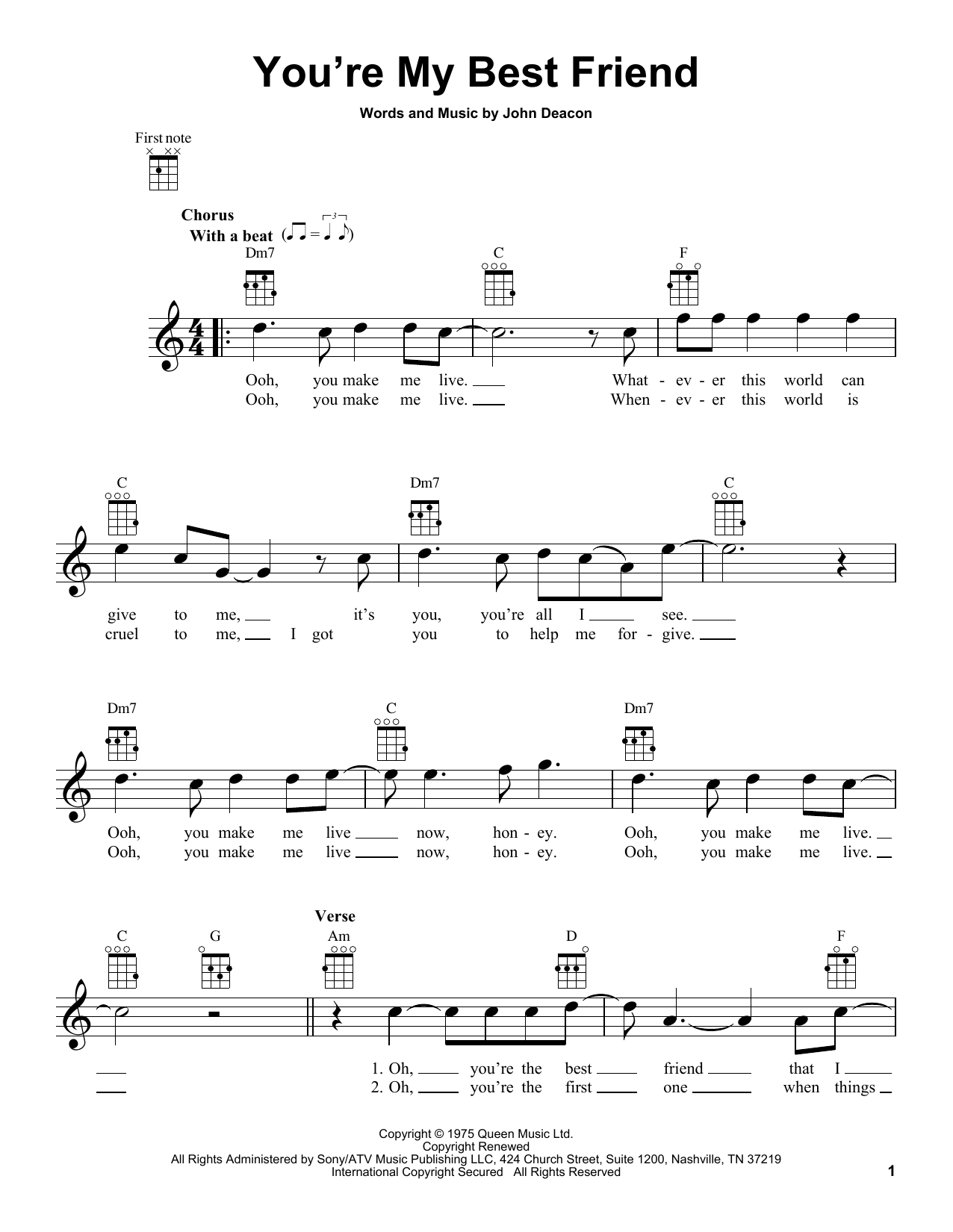
It wasn't a Freddie Mercury anthem. It wasn't a Brian May guitar symphony. In 1975, Queen's quietest member, bassist John Deacon, sat down at a Wurlitzer electric piano—an instrument Freddie actually kind of hated—and wrote a love letter to his wife, Veronica Tetzlaff. That song was You’re My Best Friend.
People often forget how risky this track was for a band that had just released the world-shaking "Bohemian Rhapsody." It was short. It was pop. It was sugary. But honestly, it’s the heart of the A Night at the Opera album because it proved Queen could do "simple" just as well as they did "operatic." For another perspective, read: this related article.
Why the Wurlitzer mattered (and the Freddie feud)
Most fans don’t realize that Freddie Mercury was a piano purist. He loved the grand piano. He loved the touch, the resonance, the dignity of it. When John Deacon brought in You’re My Best Friend, he insisted it be played on a Wurlitzer electric piano to get that specific, barking, "reedy" tone.
Freddie refused to play it. Similar insight regarding this has been published by E! News.
"I refused to play that damn thing," Mercury later joked in interviews. "It’s tinny and horrible. I don’t like them. Why play those things when you have a superb grand piano?"
So, John took the Wurlitzer home, learned how to play it himself, and recorded the main track. If you listen closely, that signature "ping" you hear throughout the song isn't the lead singer; it’s the bass player stepping out of the shadows. This small act of defiance defined the band's internal democracy. Everyone wrote hits. Everyone had a voice. Even the "quiet one."
The reality of the lyrics
There are no metaphors here. No "thunderbolts and lightning." Unlike the cryptic poetry of "Bohemian Rhapsody" or the campy drama of "Killer Queen," You’re My Best Friend is a direct, honest confession. Deacon had married Veronica earlier that year, in January 1975.
While the rest of the rock world was leaning into the "sex, drugs, and rock 'n' roll" lifestyle, John was writing about domestic stability.
"Ooh, you make me live."
It’s a heavy sentiment for a pop song. It suggests that the chaos of superstardom—the grueling tours, the legal battles with their former manager Norman Sheffield, the pressure to follow up Sheer Heart Attack—was only bearable because of a singular human connection. It’s one of the few Queen songs that feels like it belongs in a kitchen at 7:00 AM rather than a stadium at 9:00 PM.
Compositional brilliance in under three minutes
Musically, the song is a masterclass in "less is more." Brian May’s guitar work is surprisingly restrained. Instead of his typical wall-of-sound orchestration, he uses his Red Special to create little "bell" effects that mimic the electric piano.
Then there’s the vocal arrangement.
Queen was famous for their three-part harmonies (Mercury, May, and Taylor). In You’re My Best Friend, these harmonies are used as a soft cushion. They don't shout; they glow. Roger Taylor’s drumming is also notably crisp and tight, avoiding the heavy fills that characterized their earlier prog-rock days. It’s a radio-friendly mix that helped Queen break into the US market in a massive way, reaching number 16 on the Billboard Hot 100.
A few things people get wrong about the track:
- Freddie didn't write it. People still credit Freddie for every Queen hit, but this was John’s second-ever composition for the band (the first being "Misfire").
- It’s not a ballad. It’s a mid-tempo pop song. A ballad drags; this skips.
- The video wasn't high-budget. It was filmed in a rehearsal space surrounded by over a thousand candles. It was hot, sweaty, and incredibly dangerous, but it gave the song a warm, intimate glow that matched the lyrics.
The legacy of the "Deaky" sound
John Deacon eventually became the secret weapon of Queen’s commercial dominance. After the success of You’re My Best Friend, he went on to write "Another One Bites the Dust" and "I Want to Break Free." He had an ear for what worked on the dance floor and the radio, often clashing with the more rock-oriented sensibilities of Brian and Roger.
Without this song, Queen might have stayed a niche, high-concept art-rock band. This track gave them humanity. It made them relatable. It’s the song played at ten thousand weddings every year because it captures a specific type of love: the kind that is built on friendship rather than just passion.
The song’s longevity is staggering. It has been featured in everything from The Simpsons and Family Guy to Shaun of the Dead. It resonates because it isn't trying to be cool. It's just trying to be true.
How to appreciate the track today
If you want to actually "hear" the song properly, stop listening to it on phone speakers.
- Find the 2011 Remaster. The bass frequencies are much cleaner.
- Focus on the panning. Listen to how Brian May’s guitar parts move from the left ear to the right ear during the bridge.
- Isolate the Wurlitzer. Notice how the "bark" of the electric piano provides the percussion for the entire track, allowing Roger Taylor to play a simpler beat.
- Watch the 1976 Hyde Park performance. Seeing John play this live (on a grand piano, ironically, because touring with a Wurlitzer was a nightmare) shows how much the song meant to the band’s live dynamic.
The brilliance of You’re My Best Friend lies in its lack of ego. It’s a tribute to a person, not a performance. In the high-octane world of 1970s stadium rock, that was the most radical thing John Deacon could have written.
Actionable insights for Queen fans and musicians
- Study the "Deacon Method": If you’re a songwriter, look at how John uses a single, repeating keyboard motif to anchor a song. You don't need complex chord changes if the melody is infectious.
- Analyze the Harmony: Take a moment to listen to the isolated vocal stems (available on various archival sites). Notice how Roger Taylor’s high-tenor voice provides the "shimmer" on top of Freddie’s lead.
- Check the Gear: For those looking to replicate the sound, the specific model was a Wurlitzer 200 series. Using a modern VST (Virtual Instrument) with a "bark" setting will get you close to that 1975 warmth.
- Revisit the Album: Don't just play the hit. Listen to "You're My Best Friend" in the context of A Night at the Opera. It serves as the perfect palate cleanser between the high-drama "39" and the hard-rocking "Sweet Lady."



