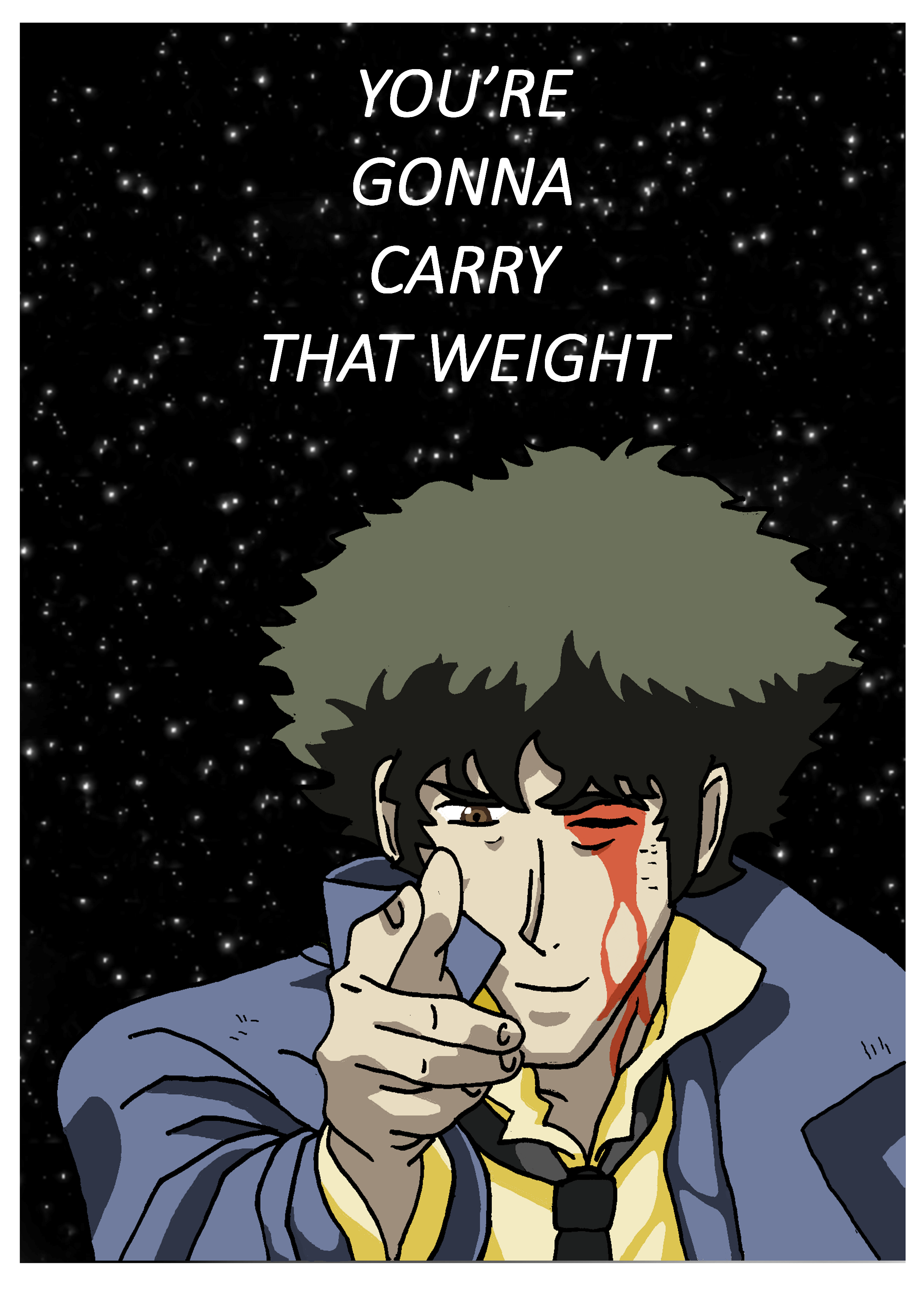
It is the final frame. The screen fades to black, and those four words appear in white, serifed type. You're gonna carry that weight. If you watched Cowboy Bebop for the first time on Adult Swim in the early 2000s, or even if you just binged it on a streaming service yesterday, that sentence probably did something to your internal chemistry. It isn't just a stylistic choice. It’s a heavy, somewhat aggressive parting gift from director Shinichirō Watanabe.
Honestly, most anime endings try to wrap things up with a bow or leave you with a sense of "the adventure continues." Not this one. Cowboy Bebop doesn't care about your closure. It cares about the baggage you’re taking with you. For another perspective, check out: this related article.
What "You're Gonna Carry That Weight" Actually Means
People argue about this constantly. Is it a Beatles reference? Yes, obviously. It's the title of a track from Abbey Road. But in the context of Spike Spiegel’s journey, it’s much more than a musical nod. The "weight" is the past. It is the inescapable gravity of everything you’ve done, everyone you’ve lost, and the version of yourself you can’t seem to outrun.
Spike spends the entire series pretending he’s a ghost. He tells Jet he’s "just watching a dream he can't wake up from." That sounds cool, right? Very noir. But it’s a defense mechanism. By the time he reaches the finale, "The Real Folk Blues (Part 2)," the dream has collapsed. When he goes to confront Vicious, he isn't going because he wants to win. He’s going because he has to finish the story. He’s finally picking up the weight he tried to drop years ago. Further coverage on this trend has been published by Variety.
The Beatles Connection
We have to talk about Lennon and McCartney for a second. The song "You Never Give Me Your Money" leads into "Carry That Weight" on the Abbey Road medley. It’s a song about the struggles of the band during their breakup—the financial burdens, the interpersonal drama, the realization that their legacy is something they will have to deal with for the rest of their lives.
Watanabe is a massive music nerd. Every episode is a "Session." We have "Stray Dog Strut," "Bohemian Rhapsody," and "Honky Tonk Women." By ending the series with a Beatles reference, he’s linking the end of the Bebop crew’s era to the end of the 1960s' greatest cultural icons. It signals the end of an era. The party is over. The bill has arrived.
Why Spike Couldn't Just Walk Away
A lot of fans—especially when they first see the show—get frustrated. They want Spike to stay with Jet and Faye. They want the found family to stay found. But that’s not how Cowboy Bebop works.
Spike’s eye is a constant reminder of this. Remember how he explains his eyes? One sees the present, the other sees the past. He’s literally incapable of seeing the world as a unified reality. To Spike, Julia wasn't just a girlfriend; she was the only proof that he was actually alive. When she dies, his tether to the "present" snaps.
He tells Faye, "I'm not going there to die. I'm going to find out if I'm really alive."
That is the ultimate "weight." It’s the realization that you cannot live in the "now" until you’ve settled the "then." He goes to the Red Dragon Syndicate building because it’s the only place where his life makes sense. He kills Vicious, he walks down those stairs, he mimics a gun with his fingers, says "Bang," and collapses. Whether he dies there or just passes out is a debate that has raged for decades, but the outcome is the same: the story is over because the weight has been carried to the finish line.
The Emotional Burden on the Audience
The brilliance of the phrase "You're gonna carry that weight" is that the "you" isn't Spike.
It’s you. The viewer.
You’ve spent 26 episodes with these losers. You’ve watched Faye Valentine realize she has no home to go back to because her past was literally erased by time. You’ve watched Jet Black realize his "principled" life as a cop was a sham. You’ve watched Ed walk away because she’s the only one healthy enough to actually move forward.
When the show ends, you are left with the silence. The music stops. The credits roll. You are carrying the weight of the experience. It’s a meta-commentary on how stories affect us. Great art doesn't leave you the same way it found you. It leaves a mark. It adds a little bit of heaviness to your soul.
The "Bebop" Philosophy of Regret
Regret is the engine of this show.
- Jet carries the weight of his lost arm and his lost love, Alisa.
- Faye carries the weight of a debt she can't pay and a life she can't remember.
- Spike carries the weight of a betrayal.
They are all together on a ship, but they are all profoundly alone. They are like billiard balls—hitting each other for a moment, changing direction, but ultimately moving toward their own corners of the table.
The Cultural Legacy of a Four-Word Sentence
You see this quote everywhere now. It’s on T-shirts, tattoos, and Lo-Fi hip-hop thumbnails. Why did it stick so much better than, say, "See you space cowboy"?
"See you space cowboy" is a farewell. It’s cool. It’s iconic. But "You're gonna carry that weight" is a prophecy. It’s a truth about the human condition. As we get older, we all start to understand it. We accumulate mistakes. We lose friends. We make choices we can’t take back.
In the late 90s, anime was often seen in the West as just "cartoons with more violence." Cowboy Bebop changed that because it felt adult in a way most live-action shows didn't. It was cynical, yet deeply romantic. It was stylish, yet grounded in the reality of poverty and boredom. That final message cemented its status as a piece of literature. It wasn't just entertainment; it was a reflection.
Misconceptions About the Ending
Some people think the ending is depressing. I'd argue it's actually cathartic.
If Spike had stayed on the Bebop, he would have just kept rotting. He would have kept staring out the window, eating "bell peppers and beef" without any beef, and thinking about what might have been. By going back, he takes agency.
There's a common theory that the whole show is just Spike's dying dream after he was shot the first time by Vicious years prior. While interesting, it sort of cheapens the message. If it’s all a dream, the "weight" doesn't matter. The weight only matters if the choices were real. Watanabe has stayed famously ambiguous about Spike's survival, but in a 2014 interview, he noted that Spike might just be "sleeping."
But the physical state of Spike’s body is irrelevant. The character arc is complete. The weight has been carried.
How to Handle Your Own "Weight"
So, what do we actually do with this? If the show is telling us that we are all destined to carry the weight of our pasts, is there a way to make it lighter?
Cowboy Bebop suggests two paths.
There is the Spike path: confront it head-on, even if it destroys you. This is the path of the romantic, the tragic hero. It leads to a spectacular ending, but it doesn't leave much room for a future.
Then there is the Ed path: keep moving. Ed is the only character who doesn't look back. She doesn't have a "weight" because she lives entirely in the moment. When she leaves the ship, she doesn't do it with a heavy heart; she does it because it's time for the next thing.
Most of us are somewhere in the middle. We aren't as free as Ed, but we aren't as haunted as Spike. We’re more like Jet—keeping the ship running, tending to our bonsai trees, and learning to live with the scars.
Practical Takeaways from the Bebop Finale
If you find yourself stuck in your own "dream you can't wake up from," consider these shifts in perspective:
- Acknowledge the baggage. You can't drop the weight if you pretend it isn't there. Spike's mistake wasn't having a past; it was pretending he was a ghost who didn't have to deal with it.
- Stop looking for "closure." Closure is a myth. You don't "close" a chapter of your life like a book. You just incorporate it into who you are. The weight doesn't go away; you just get stronger at carrying it.
- Value the "in-between" moments. The Bebop crew's happiest times weren't when they were catching bounties or settling scores. It was when they were bickering over food or watching trash TV together. The "weight" is the big stuff, but life is the small stuff.
- Know when to say "Bang." Sometimes you have to let a part of your life die so you can stop being haunted by it. It doesn't have to be literal or violent. It just means finishing what you started.
Cowboy Bebop ends on a high note because it refuses to lie to you. It tells you that life is hard, the past is heavy, and you're probably not going to get everything you want. But it also tells you that there is a certain dignity in facing that reality.
You're gonna carry that weight. You might as well do it with style.



