Everyone knows the song. You hear that deep, rumbling bass voice and those brassy, sneering horns, and you immediately think of Christmas. Or, more accurately, the guy who tried to ruin it.
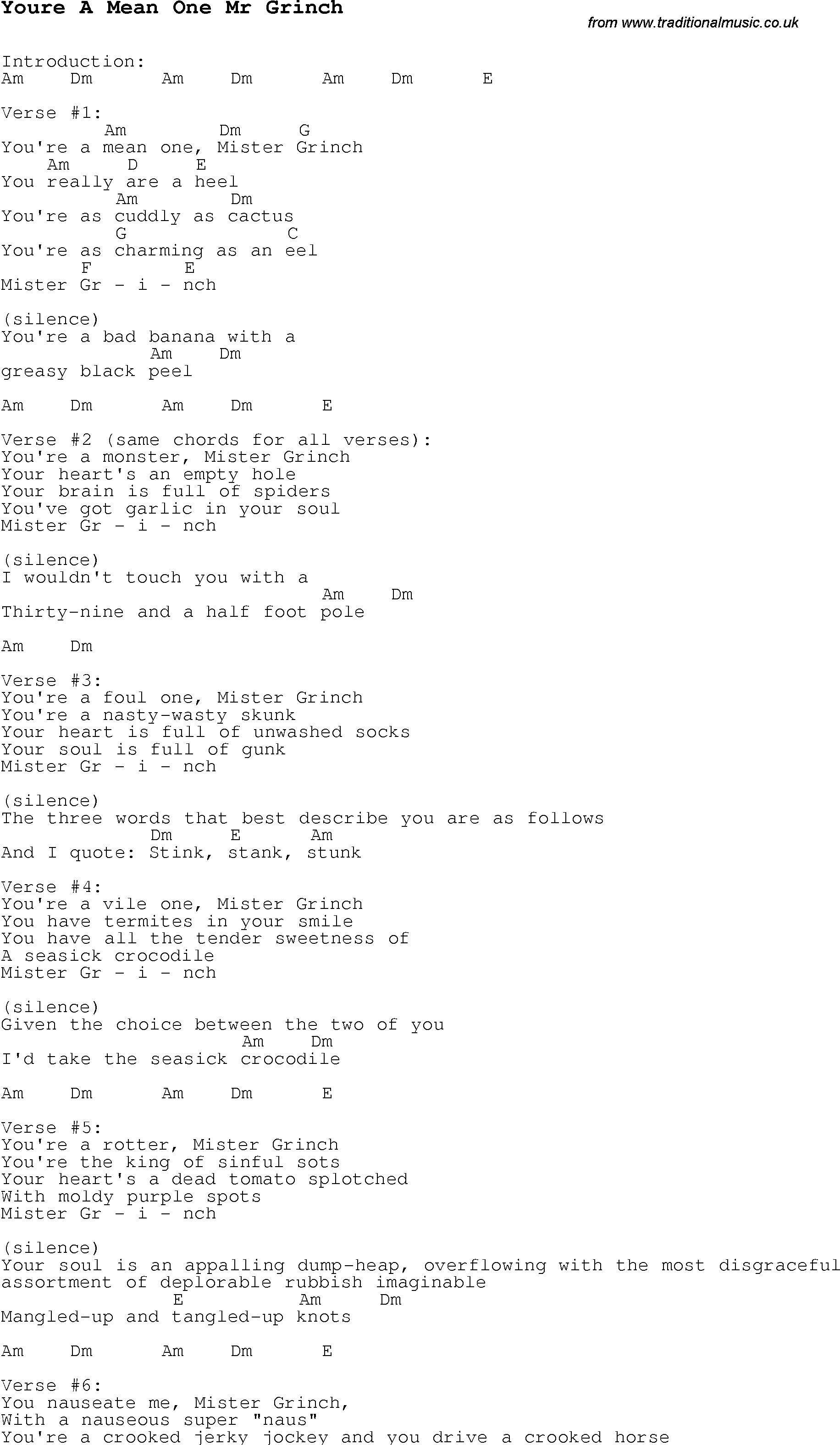
"You're a Mean One, Mr. Grinch" is arguably the greatest "diss track" in history. It doesn't just call the Grinch a bad guy. It systematically deconstructs his hygiene, his diet, and the very composition of his soul. Honestly, it’s brutal.
But there is a lot more to the song mr grinch lyrics than just clever insults. Behind the scenes, there was a major credit mix-up, a Broadway legend, and a man who voiced a cereal mascot.
The Mystery Behind the Voice
For decades, people thought Boris Karloff sang the song. It makes sense, right? He was the narrator. He was the voice of the Grinch. When the 1966 special aired, Karloff’s name was the big draw.
But Karloff couldn't sing a lick.
The real singer was a man named Thurl Ravenscroft. If that name sounds like something out of a Dickens novel, his voice was even more legendary. You’ve heard him your whole life. He was the voice of Tony the Tiger for Kellogg’s Frosted Flakes. "They’re Gr-r-reat!"? That was Thurl.
Because of a weird oversight in the closing credits, Ravenscroft wasn't listed. Dr. Seuss actually felt terrible about it. He reportedly called up newspapers and columnists across the country to tell them, "Hey, that wasn't Boris Karloff. That was Thurl Ravenscroft!"
It took years for the public to catch on. Even today, if you look at old vinyl records or early CD releases, you’ll sometimes see Karloff’s name slapped on the track.
Decoding the Genius of the Song Mr Grinch Lyrics
Theodor Geisel (Dr. Seuss) wrote the words, but he didn't do it alone. He teamed up with Albert Hague, a Tony-winning Broadway composer. Hague was the one who came up with that slinky, jazzy melody that feels like a villain creeping through a chimney.
The lyrics are a masterclass in creative writing. Seuss used metaphors that shouldn't work, but somehow they’re perfect.
- "Cuddly as a cactus"
- "Charming as an eel"
- "Garlic in your soul"
Think about that last one. In the 1960s, garlic wasn't the kitchen staple it is now. It was considered pungent, overwhelming, and "foreign" to many American palates. Calling someone’s soul "garlic" was a high-tier insult.
Then there’s the "thirty-nine-and-a-half foot pole." Why that specific number? Why not forty? Because forty is boring. Thirty-nine-and-a-half implies a level of precision in his disgust. He has measured the distance required to remain safe from the Grinch's "gunk."
The Six Verses of Filth
The song follows a strict pattern. Every verse starts with an insult ("You're a rotter," "You're a foul one") and ends with the name "Mr. Grinch" followed by a final, devastating blow.
Most people only remember the "Stink, Stank, Stunk" part. That's the climax of verse four. It’s simple, it’s percussive, and it’s pure Seuss. He loved invented words, but here he just played with tenses to make the Grinch sound like a rotting heap of garbage.
One of the weirdest lines is in verse six: "You’re a crooked dirty jockey and you drive a crooked hoss." It feels a bit out of place compared to the talk of "seasick crocodiles" and "dead tomatoes." But it speaks to the Grinch’s lack of integrity. He isn't just mean; he’s a cheat.
Why We Still Sing It
Most Christmas songs are about joy, snow, and "peace on earth." This song is about a guy who is a "three-decker sauerkraut and toadstool sandwich with arsenic sauce."
It’s the antidote to holiday sweetness.
We love the Grinch because he’s relatable. Everyone has those days where they want to scream at the neighbors for putting up lights too early. The lyrics give us permission to be a little bit "nasty-wasty" for three minutes.
The song has been covered by everyone. Jim Carrey did his own version for the 2000 movie. Tyler, The Creator brought a modern, bass-heavy vibe to it in 2018. But none of them quite capture the original "greasy black peel" energy of Ravenscroft’s bass notes.
Actionable Takeaways for Fans
If you're looking to win the next holiday trivia night or just want to appreciate the song more, keep these facts in your back pocket:
- Check the Credits: If you own an old copy of the soundtrack that credits Boris Karloff as the singer, you've got a piece of history (and a factual error).
- Listen for the Octave Jump: Albert Hague got the job because he made the singer slide a full octave on the word "Grinch" at the end of each verse. It’s much harder to sing than it sounds.
- The "Thirty-Nine-and-a-Half Foot Pole" Rule: Use this as a metaphor for setting boundaries. Sometimes, life requires a very specific distance from "moldy purple spots."
The next time this track comes on the radio, listen for the "stankiness" in the brass section. It’s not just a kids' song. It’s a perfectly constructed piece of musical theatre that happens to be about a green guy with a heart two sizes too small.
To fully appreciate the craft, try reading the lyrics aloud without the music. You’ll see the rhythmic internal rhymes—like "mangled up in tangled up knots"—that made Dr. Seuss a literary icon. It's poetry disguised as a put-down.



