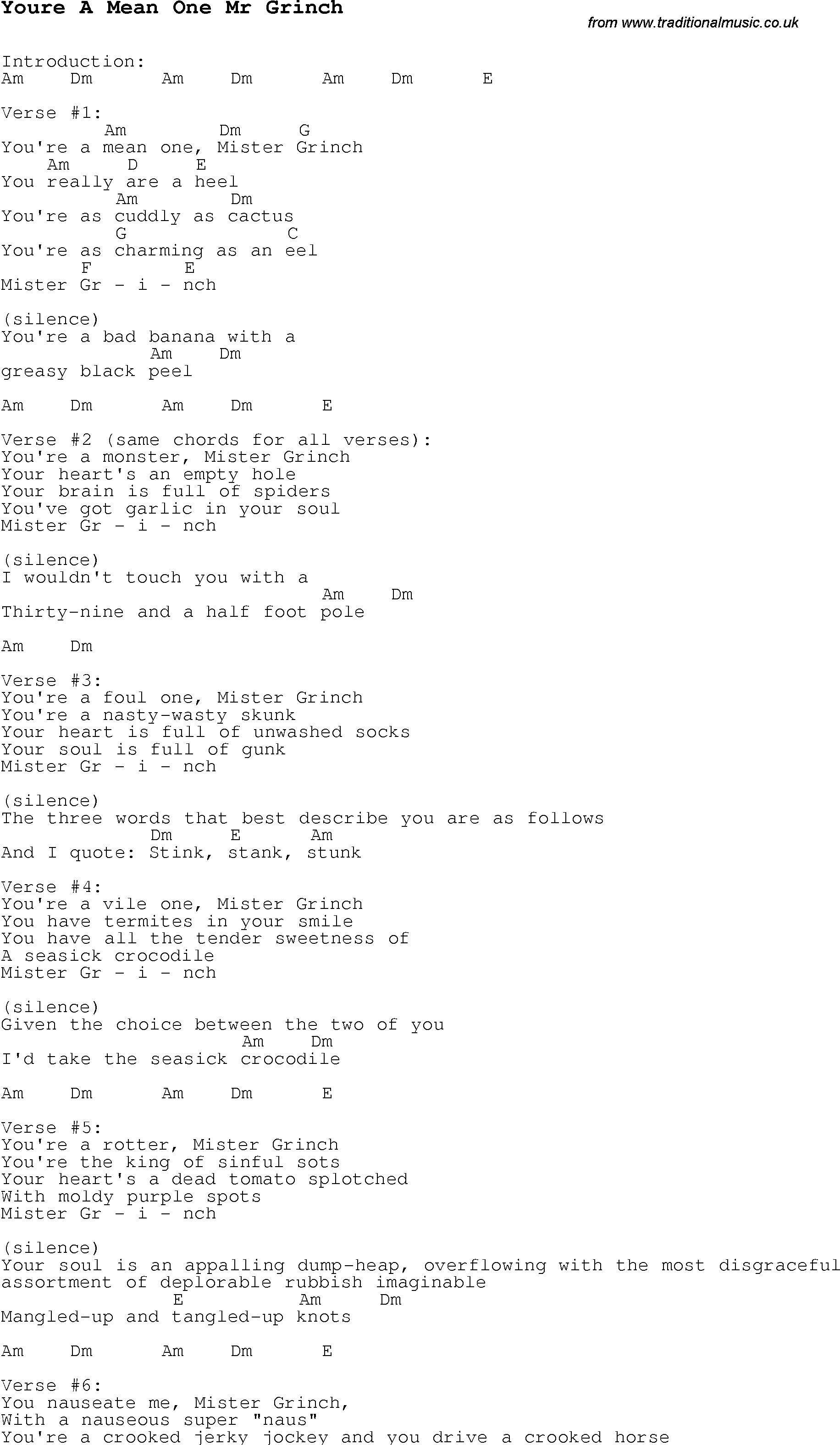
Everyone thinks they know the song. You hear that deep, gravelly baritone start to rumble, and suddenly you're six years old again, staring at a lime-green cartoon hermit with a heart two sizes too small. But honestly? The You're a Mean One, Mr. Grinch lyrics are a masterpiece of insults that would make a modern battle rapper blush. It is arguably the most creative "diss track" in history.
Most people get one thing wrong immediately. They hear that voice—so heavy it feels like it’s vibrating in your chest—and they assume it’s Boris Karloff. It makes sense. Karloff narrated the 1966 special. He is the Grinch. But he didn't sing it. Because Karloff couldn't hit those basement-level notes, a man named Thurl Ravenscroft stepped up to the mic. If that name sounds familiar, it should. He was the voice of Tony the Tiger. "They're Gr-r-reat!" Yeah, that guy. Because of a weird titling oversight, Ravenscroft wasn't credited in the original special, leading many to think Karloff had a secret operatic range. He didn't.
The Dr. Seuss School of High-Level Insults
The lyrics were written by Theodor Geisel (Dr. Seuss) himself, and you can tell. This wasn't some studio executive trying to rhyme "Grinch" with "inch." Geisel went for the jugular. He used words like "nauseate" and "asunder."
Why do these lyrics work? It’s the imagery. Most Christmas songs are about bells, snow, and love. This song is about garlic in your soul and termites in your smile. It’s visceral. It’s gross. And it’s incredibly fun to sing along to.
The song follows a very specific structure of escalating disgust. It starts with a general observation: you’re mean. Then it gets specific. Your heart is an empty hole. Your brain is full of spiders. By the time we get to the third verse, Geisel is inventing measurements of "stink, stank, stunk" that haven't been topped since 1966.
Why the Baritone Matters
If a soprano sang this, it would be a joke. The depth of the You're a Mean One, Mr. Grinch lyrics requires a singer who sounds like they’ve been eating coal for breakfast. Thurl Ravenscroft had that. His voice provides the "weight" that makes the insults feel earned.
When he sings about a "three-decker sauerkraut and toadstool sandwich with arsenic sauce," you actually believe he's smelled it. It's a masterclass in vocal performance meeting lyrical absurdity.
Breaking Down the Most Iconic Lines
Let’s look at the "seasick crocodile" line. It’s brilliant. You’re not just comparing him to a predator; you’re comparing him to a predator that is currently vomiting. It’s a double-layered insult. Geisel wasn't just being silly; he was being precise.
Then there’s the "thirty-nine-and-a-half foot pole" bit. Why that specific number? It’s such a Seussian detail. Forty feet would be too round. Thirty-nine feels like a calculated measurement of exactly how much distance you need to maintain to avoid catching whatever psychological plague the Grinch is carrying.
The Missing Verse Mystery
If you’ve only ever heard the radio edit, you might be missing out. The original 1966 TV special version includes sections that often get trimmed for time or flow on holiday playlists.
- The "bad banana" verse sets the tone for the entire physiological profile of the Grinch.
- The "nauseate" verse is often the one people trip over because the rhyme scheme gets a bit more complex.
- The "stink, stank, stunk" section is the emotional climax. It’s the linguistic equivalent of a mic drop.
Honestly, the word "stunk" shouldn't be that funny, but in the context of the Grinch, it’s a revelation.
Covers, Remakes, and Tyler, the Creator
We have to talk about the 2018 remake. Illumination’s The Grinch brought in Tyler, the Creator to reimagine the track. It was a polarizing move. Some purists hated it. Others felt it was the only way to modernize a song that is so tied to a specific 1960s aesthetic.
Tyler didn’t try to out-sing Ravenscroft. He couldn't. Instead, he leaned into the production. He kept the You're a Mean One, Mr. Grinch lyrics largely intact but changed the "vibe" to something more rhythmic and bass-heavy. It proved the song is "cover-proof." You can’t really break it because the writing is too strong.
Even Jim Carrey’s 2000 version stayed relatively faithful, though Carrey added his own manic energy to the delivery. What’s interesting is that no matter who sings it, the lyrics remain the star. They are the constant.
The Psychology of Why We Love a Villain Song
There’s a reason this is the most popular song in the Grinch catalog, beating out "Welcome Christmas" (the "Fah Who Doraze" song). Humans love a well-articulated villain. There is something deeply satisfying about hearing someone described as having "termites in their smile." It’s an exercise in creative negativity that feels cathartic during the sugary-sweet holiday season.
The You're a Mean One, Mr. Grinch lyrics offer a break from the relentless cheer of Hallmark movies and "Jingle Bells." It acknowledges that, yeah, some people (or creatures) are just unpleasant. And it’s okay to find humor in that.
Fact-Checking the Grinch Myths
People love to spread misinformation about this song. Let's clear the air.
- Fact: Thurl Ravenscroft was paid very little for the session and wasn't even credited on the screen. It took a massive letter-writing campaign from Dr. Seuss himself to get the record straight.
- Fact: The song was never intended to be a hit. It was just a narrative device for a 26-minute cartoon.
- Myth: Albert Hague, who wrote the music, hated the lyrics. Actually, Hague and Geisel worked quite closely. Hague knew he needed a melody that sounded "jagged" to match the words.
The melody itself is actually quite difficult to sing. It jumps around. It doesn't stay in a comfortable pop range. It requires a lot of breath control, especially during those long, held notes on "Mr. Grinch."
Technical Brilliance in the Lyrics
If you look at the meter of the You're a Mean One, Mr. Grinch lyrics, it’s erratic. It’s not a perfect iambic pentameter or anything you’d find in a textbook. It’s conversational but rhythmic.
"You're a foul one, Mr. Grinch / You have termites in your smile / You have all the tender sweetness of a seasick crocodile, Mr. Grinch!"
Notice the repetition of "Mr. Grinch" at the end of the phrases. It’s an accusatory punctuation mark. It’s not just "you're mean"; it's "you're mean, you." It makes the song feel like a direct confrontation.
The Vocabulary of Vile
Geisel’s choice of words is what elevates the song. Let's look at "Mangled up in tangled-up knots." It’s a tongue twister. It’s meant to make the singer feel as frustrated as the Grinch is.
And then there's the "Greasy black peel." This refers back to the bad banana. It’s a callback. Most people don't notice that the song has its own internal lore and recurring motifs. It’s a tightly written piece of musical theater disguised as a children's song.
How to Use These Lyrics Today
Believe it or not, this song is a staple in vocal pedagogy. Teachers use it to show bass singers how to project without losing clarity. Because the lyrics are so wordy, you have to have impeccable diction, or it just sounds like a low-frequency hum.
If you're looking to perform it, the trick isn't just hitting the low notes. It's the "sneer" in the voice. You have to sound like you're smelling something bad the whole time you're singing.
Actionable Insights for Fans and Performers
If you're diving back into this classic, here’s how to truly appreciate the You're a Mean One, Mr. Grinch lyrics:
- Listen to the 1966 Mono Mix: If you can find the original mono recording, the vocals are much more front-and-center. You can hear the "clicks" and "pops" of Ravenscroft’s mouth, which adds to the "gross" factor.
- Read the lyrics as poetry: Take the music away. Read them out loud. You'll notice the internal rhymes (like "stink, stank, stunk") have a percussion of their own.
- Watch the animation sync: If you watch the original 1966 special, notice how the Grinch’s movements are timed to the lyrics. When the song mentions the "empty hole" in his heart, the animation shows him literally shrinking. It’s a total integration of sound and sight.
- Check the tempo: Most modern covers speed the song up. If you want the real experience, slow it down. The original is surprisingly slow, which gives those insults time to "breathe" and sink in.
The song persists because it’s the perfect marriage of a legendary author’s wit and a once-in-a-generation vocal performance. It’s not just a Christmas song; it’s a masterclass in character building.
To get the most out of your next holiday listening session, try to identify every single metaphor Geisel uses. There are over a dozen distinct comparisons used to describe the Grinch's personality, ranging from fruit to garbage to diseases. It's a miracle they fit that much negativity into three minutes of music.
Compare the original Thurl Ravenscroft version with the Jim Carrey and Tyler, the Creator versions side-by-side. You'll see that while the production changes, the "soul" of the song—the sheer audacity of the insults—never fades. It's a timeless piece of art that proves sometimes, it's good to be a little bit mean.



