Let’s be real. Most Christmas songs are sugary, repetitive, and frankly, a bit exhausting by the time December 15th rolls around. But then there’s the outlier. The one song that doesn't talk about snow or mistletoe, but instead compares a protagonist to a "greasy black peeled banana skin." It’s weird. It’s gross. It’s perfect.
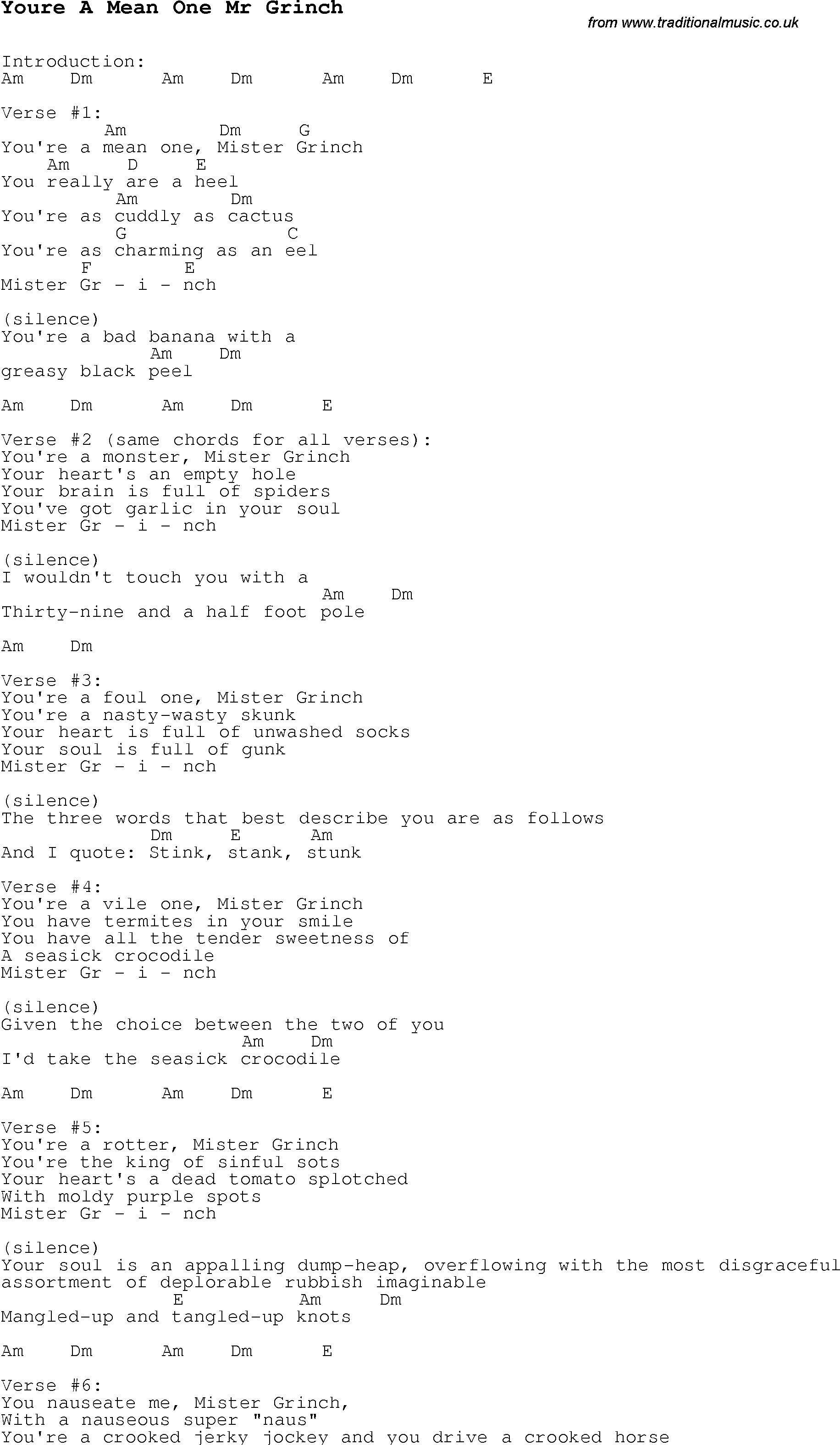
You're a mean one Mr. Grinch lyrics are more than just a soundtrack to a 1966 TV special; they are arguably the most creative "diss track" in the history of American music.
If you grew up watching How the Grinch Stole Christmas!, you probably know the melody by heart. But have you ever actually looked at what’s being said? Most people assume it’s just a funny kid's song. Honestly, it’s a lyrical feat that involves three of the biggest creative powerhouses of the 20th century: Theodor Geisel (Dr. Seuss), Albert Hague, and the booming, subterranean voice of Thurl Ravenscroft.
The Identity Crisis: No, It’s Not Boris Karloff
One of the biggest misconceptions that persists to this day—even in the age of instant Google searches—is who actually sang the song.
Boris Karloff narrated the special. He did a phenomenal job. Because of his top billing, everyone just assumed he was the one singing about the "three-decker sauerkraut and toadstool sandwich with arsenic sauce." He wasn't. Karloff couldn't sing a lick in that range.
The real voice belonged to Thurl Ravenscroft. You might know him as the voice of Tony the Tiger ("They're Grrreat!"). Because Ravenscroft wasn't credited in the original closing titles, Dr. Seuss actually felt terrible about the oversight. He reportedly wrote a letter to every major columnist in the country to set the record after the special aired, making sure people knew it was Thurl’s bass-baritone that brought those insults to life.
It’s a deep, vibrating sound. It feels like it’s coming from the bottom of a damp cave. Without that specific vocal texture, the lyrics wouldn't land the same way.
Why You're a Mean One Mr. Grinch Lyrics Work So Well
The brilliance of these lyrics lies in the escalation of the metaphors. Dr. Seuss didn't just say the Grinch was "bad." He used sensory triggers—smell, touch, and taste—to make the listener physically recoil.
Think about the structure. It starts relatively tame. He’s a "heel." He’s as "cuddly as a cactus."
But then, the lyrics take a sharp turn into the truly bizarre. We get imagery of termites in the smile and hearts full of unwashed socks. Seuss was a master of the "gross-out" long before it became a staple of 90s cartoons. The lyrics don't just describe a villain; they describe a physical sensation of filth.
The Art of the Creative Insult
Look at the stanza involving the "seasick crocodile."
That is a specific kind of writing you don't see anymore. It’s not just calling someone ugly; it’s comparing them to a creature that is already frightening but adding a layer of physical illness to it. It’s genius.
The song also uses a unique "ranking" system. By the end, the narrator isn't just calling the Grinch names. He’s making a choice between two terrible things. "Given the choice between the two of you, I'd take the seasick crocodile." That’s a brutal line for a cartoon.
Musically, It’s a Mess—In a Good Way
Albert Hague, the composer, did something very clever here. Most holiday tunes are in major keys. They are bright. They are "jingly."
The Grinch’s theme is jazzy, but it’s a dark, plodding kind of jazz. It feels like a heavy footfall. The brass hits are sharp and punctuating, almost like they are laughing at the Grinch. It creates a "sneaky" atmosphere that perfectly matches the lyrics' description of a soul full of "gunk."
The Lyrics That People Always Forget
We all remember the "stink, stank, stunk" part. It’s a classic Seussian play on grammar. But some of the later verses get genuinely dark.
"You're a crooked dirty jockey and you drive a crooked hoss, Mr. Grinch!"
This line is a bit of an outlier. It moves away from the "monster" imagery and into the territory of a con man. It suggests that the Grinch isn't just a hermit; he’s a cheat.
Then there’s the "three-decker sauerkraut" line. If you think about the physics of a toadstool sandwich with arsenic sauce, it’s basically a recipe for a bad time. Dr. Seuss had a way of using words that sounded delicious to say but described things that were absolutely revolting. The sibilance—the "s" sounds—in those lines makes it sound like a snake is singing.
The Cultural Longevity of "Mean One"
Why do we still play this?
Every year, there are dozens of new Christmas covers. Everyone from Pentatonix to Tyler, The Creator has taken a stab at this song. Tyler’s version for the 2018 movie was fascinating because it stripped back some of the orchestral weight and replaced it with a modern, grinding beat.
But it still worked.
The reason it works is that the you're a mean one Mr. Grinch lyrics are built on a universal truth: we all know someone who is a "bad banana." There is a catharsis in hearing someone get roasted so thoroughly. In a season of "be nice" and "joy to the world," this song is the pressure valve. It allows us to acknowledge that some people are just... difficult.
Breaking Down the "Stink" Factor
Let's talk about the "Three Words" section.
- Stink.
- Stank.
- Stunk.
This is a linguistic joke. It follows the pattern of drink, drank, drunk. By applying the conjugation of a liquid to a smell, Seuss suggests that the Grinch's odor is so pervasive it’s almost something you can drown in. It’s a very subtle bit of writing that most kids miss, but as an adult, you realize how clever it is.
It also provides the perfect rhythmic break. The music stops. The voice drops an octave. It’s the hook that everyone waits for.
The Impact of the 1966 Animation
We can't talk about the lyrics without the visuals of Chuck Jones.
When the song talks about the Grinch having "termites in his smile," the animation literally shows his teeth turning into a jagged, rotting mess. The synergy between the words and the drawings is what made this a permanent fixture of the holidays.
Interestingly, the original book didn't have the song. Dr. Seuss wrote the lyrics specifically for the television special. This is a rare case where the movie actually improved upon the source material by adding a layer of characterization that the book lacked. In the book, the Grinch is just a mean guy. In the song, he’s a "nasty-wasty skunk." It adds flavor.
Misheard Lyrics and Common Blunders
Because the song is so fast-paced and uses invented words (Seussisms), people get things wrong all the time.
A common one is the "soul is an empty hole" line. Some people hear it as "soul is a black hole." While both work, the "empty hole" is more consistent with the Grinch's lack of "Whoville spirit."
Another one is "garlic in your soul." Many people think it’s "garbage in your soul." Garlic is much better. It implies a pungency that lingers. You can’t just throw garlic away; it stays in the room. It stays on your breath. It’s a much more invasive insult.
How to Use the Grinch Energy
Honestly, if you're writing a holiday card or trying to be funny at a Christmas party, referencing these lyrics is a safe bet. It’s the "edgy" side of Christmas that everyone agrees on.
But if you’re looking to analyze them, look at the contrast.
- The Grinch is "cold."
- The Whos are "warm."
- The Grinch is "smelly."
- The Whos are "sweet."
The lyrics act as a boundary. They define exactly what the Grinch is not, which helps define what the holiday spirit is. By the time he has his change of heart, the lyrics have done such a good job of burying him in the mud that his redemption feels like a genuine miracle.
Understanding the Legacy
If you want to really appreciate the craft here, try reading the lyrics out loud without the music. You’ll notice the dactylic meter—that "DA-da-da, DA-da-da" rhythm that Seuss is famous for. It’s the same rhythm as The Cat in the Hat.
It’s an incredibly difficult rhythm to maintain while using words like "arsenic" and "sauerkraut," yet he pulls it off flawlessly.
Actionable Steps for Grinch Fans
If you're looking to dive deeper into the world of Seuss or just want to win the next holiday trivia night, here is what you should do:
- Listen to the Original Mono Recording: If you can find the original 1966 soundtrack, listen to it on a good pair of headphones. You can hear the "growl" in Thurl Ravenscroft's voice that modern digital remasters sometimes smooth out.
- Compare the Covers: Check out the version by The Whirling Dervishes (a 90s cult classic) or the Tyler, The Creator version. Notice how the change in tempo changes the "threat level" of the lyrics.
- Watch for the Credit: The next time the special airs on TV, look at the credits. You won't see Thurl's name as the singer. Now you know the secret history.
- Analyze the Metaphors: Try to find another song that uses more than ten unique metaphors for "being a jerk." You won't. Use this as a benchmark for creative writing.
- Host a "Mean One" Roast: Instead of a Secret Santa, have friends write their own "Grinch-style" lyrics about each other (keep it friendly, obviously). It's a great exercise in Seussian vocabulary.
The song remains a masterpiece because it refuses to be polite. It’s a reminder that even in the most "wonderful time of the year," there’s room for a little bit of creative bile and a lot of deep-voiced insults.



