It is basically the ultimate earworm of American patriotism. You know how it goes. You’ve probably belted it out at a 4th of July parade or heard a school choir stumble through it while waving those tiny plastic flags. But honestly, most people singing the lyrics to You're a Grand Old Flag are actually singing a revised version that the songwriter, George M. Cohan, was forced to change because of a massive public outcry.
It wasn't always "Grand Old Flag."
Back in 1906, when the song debuted in the Broadway musical George Washington, Jr., the opening line was actually "You're a Grand Old Rag." Sounds insulting, right? That’s exactly what people thought back then too. Cohan, who was the undisputed king of Broadway and a guy who practically bled red, white, and blue, didn't mean it as a jab. He was actually quoting a Civil War veteran he’d met. The old soldier was holding a tattered, battle-worn flag and supposedly whispered, "She's a grand old rag." Cohan loved the grit of that sentiment. The public? Not so much. They hated it. Patriotic groups went wild with anger, and Cohan, being a savvy businessman, swapped "rag" for "flag" faster than you can march a beat.
The Lyrics to You're a Grand Old Flag: What You’re Actually Singing
Let's look at the words. Most people only know the chorus. It’s the meat of the song.
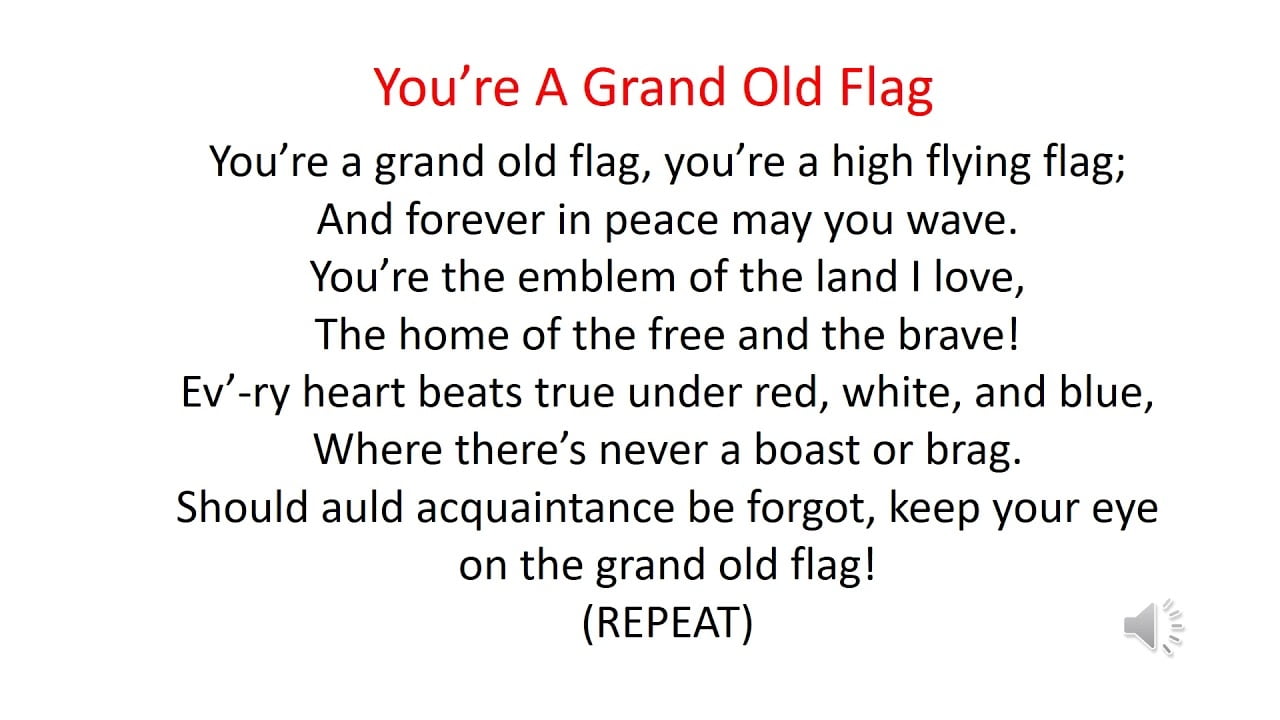
You're a grand old flag, You're a high-flying flag And forever in peace may you wave! You're the emblem of The land I love, The home of the free and the brave. Ev'ry heart beats true 'Neath the Red, White and Blue, Where there's never a boast or brag. But should auld acquaintance be forgot, Keep your eye on the grand old flag.
It’s simple. Effective. Brilliantly rhythmic. Cohan was a master of the "patrimonic" song—a term people used to describe his specific brand of flag-waving theatrical hits. He understood that to make a song stick, you needed a melody that felt like it had already existed for a hundred years.
He was a thief, in a way. A musical one.
Notice that second-to-last line? "Should auld acquaintance be forgot." He literally lifted that straight from Robert Burns' "Auld Lang Syne." He also peppered in bits of "The Star-Spangled Banner" and "Dixie" into the orchestral arrangements. It was a mashup before mashups were a thing. By weaving these familiar threads together, he made the song feel deeply nostalgic even the first time someone heard it in a theater.
Why the Verse Matters (And Why Nobody Sings It)
While everyone knows the chorus, the verses are a different story. They’re rarely performed today because they are very much products of 1906. They feel a bit clunky compared to the soaring hook of the chorus.
The first verse starts with: There's a feeling comes a-stealing, and it sets my brain a-reeling, It's a feeling of the loyalty I owe. O'er the king and all his forces victory is ours of course is, You can hear the voices calling even so...
It's very "theater kid." It sets the stage for the character in the play, but as a standalone patriotic anthem, it’s a bit much. The rhyme of "ours of course is" with "forces" is the kind of songwriting gymnastics that worked in a Vaudeville-style musical but feels a bit silly at a modern sporting event.
The Scandal of the "Rag"
Let’s get back to the "Rag" controversy because it’s the most interesting part of the song's history. Cohan was a guy who thrived on energy and street-level authenticity. When he met that veteran—who reportedly fought at Gettysburg—the word "rag" represented sacrifice. It meant the flag had been through the literal fire. It was torn, bloodied, and used, but still flying. To Cohan, that was the ultimate respect.
But the 1900s were a time of intense, formal nationalism. To the Daughters of the American Revolution and various veterans' groups, calling the flag a "rag" was bordering on treason. The backlash was so swift that Cohan had to stop the presses. He recalled the sheet music. He apologized.
He renamed it "The Grand Old Flag," and the rest is history. It became the first song from a musical to sell over a million copies of sheet music. Think about that for a second. In an era without Spotify, without radio, and without YouTube, a million households bought the physical paper to play this song on their parlor pianos.
The Genius of George M. Cohan
You can't talk about these lyrics without talking about the man who wrote them. Cohan was a powerhouse. He was an actor, singer, dancer, songwriter, and producer. He basically invented the modern musical comedy. Before him, Broadway was mostly stuffy operettas or disjointed Vaudeville acts. Cohan brought speed. He brought American slang.
He once said, "I can write a play around a flag." And he wasn't kidding.
There's a reason the lyrics to You're a Grand Old Flag feel so rhythmic. Cohan was a hoofing dancer first. He wrote songs that you could march to, tap your toes to, and swing a cane to. The "Red, White and Blue" section of the lyrics is specifically designed to land on the beat of a heavy footfall.
Common Misconceptions About the Song
People often think this is a folk song from the 1800s. It isn't. It’s a commercial Broadway hit.
Another common mistake? People get the "never a boast or brag" line confused. Some sing it as "never a boast to brag," which makes zero sense if you think about it. The point Cohan was making was that American greatness didn't need to be loud or arrogant—it just was. (Though irony abounds here, considering the song itself is a bit of a brag).
Also, a lot of people think the song was written for World War I. While it was incredibly popular during the Great War, it actually predates it by nearly a decade. By the time the U.S. entered WWI in 1917, "You're a Grand Old Flag" was already an established standard, which is why it became such a massive recruitment tool alongside Cohan's other big hit, "Over There."
The Technical Breakdown of the Lyrics
If you look at the structure, it’s a masterpiece of simplicity.
The rhyme scheme in the chorus is A-B-C-B-D-D-E-E-F-B.
- Flag / Wave / Brave (B)
- Love / Free (D)
- True / Blue (E)
- Brag / Flag (B)
Wait, look at that. Cohan loops the "B" rhyme (Wave, Brave, Brag, Flag) throughout the entire chorus. This is why the song is so easy to memorize. Your brain is essentially just waiting for that "ay-g" or "ay-v" sound to resolve. It's satisfying. It’s like a puzzle piece clicking into place.
How to Teach the Song to Kids (Or Yourself)
If you're trying to memorize the lyrics to You're a Grand Old Flag, the easiest way is to focus on the imagery.
- The Object: The flag itself (High-flying, grand).
- The Wish: Peace (Forever in peace may you wave).
- The Identity: The Land I Love (Home of the free and brave).
- The Feeling: Heart beats true (Red, White, and Blue).
- The Action: Keep your eye on the flag.
It moves from the physical object to a global wish, then to a personal connection, and finally to an instruction. It’s a perfect narrative arc in just a few lines.
The Cultural Legacy
This song has been covered by everyone. From Mitch Miller to the Muppets. Jimmy Cagney famously performed it in the 1942 biopic Yankee Doodle Dandy, which, if you haven't seen it, is basically a masterclass in 1940s propaganda and incredible tap dancing. Cagney's performance solidified the song's place in the American "Great American Songbook."
But it's not just a museum piece.
Even now, the song shows up in weird places. It’s in The Simpsons. It’s in Bioshock Infinite (in a creepy, distorted way). It’s ubiquitous because it represents a very specific, uncomplicated version of American pride. It’s the "apple pie" of music.
Actionable Steps for Musicians and Teachers
If you are planning to perform this or use it in a classroom, here is how to handle it properly:
- Check the Key: Most sheet music is in B-flat or F major. If you’re leading a group of non-singers, G major is often much more "singable" for the average person who can't hit those high Broadway notes.
- The Tempo: Don't drag it. It’s a march. It should be roughly 120 beats per minute. If you go too slow, it becomes a dirge. If you go too fast, you lose the words.
- Contextualize the "Rag": If you’re teaching this to students, tell them the "Grand Old Rag" story. It’s a great lesson in how language changes and how "intent" versus "perception" works in art.
- Watch the Breath: The longest line is "And forever in peace may you wave." Make sure singers take a deep breath after "High-flying flag" so they don't run out of air before they hit the word "wave."
The song remains a staple because it does exactly what George M. Cohan intended: it makes you feel like you're part of something bigger. Whether you’re a fan of the old-school Broadway style or just someone looking for the words for a school project, the lyrics to You're a Grand Old Flag are a fascinating window into 1900s America—a time when a single word like "rag" could start a national conversation, and a simple melody could unite a million people.
Next time you sing it, remember the old veteran Cohan met. Think about that "Grand Old Rag" he was holding. It gives the song a bit more weight, doesn't it? It's not just a catchy tune; it's a tribute to the wear and tear of history.



