George M. Cohan was a bit of a fireball. He wasn't just a songwriter; he was a one-man industry who basically invented the modern Broadway musical. But back in 1906, he did something that would cement his name in the American psyche forever. He wrote a song for a show called The George Washington, Jr. that didn't just top the charts—it became a permanent part of the national DNA. If you’ve ever been to a 4th of July parade or a grade school assembly, you know the lyrics You're a Grand Old Flag by heart, even if you don't realize it.
It’s a simple tune. Catchy? Absolutely. But there’s a weird bit of history tucked into those lines that most people totally miss.
The Civil War Encounter That Started It All
The song didn't come from a marketing brainstorm. It came from a chance meeting. Cohan was sitting on a park bench next to a Civil War veteran. This old soldier, a member of the Grand Army of the Republic, was holding a carefully folded, tattered American flag. He had fought at Gettysburg. He looked at the flag in his lap and told Cohan, "She's a grand old rag."
Cohan loved it. He thought it was poetic. He went home and wrote the song originally titled "You're a Grand Old Rag."
People hated it.
Well, they didn't hate the music, but they were furious about the word "rag." To the veteran, it was a term of endearment, like an old, reliable piece of clothing that had survived the storm. To the public in 1906, it felt like an insult to the flag. The backlash was so swift that Cohan had to pivot. He changed "rag" to "flag," and the rest is history. Honestly, it’s a good thing he did, because "You're a Grand Old Flag" just rolls off the tongue a lot better, doesn't it?
Breaking Down the Lyrics You're a Grand Old Flag
Let’s actually look at what we’re singing. It’s a mashup. Cohan was a master of the "quodlibet"—a fancy musical term for taking bits of other famous songs and weaving them together. If you listen closely to the melody and the phrasing, you’ll hear echoes of "Auld Lang Syne." In fact, Cohan explicitly references it in the lyrics.
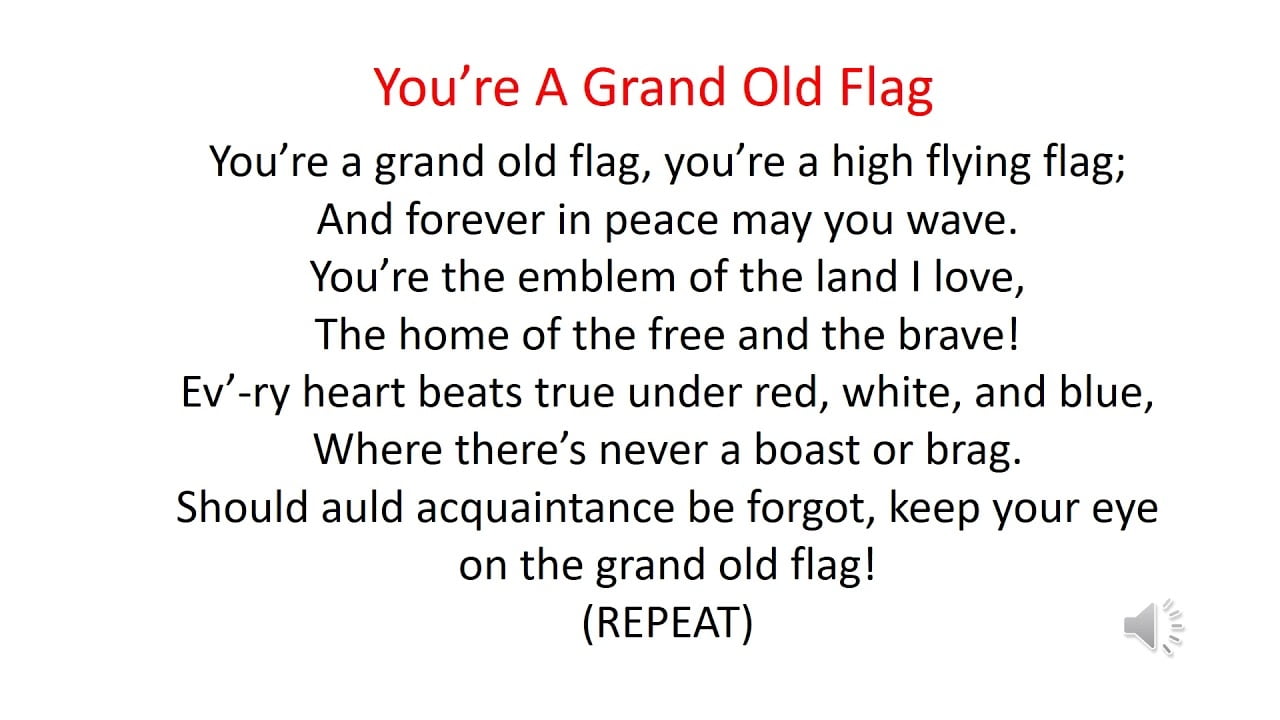
The opening lines are iconic: You're a grand old flag, you're a high-flying flag And forever in peace may you wave
It’s a prayer as much as a celebration. When he wrote this, the U.S. was emerging as a global power. The Spanish-American War was still fresh in the collective memory. People were feeling a specific kind of intense, turn-of-the-century patriotism.
Then he hits the middle section: You're the emblem of the land I love The home of the free and the brave
Sound familiar? He's tipping his hat to "The Star-Spangled Banner" here. Cohan knew that to make a song feel "instant," it had to feel "familiar." By borrowing the sentiment of the national anthem, he made his new song feel like it had existed forever.
The Auld Lang Syne Connection
The most interesting part of the lyrics You're a Grand Old Flag is the bridge: Every heart beats true 'neath the Red, White and Blue Where there's never a boast or brag But should auld acquaintance be forgot Keep your eye on the grand old flag
That "never a boast or brag" line is kind of ironic considering how bombastic the song is, right? But the "auld acquaintance" line is the kicker. By pulling from Robert Burns’ classic song of remembrance, Cohan was telling the audience that even as the country moves forward into a new century, they shouldn't forget the sacrifices of the past—specifically the veterans like the one he met on the park bench.
Why the Song Became the First "Million-Seller"
We take digital streaming for granted now. Back in 1906, success was measured in sheet music.
"You're a Grand Old Flag" was the first song from a musical to sell over a million copies of sheet music. Think about that. A million households sat down at their pianos to play this themselves. It wasn't just something you heard; it was something you did.
Cohan's style was "muscular" songwriting. It wasn't flowery or operatic. It was brisk. It was 120 beats per minute—basically the pace of a marching soldier. This tempo is psychological. It makes you want to stand up straighter. It makes you want to move.
The Controversy You Probably Didn't Know About
Even after he changed "rag" to "flag," Cohan wasn't totally out of the woods. Some critics felt the song was too "vaudeville." They thought patriotism should be somber and serious, not something you’d perform with a cane and a straw hat.
But the public didn't care. They loved the energy. Cohan’s genius was in realizing that American patriotism wasn't just about solemn oaths; it was about swagger. He captured the "Yankee Doodle" spirit (another song he’s famous for, obviously) and bottled it for the masses.
There’s also the bit about the "Red, White and Blue." In the early 1900s, the flag wasn't used in advertising or clothing as much as it is today. There were actually strict social codes about how you talked about the flag. Cohan pushed the boundaries by making the flag a "character" in a pop song. He humanized it.
How to Teach the Lyrics Today
If you're teaching this to kids or trying to learn it for a performance, the rhythm is more important than the notes. It’s a march.
- Start with the pulse. If you aren't tapping your foot, you're doing it wrong.
- Enunciate the "T" sounds. "Grand," "Heart," "Beat." Cohan wrote for the stage, and on stage, if you don't crisp up your consonants, the audience just hears mush.
- Watch the "Auld Lang Syne" transition. Most people stumble there because the meter changes slightly.
The song is short. It’s barely a minute and a half if you play it at the intended speed. That’s why it’s so effective. It hits you with a burst of energy and then gets out of the way.
The Cultural Legacy of a 120-Year-Old Hit
It’s rare for a song to survive this long without becoming a parody of itself. Somehow, "You're a Grand Old Flag" stayed earnest. Maybe it’s because it’s so inextricably linked to our childhoods.
It has been covered by everyone from Mitch Miller to Alvin and the Chipmunks. It was a staple for James Cagney in the 1942 biopic Yankee Doodle Dandy. When Cagney performed it, he brought that "tough guy" energy that Cohan actually had in real life.
It’s also one of the few songs from that era that doesn't have "cringe" lyrics. A lot of songs from the early 1900s are riddled with outdated stereotypes or offensive language. Cohan kept this one clean and focused on the symbol. Because of that, it hasn't needed a "reboot" or a lyrical overhaul. It’s a time capsule that still fits the modern world.
Taking Action: Beyond the Lyrics
If you’re looking to dive deeper into this era of music, don't stop at the lyrics You're a Grand Old Flag.
- Listen to the original 1906 recordings. You can find them on the Library of Congress website (the National Jukebox). They sound scratchy, but you’ll hear the specific "ragtime" syncopation that Cohan intended, which is often lost in modern, slower versions.
- Check out the sheet music art. The original covers are beautiful examples of early 20th-century lithography.
- Visit the George M. Cohan statue. If you’re ever in New York City, he’s the only actor with a statue in Times Square (46th and Broadway). Give him a nod for giving us the catchiest earworm in American history.
The real power of the song isn't in the rhymes or the melody. It's in the fact that it started with a veteran and a "rag." It’s a reminder that symbols are only as powerful as the stories we attach to them. Next time you hear it, remember that old man on the park bench. It turns out he was right—she is a grand old rag, in the best possible way.
Practical Steps for Performers and Educators
- Verify the Tempo: Ensure you are performing at approximately 120 BPM to maintain the intended "march" feel.
- Contextualize for Students: When teaching the lyrics, explain the "Rag vs. Flag" story; it makes the song much more relatable to younger generations who value authenticity over blind ceremony.
- Resource Check: Use the Library of Congress digital archives to find the original George Washington, Jr. playbill to see how the song was first framed within the narrative of the play.



