George M. Cohan was basically the Lin-Manuel Miranda of 1906. He was everywhere. He was a playwright, a dancer, a singer, and a guy who knew exactly how to pull at America’s heartstrings without being too "extra" about it. When he sat down to write the lyrics for You’re a Grand Old Flag, he didn't just want a catchy tune for his musical George Washington, Jr. He wanted something that felt like a pulse.
Honestly, if you grew up in the U.S., you've probably screamed these lyrics in a drafty elementary school cafeteria while wearing a paper hat. But most people get the history—and even some of the words—totally wrong. It isn't just a song about a piece of cloth. It’s a song about a specific encounter Cohan had with a Civil War veteran that changed the way he viewed the American symbol forever.
The Story Behind the Lyrics for You're a Grand Old Flag
Let’s talk about that veteran. Cohan was sitting next to a guy who had fought at Gettysburg. The old soldier was holding a folded, tattered flag. According to theater lore, the veteran looked at the flag and whispered, "She’s a grand old rag."
Cohan loved that. He thought it was poetic.
So, the original 1906 title wasn't "Grand Old Flag" at all. It was "You're a Grand Old Rag." People absolutely hated it. Patriotic groups and veterans' organizations went ballistic, thinking Cohan was being disrespectful by calling the stars and stripes a "rag." They didn't get the nuance. They didn't see the affection in the veteran's words. Cohan, being a savvy businessman who didn't want his show to flop, pivoted fast. He swapped "rag" for "flag," and a legendary anthem was born.
What the Lyrics Actually Say (and What They Mean)
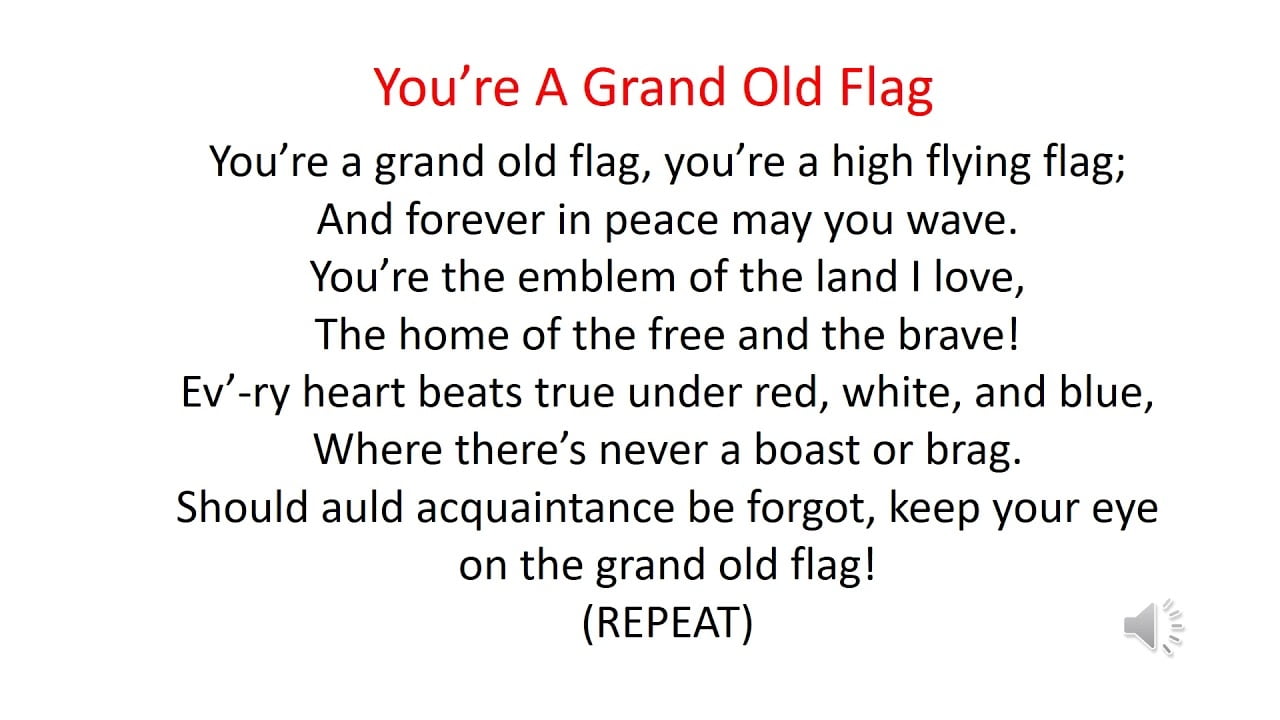
The song starts with that iconic "You're a grand old flag, you're a high-flying flag." It’s simple. It’s punchy. But then it gets into the "Emblem of the land I love" part. This is where Cohan’s songwriting genius kicks in. He uses the word "emblem" to elevate the flag from a physical object to an idea.
"The home of the free and the brave." Sound familiar? It’s a direct nod to The Star-Spangled Banner, which wasn't even the official national anthem yet back then. Cohan was basically sampling other patriotic hits before sampling was a thing.
Then we get to the part everyone mumbles: "Every heart beats true 'neath the Red, White and Blue." It’s a line about unity. In 1906, the country was dealing with massive waves of immigration and the lingering shadows of the Civil War. Cohan was trying to bridge those gaps. He followed it up with "Where there's never a boast or brag." This is actually kind of funny if you think about American culture today, but back then, it was meant to portray a sense of quiet, steady strength.
The Auld Lang Syne Connection
Have you ever noticed that the middle of the song sounds suspiciously like a New Year's Eve party?
That’s because it is.
Cohan intentionally woven in a snippet of "Auld Lang Syne." Specifically, the line "Should auld acquaintance be forgot" gets a melodic shout-out. Why? Because he wanted to ground the song in nostalgia. He wanted people to feel like the flag was an old friend they'd known their whole lives.
- The Verse: Most people only know the chorus.
- The Tempo: It’s a march. It’s designed to keep you moving.
- The Rhyme Scheme: A-B-C-B. It's built for the human brain to memorize instantly.
Why These Lyrics Became the First "Million-Seller"
Before Spotify wrapped, we had sheet music sales. You’re a Grand Old Flag was the first song from a musical to sell over a million copies of sheet music. Think about that for a second. In an era without radio, a million people bought the paper just so they could play these lyrics on their parlor pianos.
It was the viral hit of the early 20th century.
The lyrics worked because they were accessible. Unlike "The Star-Spangled Banner," which requires a vocal range most humans don't possess, anyone can sing Cohan’s lyrics. You don't need to be an opera singer. You just need to be able to shout-sing in a group.
The Verse Nobody Remembers
Everyone knows the chorus. Barely anyone knows the verse. It starts with:
"There's a feeling comes a-stealing and it sets my brain a-reeling."
It’s very Vaudeville. It talks about the "stars and stripes" and how every state is a "bright and beaming star." It’s much wordier than the chorus and honestly, a bit clunky. That’s why it fell out of favor. We like our anthems lean. We want the hook. Cohan gave us the ultimate hook.
The Cultural Longevity of Cohan's Words
Why do we still care? Honestly, it's because the song is indestructible. It survived two World Wars, the Great Depression, and the total transformation of the American music industry.
When James Cagney played Cohan in the 1942 film Yankee Doodle Dandy, the song got a second life. During World War II, those lyrics felt urgent again. They weren't just musical theater fluff; they were a rallying cry. It’s weird how a song written for a comedy play about a guy named George Washington, Jr. ended up becoming a pillar of national identity.
But that’s the power of simple lyrics.
They don't have to be complex to be profound. "Keep your eye on the grand old flag" is a pretty straightforward instruction. It’s about focus. It’s about looking at something bigger than yourself.
Misconceptions and Lyric Flubs
People often mix up the lines. You’ll hear kids sing "The land of the free and the home of the brave" because their brains default to the National Anthem. Cohan actually wrote "The home of the free and the brave." It’s a tiny flip, but purists notice.
Another common mistake? The "boast or brag" line. Some people sing "Where there's never a toast or brag," which makes zero sense unless you’re at a very dry party. It’s boast.
How to Teach or Perform the Song Today
If you're putting this together for a school play or a community event, don't overthink it. The song is a march.
- Keep the tempo up. If you drag it, it sounds like a funeral dirge.
- Emphasize the "Grand." It’s the operative word.
- Use the "Rag" history. If you’re teaching kids, tell them the "Grand Old Rag" story. It makes the song human. It shows that even "perfect" patriotic songs started with a mistake and a grumpy public.
Cohan wasn't trying to write a sacred text. He was trying to write a hit. By making the lyrics for You’re a Grand Old Flag so rhythmic and repetitive, he ensured that the song would outlive him by centuries.
Actionable Next Steps for Enthusiasts
If you want to dive deeper into this specific era of American music, start with the 1942 film Yankee Doodle Dandy. It’s not a 100% accurate biopic (Cohan was a lot more complicated and "tough" than the movie suggests), but the musical sequences are gold.
Next, look up the original sheet music covers from 1906. You can find digital archives at the Library of Congress. Seeing the "Grand Old Rag" transition in print is a trip. It shows you how much public opinion can shape art.
Finally, try listening to different versions. From the Mormon Tabernacle Choir to Alvin and the Chipmunks (yes, they did it), the song changes based on who is singing it. The lyrics remain the same, but the "vibe" shifts from reverent to ridiculous. That’s the mark of a truly great song—it can handle any interpretation you throw at it.
Check out the Library of Congress "National Jukebox" for some of the earliest 78rpm recordings. Hearing it with the crackle of an old record player makes the lyrics feel a lot more grounded in that 1906 reality. You'll realize it wasn't just a song; it was a snapshot of a country trying to figure out what it stood for.
Don't just sing the words. Understand that they were written by a guy who loved the "ragged" parts of history just as much as the "grand" ones. That’s where the real magic is.
Key Takeaways to Remember:
- The song was originally titled "You're a Grand Old Rag."
- It was the first song from a Broadway musical to sell a million copies of sheet music.
- The melody incorporates "Auld Lang Syne."
- George M. Cohan wrote it after a chance meeting with a Civil War vet.
Now, go listen to the 1906 Billy Murray recording. It’s fast, it’s weird, and it’s exactly how the song was meant to be heard before it became a sanitized schoolroom staple.



