George M. Cohan was a firecracker. Actually, that’s an understatement. He was the undisputed king of Broadway at the turn of the 20th century, a guy who basically invented the modern musical comedy by sheer force of will and a lot of rhythmic tapping. In 1906, he sat down and wrote a tune for his musical The George Washington, Jr., and honestly, the world hasn't stopped singing it since. But if you look closely at the You're a Grand Old Flag lyrics, you aren't just looking at a catchy marching tune. You're looking at a piece of history that survived a pretty weird controversy involving a literal pile of rags.
It’s iconic. Everyone knows the chorus. You probably sang it in a third-grade pageant while wearing a construction paper hat. But there is a massive amount of nuance in how these words came to be.
The Civil War Encounter That Started It All
Cohan didn't just pull these lyrics out of thin air. He was a storyteller. The inspiration supposedly came from a chance meeting with a Civil War veteran who had fought at Gettysburg. Cohan was sitting next to the old man, who was carefully holding a folded, tattered American flag. The vet looked at the fabric and whispered, "She’s a grand old rag."
Cohan loved that. He thought it was poetic.
So, when he wrote the song, the original title wasn't what we know today. It was "You’re a Grand Old Rag." He thought it showed the grit and the sacrifice of the soldiers who had carried those colors through smoke and lead. He wanted to honor the "ragged" nature of a battle-worn flag.
People hated it.
The public reaction was swift and pretty brutal. Patriotic groups and veterans' organizations flipped out. They thought calling the Stars and Stripes a "rag" was the ultimate insult, regardless of Cohan’s intentions. Cohan, being a savvy businessman who didn't want his show to flop, changed "rag" to "flag" almost immediately. The rest is history.
Breaking Down the You're a Grand Old Flag Lyrics
Most people only know the chorus. That’s the part that sticks in your brain like glue. But the full song actually has verses that set the stage for that big, bombastic payoff.
The song starts by talking about "There's a feeling comes a-stealing," which is a very Cohan-esque way of describing sudden inspiration. He talks about how every heart beats true under the Red, White, and Blue. It’s simple. It’s direct. It’s designed to make you feel like you’re part of something bigger.
The Chorus Everyone Knows
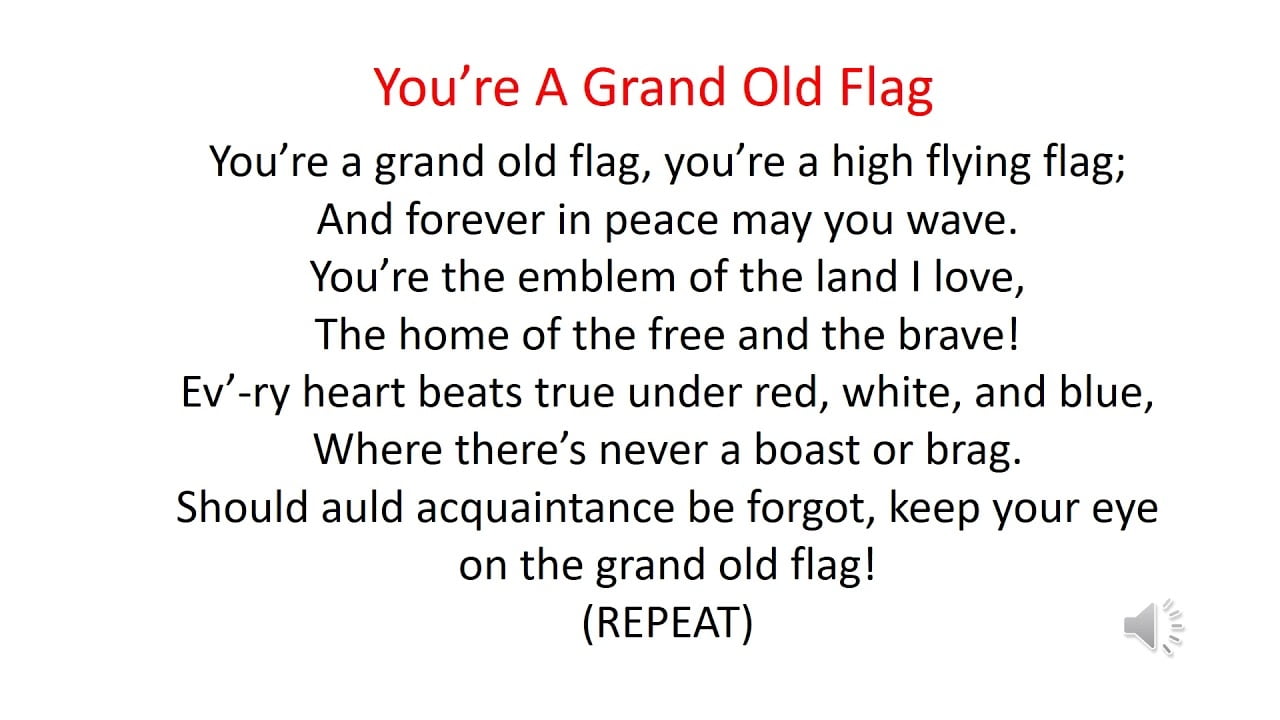
"You're a grand old flag, You're a high-flying flag And forever in peace may you wave. You're the emblem of The land I love. The home of the free and the brave."
Think about that last line. "The home of the free and the brave." Cohan was directly lifting from "The Star-Spangled Banner," which wasn't even the official national anthem yet (that didn't happen until 1931). Cohan was a master of musical "sampling" before that was even a thing. He took bits of "Auld Lang Syne" and "The Star-Spangled Banner" and mashed them into a high-energy ragtime beat.
It was brilliant. It made the song feel familiar even the first time you heard it.
The Missing Verses
The verse that people usually skip mentions "Ev'ry heart beats true 'neath the Red, White and Blue," but it also goes into "Where there's never a boast or brag." This is a bit ironic, considering the song is basically one long, glorious boast about the United States. But that was the vibe of the early 1900s. America was finding its footing as a global power, and Cohan was the hype man.
He also writes, "But should auld acquaintance be forgot, keep your eye on the grand old flag." Again, he’s leaning on Robert Burns and traditional nostalgia to anchor his new song in the past. It’s clever songwriting. It bridges the gap between the old world and the new American century.
Why the Song Still Works in 2026
You might think a song from 1906 would feel like a dusty museum piece by now. It doesn't. Why? Because it’s a "march." It has a specific tempo—around 120 beats per minute—which is the natural walking pace of a human. It feels good to sing. It feels active.
Musically, it’s a marvel of simplicity. Cohan wasn't trying to be Gershwin or Porter. He didn't want complex harmonies. He wanted something a drunk guy in a pub or a kid in a classroom could belt out without missing a note.
The You're a Grand Old Flag lyrics also tap into a very specific kind of optimistic patriotism. It’s not a war song, really. It doesn't talk about killing enemies or conquering lands. It talks about "peace may you wave." It’s about the symbol itself.
The Cultural Impact and the "Rag" Controversy Legacy
The shift from "rag" to "flag" is actually a major case study in American branding. If Cohan had dug his heels in, the song probably would have faded away as a weird, offensive curiosity. By pivoting, he created a standard.
It’s interesting to note that Cohan was the first actor ever to be honored with a Congressional Gold Medal. President Franklin D. Roosevelt presented it to him in 1936, specifically citing his songs like "You're a Grand Old Flag" and "Over There" for their role in boosting national morale.
Think about that for a second. A Broadway guy who wrote catchy tunes about rags and flags ended up with the same honor as military generals. That’s the power of these lyrics. They defined an era.
Real-World Usage and Performance Tips
If you're looking to perform this or use it in a project, there are a few things to keep in mind regarding the lyrics and the arrangement:
- Tempo is Everything: Don't drag it. It’s a march. If you sing it too slow, it becomes a dirge. Keep it snappy.
- The "Auld Lang Syne" Reference: When you hit the line "But should auld acquaintance be forgot," many singers naturally slow down for a second for dramatic effect before launching back into the final "Keep your eye on the grand old flag." It adds a nice bit of texture.
- The Lyrics Variation: You’ll sometimes see "high-flying flag" and sometimes "high-faling flag" in old sheet music. Stick with "high-flying." It makes more sense to modern ears.
- Enunciation: Cohan was big on "patter." The words should be crisp. "Em-blem of the land I love" should hit like a drum beat.
Actionable Steps for Music Lovers and Historians
If you really want to dive into the world of George M. Cohan and this specific song, here is how you should actually do it. Don't just read the lyrics on a screen; experience the context.
- Listen to the 1906 Billy Murray Recording: This is the closest you’ll get to how the song sounded when it first hit the streets. Murray was the "Denver Nightingale" and his phrasing is exactly what Cohan intended. You can find this in the Library of Congress digital archives.
- Watch 'Yankee Doodle Dandy': Specifically the scene where James Cagney (playing Cohan) performs the song. Cagney actually won an Oscar for this role, and his "stiff-legged" dancing style is a direct homage to Cohan’s actual performance style. It shows you the energy required to make the lyrics work.
- Check the Sheet Music: Look for the original 1906 prints. You can often find them on eBay or in digital museum collections. Seeing the cover art—usually featuring Cohan in his "George Washington Jr." costume—gives you a sense of the theatricality of the piece.
- Analyze the 'Sampling': Grab a copy of the lyrics and highlight the parts Cohan borrowed. Mark "The Star-Spangled Banner" references in one color and "Auld Lang Syne" in another. It’s a great exercise in understanding how classic American songwriting was built on the shoulders of what came before.
The You're a Grand Old Flag lyrics are more than just a patriotic jingle. They are a snapshot of a moment when America was trying to define its identity through music, theater, and a bit of trial and error. Whether it’s a "rag" or a "flag," the sentiment remains one of the most durable pieces of the American songbook. It’s short, it’s loud, and it’s unapologetically proud. Just like Cohan himself.



