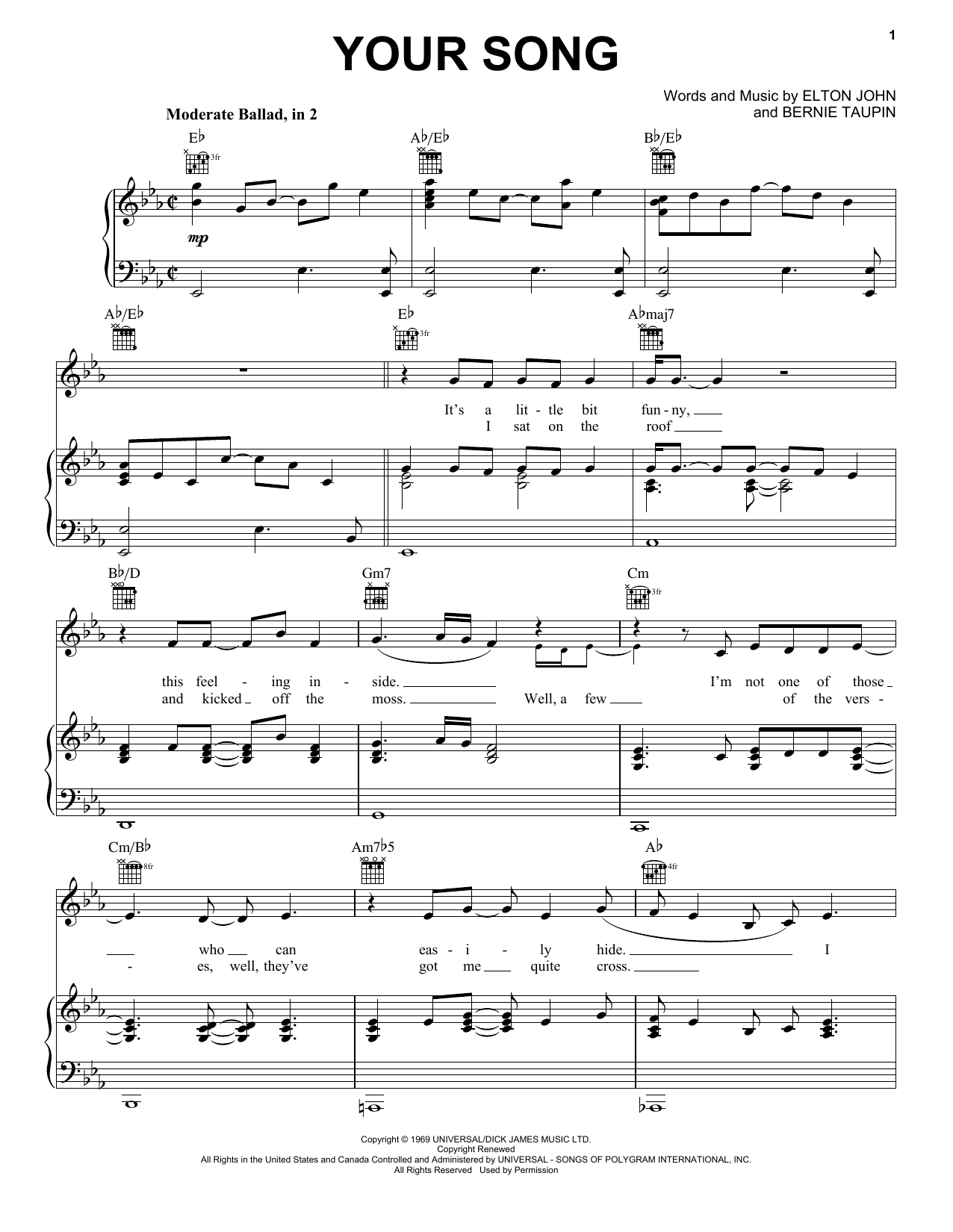
It’s just a piano and a voice. No pyrotechnics, no massive orchestral swells at the start, just a guy sitting at a keyboard trying to figure out how to tell someone he loves them without sounding like a total idiot. Honestly, that’s the magic. When you listen to Your Song, you aren’t hearing a global superstar at the height of his powers; you’re hearing a 22-year-old kid named Reg Dwight and his 19-year-old buddy Bernie Taupin catching lightning in a bottle.
It’s 1969. North London. If you enjoyed this piece, you should look at: this related article.
Bernie Taupin is sitting at a kitchen table in Elton’s mother’s apartment in Northwood Hills. He’s eating breakfast. He’s got a "grubby piece of exercise paper" and he’s scribbling. He’s nineteen. He’s never really been in love, or at least not the kind of love that changes the world. He finishes the lyrics, hands them to Elton—who’s probably still finishing his eggs—and twenty minutes later, the melody is done.
Twenty minutes. For another angle on this event, see the latest coverage from Vanity Fair.
Most people take longer to choose a Netflix show. But for Elton John and Bernie Taupin, Your Song was just... there. It was their first real hit, the one that made John Lennon say it was the first new thing since the Beatles. That’s a hell of a stamp of approval.
What Most People Get Wrong About the Lyrics
There is this persistent urban legend that Bernie wrote the lyrics on the roof of 20 Denmark Street while looking at the moss. It sounds poetic, right? The struggling artist perched above the city. Even the movie Rocketman leans into the romance of the moment.
But Bernie actually debunked that himself.
He’s gone on record saying he doesn't even know where 20 Denmark Street is. He’s called the idea "fanciful icing on the cake." The reality is much more mundane—just a kitchen table and some coffee stains. In fact, those original handwritten lyrics, coffee spills and all, were eventually auctioned off for a small fortune.
The lyrics are famously self-deprecating. "I know it’s not much, but it’s the best I can do." It’s a song about not being able to write a song.
The "Naïve" Genius
Bernie has called the lyrics "childish" in interviews. He’s being modest. Sure, lines like "if I were a sculptor, but then again no" are a bit clunky on paper. They jump around. They stumble. But that’s exactly why it works. It feels like a real person talking. It’s not a polished, corporate love ballad designed by a committee to sell diamond rings. It’s a 17-year-old's perspective on a feeling he doesn't quite understand yet.
- The song avoids gendered pronouns.
- It doesn't name the person it's for.
- It focuses on the frustration of expression.
Because it’s so vague, it’s universal. You can sing it to a partner, a kid, or a friend. Elton has performed it thousands of times, and he’s said it’s the one song he never gets tired of.
The Three Dog Night "Mistake"
Here is a weird bit of music history: Elton John wasn't actually the first person to record Your Song.
He was working as a songwriter and a session guy. He’d toured as an opening act for Three Dog Night, and they actually recorded a version of it for their 1970 album It Ain't Easy. They knew it was a smash. But they did something almost unheard of in the music business.
They didn't release it as a single.
They basically told Elton, "Look, you’re a young kid trying to make it. This is your career-maker. We’re going to let you have the hit." That kind of generosity is basically extinct now. If Three Dog Night had put it out as a single, the Elton John we know today might never have happened. He might have just stayed a songwriter in the background.
Production Secrets from Trident Studios
When Elton finally went into Trident Studios to record it for his self-titled second album, he wasn't alone. You’ve got Gus Dudgeon producing—the guy who did David Bowie’s Space Oddity. He brought in Paul Buckmaster for the string arrangements.
If you listen closely, the strings don't just "pad" the background. They move. They have this baroque, slightly sophisticated feel that elevates the simple piano melody.
Trident was the place to be back then. The Beatles did Hey Jude there. It had a specific sound—cleaner and punchier than Abbey Road at the time. Elton’s piano sounds massive on the track, which is impressive considering it’s basically just him and a few session players. The "simple" sound actually took a lot of careful engineering to perfect.
The Chart Climb
The song didn't explode instantly. It was originally the B-side to "Take Me to the Pilot." Imagine that. One of the greatest songs in history was tucked away on the back of a record. DJs started flipping the disc over because they realized Your Song was the real draw. It eventually hit No. 8 on the Billboard Hot 100 in early 1971.
Why it Still Matters in 2026
We live in an era of hyper-tuned vocals and 15 songwriters per track. Your Song stands out because it’s vulnerable. It’s okay with being "a little bit funny."
It’s been covered by everyone. Lady Gaga, Ellie Goulding, Ewan McGregor in Moulin Rouge. Everyone tries to put their own spin on it, but they always come back to that same simple piano riff. It’s the ultimate "less is more" case study.
Actionable Insights for Music Lovers
If you really want to appreciate the song, stop listening to the radio edit. Find the 1969 piano demo. It’s raw. You can hear the hesitation in Elton's voice.
- Listen for the "Well": In the lyrics, Elton sings "Well, a few of the verses..." He repeats the word "well" like he's thinking of the next line. It’s a deliberate choice that makes the song feel improvised.
- Check the Bass: Dee Murray’s bass work on the final studio version is incredibly melodic. It doesn't just hold the beat; it dances around the piano.
- Read the Lyrics Alone: Read them like a poem. You’ll see the "coffee stain" honesty that Bernie was going for.
The best thing you can do is go back to the 1970 self-titled album. Don't just skip to the hits. Listen to the whole thing in order. You’ll hear the transition from a shy kid in his mom's house to the superstar who would eventually define the decade.
To get the full experience, compare the original studio recording with Elton’s performance from his 2022 "Farewell Yellow Brick Road" tour. The voice is deeper, sure. But the "feeling inside" hasn't changed a bit. It’s still just a gift, and it’s still for you.



