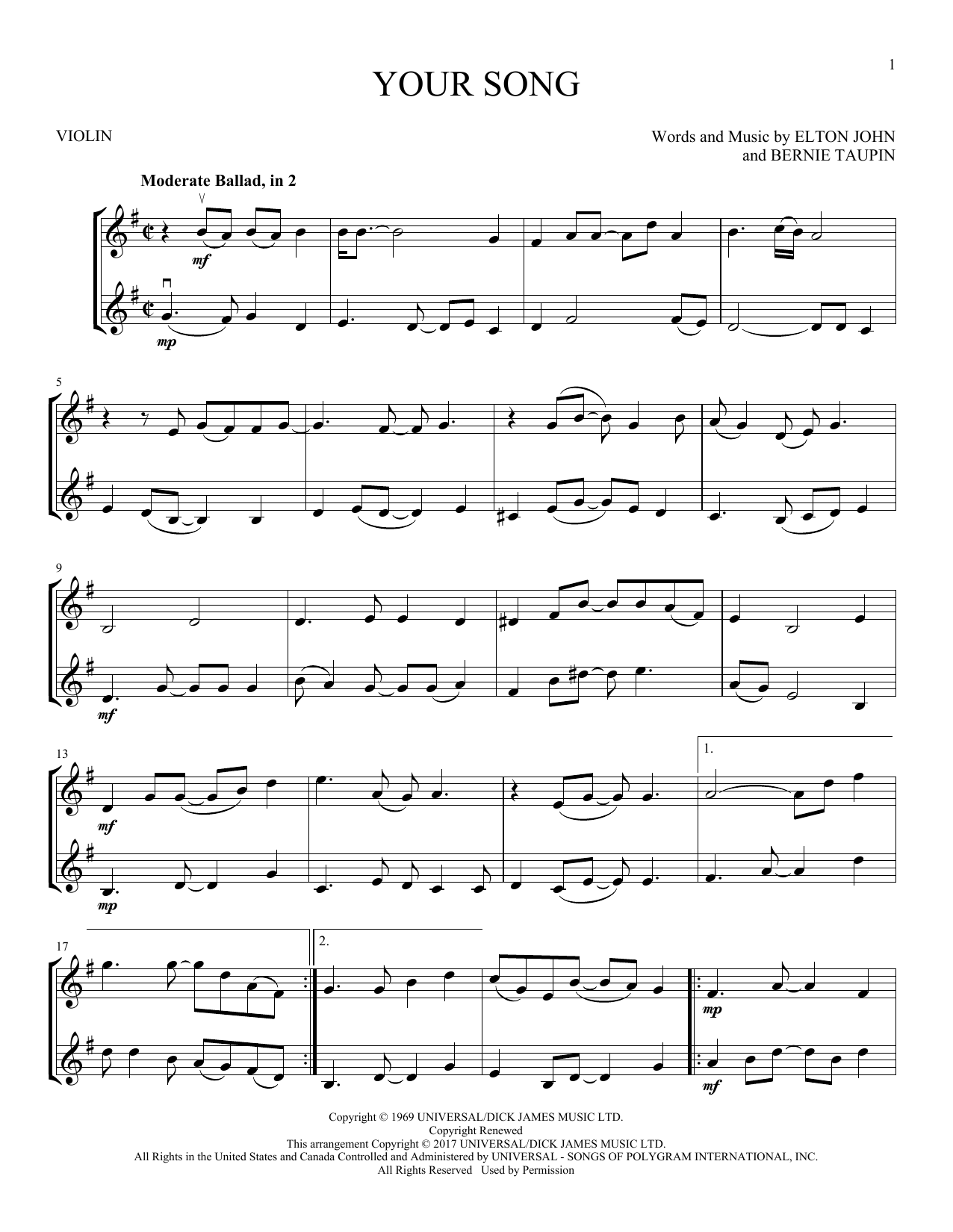
It only took about ten minutes. Think about that. While most of us struggle to write a decent grocery list in ten minutes, Bernie Taupin sat at a kitchen table in 1969 and scribbled down the lyrics to what would become one of the most enduring love songs of all time. He was nineteen. Just a teenager with some breakfast nearby and a pen in his hand. When he handed those coffee-stained lyrics to Elton John, the melody followed almost instantly. The result, Your Song by Elton John, didn’t just launch a career; it basically rewrote the rules for how a male pop star could express vulnerability without sounding like a hallmark card.
The Breakfast Table Origins of a Classic
There's a lot of mythology in rock and roll, but the story of this track is surprisingly grounded. Bernie was staying at Elton’s mother’s flat in Northwood. It wasn't some high-tech studio or a moody writing retreat. It was a mundane morning. Taupin has often said the song is "the most innocent" thing they ever wrote. You can hear that. There isn't any artifice or complex metaphor. It’s a song about someone who doesn't have much—no money, no big house—but has a song.
Elton sat down at the piano and the chords just poured out. He’s described the process as "limbic," almost like he was just a vessel for the music. If you listen closely to the original 1970 recording, you can hear that simplicity in the arrangement. Paul Buckmaster, the legendary arranger, added these sweeping strings that feel like they're lifting the song up without ever drowning out Elton’s voice. It was recorded at Trident Studios in London, a place where the air was thick with the creative energy of the era.
Why Your Song by Elton John Still Hits Different
Why does it work? Seriously. If you look at the lyrics on paper, they're almost clumsy. Lines like "If I was a sculptor, but then again, no" are objectively a bit awkward. But that’s the magic. It feels like a real person trying to find the words. It feels like a messy, honest attempt at a compliment. In a world of over-polished pop, that "but then again, no" is the most human moment in the history of Top 40 radio.
It’s about the "I." The perspective is so intimate. When Elton sings, he isn't performing for a stadium—even though he eventually would for five decades—he’s singing to one person. It’s a conversation.
Interestingly, it wasn't even the "A-side" at first. It was originally the B-side to "Take Me to the Pilot." But DJs, being the tastemakers they were back then, realized they were sitting on something much bigger. They started flipping the record over. The public reacted immediately. It peaked at number eight on the Billboard Hot 100 in the US and number seven in the UK, but charts don't really measure the cultural weight of this thing.
The Technical Brilliance Behind the Simplicity
Musicians often overlook how difficult it is to play Your Song by Elton John correctly. The piano part is a masterclass in gospel-inflected folk-pop. It uses these beautiful, descending bass lines and subtle suspended chords that create a sense of longing. It’s in the key of E-flat major, which gives it a warm, rich tone that suits Elton's early-seventies baritone-tenor range perfectly.
- The Piano: It’s an acoustic upright, not a grand, which adds to the "demo" feel.
- The Vocals: Elton’s delivery is incredibly restrained compared to his later, more flamboyant years. There are no vocal gymnastics.
- The Bridge: The shift into "And you can tell everybody this is your song" is one of the most satisfying melodic payoffs in music history.
A lot of people forget that John Lennon actually praised it early on. He famously said it was the "first new thing that's happened since we [The Beatles] happened." That’s high praise from a man who wasn't exactly known for handing out compliments like candy.
Misconceptions and Covers
People often think this was Elton's first single. It wasn't. He’d released "I've Been Loving You" and "Lady Samantha" before this, and they didn't exactly set the world on fire. He was a struggling songwriter-for-hire before this track changed his trajectory.
Then there are the covers. Everyone from Rod Stewart to Lady Gaga to Ellie Goulding has taken a crack at it. Most of them fail because they try to make it too "big." They add too much vibrato or too many synthesizers. Ewan McGregor’s version in Moulin Rouge! worked because it leaned into the theatricality of the movie, but it still lacked that quiet, slightly insecure British charm of the original.
The Long-Term Impact on Elton’s Career
This song is the cornerstone of Elton John's "Farewell Yellow Brick Road" sets for a reason. It’s the anchor. He’s played it thousands of times, yet he’s gone on record saying he never gets tired of it. That’s rare. Most artists grow to loathe their biggest hits (think Radiohead and "Creep"). But there is something so fundamentally "good" about the structure of this song that it doesn't wear out.
It also solidified the partnership between John and Taupin. It proved that their "separate but equal" writing style—where Bernie writes lyrics in a room and Elton sets them to music later—wasn't just a quirk, but a powerhouse method for creating timeless art.
How to Truly Appreciate the Track Today
If you want to experience the song properly, don't just listen to a low-bitrate stream on your phone speakers. Find a high-quality vinyl press or a lossless digital file. Listen for the way the bass enters in the second verse. It’s subtle, played by Dave Glover, and it grounds the whole track.
Pay attention to the background vocals too. They’re layered in a way that feels like a choir is slowly forming behind Elton as he gains confidence in his message. It’s a journey from a lonely bedroom to a shared experience.
Actionable Takeaways for Music Fans
- Study the Lyrics: If you're a writer, look at how Bernie Taupin uses "self-correction" in the lyrics to build character. It's a brilliant technique.
- Listen to the "Elton John" Album: Don't just stop at the hit. The entire 1970 self-titled album is a masterclass in early 70s singer-songwriter production.
- Watch the Live 1970 Performances: Look up the BBC sessions or the Troubadour recordings. Seeing Elton perform this before he became a global superstar shows the raw power of the composition without the costumes and glasses.
- Check Out the Taron Egerton Version: From the Rocketman biopic. It gives a great cinematic context to how the song felt like a lightning bolt moment for the duo.
Basically, the song is a reminder that you don't need a million-dollar budget or a team of twenty co-writers to make something that lasts forever. You just need a kitchen table, a piano, and something honest to say.
The best way to understand the legacy of this music is to simply sit with it. Forget the decades of radio play. Forget the commercials. Just listen to that opening piano riff and the first line. It’s as close to perfect as pop music gets.



