You probably think of your "abs" as that one vertical slab of muscle people flex in bathroom selfies. But that's just the surface. If you really want to understand how your body moves—how you swing a golf club, carry a heavy grocery bag, or even just breathe during a jog—you have to look at the sides. You have to look at the oblique muscle.
Honestly, it's not just one muscle. It's a complex, layered system of fibers that wrap around your torso like a high-tech corset. They are the unsung heroes of your core. Without them, you’d basically be a floppy noodle.
So, What Exactly Is an Oblique Muscle?
Most people use the term in the singular, but you’ve actually got two distinct sets on each side of your abdomen: the external obliques and the internal obliques.
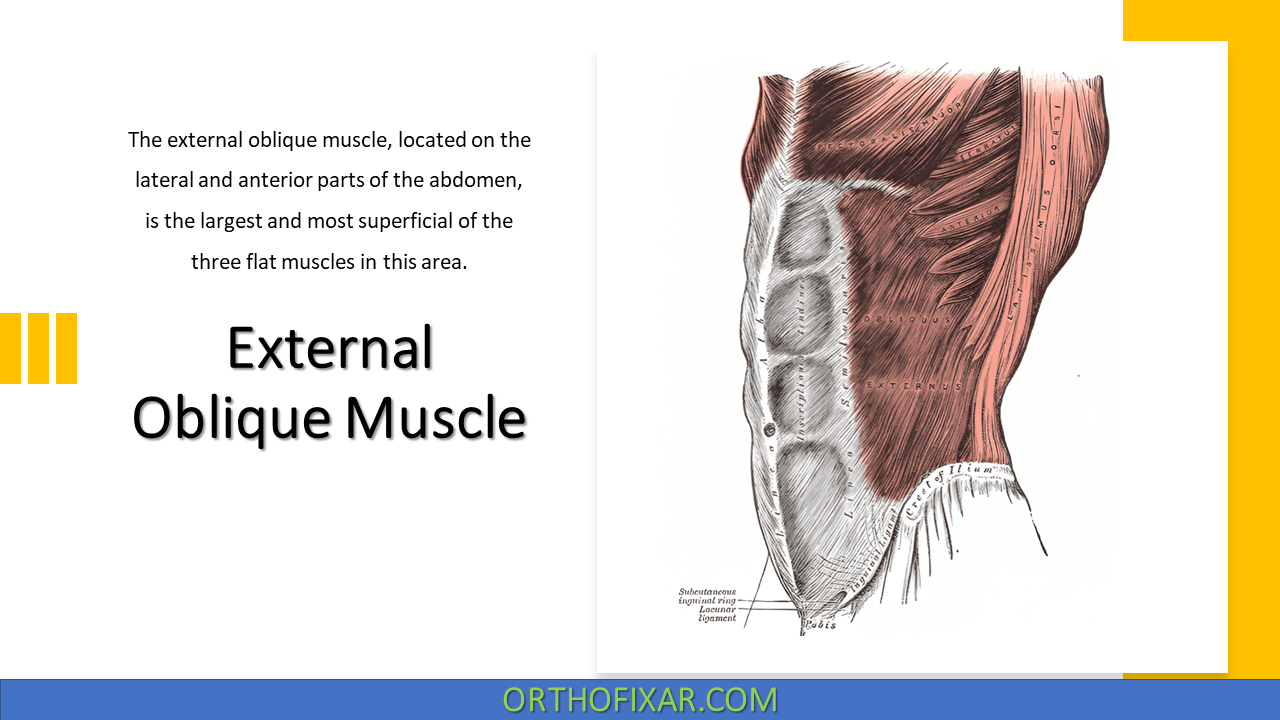
The external oblique muscle is the one you can sometimes see. It's the outermost layer, running diagonally downward from your lower ribs toward your pelvis. Think of the "V-cut" look that athletes often have; those are the externals. Just beneath those lies the internal oblique muscle. These fibers run in the opposite direction, creating a sort of "X" pattern when layered together. This crisscross structure is a masterpiece of biological engineering. It provides incredible stability while allowing for a massive range of motion.
The Biomechanics of Twisting and Shouting
Why do we have them? Stability is the short answer. But the long answer is much more interesting.
The oblique muscle is responsible for three primary movements:
- Lateral Flexion: This is just a fancy way of saying "bending sideways." When you reach down to pick up a sock you dropped without bending your knees, your obliques are doing the heavy lifting.
- Rotation: Every time you turn your torso to look behind you while backing up a car, your obliques are firing. Specifically, when you rotate to the right, your left external oblique and your right internal oblique work together as a team. It's a cross-body synergy.
- Compression: They help hold your guts in. Literally. Along with the transverse abdominis, your obliques create intra-abdominal pressure. This is vital for everything from forceful exhales to protecting your spine when you lift something heavy.
Dr. Stuart McGill, a world-renowned expert in spine biomechanics at the University of Waterloo, has spent decades studying how these muscles protect the back. He often points out that a "stiff" core—one where the obliques are properly engaged—is the best defense against herniated discs. If your obliques are weak, your spine takes the brunt of every twist and turn. That's a recipe for disaster.
The "Side Ache" Mystery
Ever gone for a run and felt a sharp, stabbing pain in your side? People call it a "side stitch." For a long time, scientists weren't entirely sure what caused it.
Some thought it was lack of blood flow to the diaphragm. Others blamed the ligaments tugging on internal organs. However, recent research suggests it might be related to the parietal peritoneum—a membrane that lines the abdominal cavity. When your oblique muscle gets fatigued, your posture slumps, and this membrane gets irritated. It’s basically your body’s way of screaming at you to stabilize your core.
Beyond the Six-Pack: The Health Impact
We live in a culture obsessed with the "rectus abdominis"—the six-pack muscle. But focusing only on the front is a mistake. It leads to muscular imbalances.
If you have a strong front but weak obliques, you might find yourself dealing with chronic lower back pain. Why? Because the oblique muscle attaches to the thoracolumbar fascia, a thick web of connective tissue in your lower back. When the obliques are strong, they "tug" on this fascia, creating a natural weightlifting belt that keeps your vertebrae aligned.
Furthermore, athletes in rotational sports—baseball, tennis, golf—rely almost entirely on their obliques for power. A home run isn't just arm strength. It's the explosive energy transferred from the ground, through the legs, and whipped around by the obliques.
Training the Oblique Muscle Without Wrecking Your Back
Most people head straight for the "side crunch" or those weighted side bends. Stop. Just stop.
While those exercises do technically target the muscle, they often put unnecessary lateral shear on the spine. If you want to train your oblique muscle like a pro, you should focus on "anti-rotation." This means teaching the muscle to resist movement, which is its primary job in real life.
- The Pallof Press: Stand sideways to a cable machine or a resistance band. Hold the handle at your chest and press it straight out in front of you. The band will try to pull your torso toward the machine. Your obliques have to fight to keep you centered. It looks easy. It feels like your sides are on fire.
- Suitcase Carries: Pick up one heavy dumbbell in one hand. Now, walk 40 yards. Keep your torso perfectly upright. Don't let the weight pull you to the side. That's your oblique muscle working in a functional, real-world way.
- Woodchoppers: These are great for rotation, but you have to keep your hips relatively stable. The movement should come from the core, not just swinging your arms.
Common Misconceptions and Errors
Let's clear the air on "spot reduction." You cannot burn fat specifically off your "love handles" by doing a thousand oblique twists. It’s a physiological impossibility. Your body burns fat from wherever it wants based on genetics and overall caloric deficit.
Building a massive oblique muscle can actually make your waist look wider. If your goal is a classic "V-taper" aesthetic, you want strong obliques, but you don't necessarily want to hypertrophy them to the point of bulging. It’s a balance. You want the tone and the functional strength without adding inches to your waistline if aesthetics are your main concern.
Another mistake? Breath holding. Many people "brace" by holding their breath, which increases blood pressure. Instead, you should learn "bracing" while breathing—using the obliques to maintain tension even as the ribs expand and contract.
The Connection to Breathing and Digestion
It sounds weird, but your oblique muscle helps you breathe. They are "expiratory" muscles. When you need to push air out quickly—like when you're blowing out candles or coughing—the obliques contract to pull the ribs down and push the diaphragm up.
They also play a role in digestion. By maintaining abdominal pressure, they help move things through your digestive tract. Weak core muscles can sometimes contribute to sluggish digestion or even issues like stress incontinence because the "container" for your internal organs isn't as tight as it should be.
Moving Forward with Better Core Health
If you're looking to improve your core, stop thinking about crunches. Start thinking about stability.
Assess your current state. Stand in front of a mirror and try to tilt your pelvis forward and backward. Then try to shift your ribcage side to side without moving your hips. If you struggle with this, your mind-muscle connection with your oblique muscle is likely weak.
Prioritize functional movements. Incorporate carries and anti-rotation holds into your routine twice a week. You don't need a dedicated "oblique day." Just add a few sets of suitcase carries at the end of your leg day.
Watch your posture. If you sit at a desk all day, your obliques tend to "turn off." Every hour, stand up, reach for the ceiling, and then do a slow, controlled twist to each side. It re-engages the nervous system.
Focus on the "X." Remember that the internal and external fibers run in opposite directions. To hit them all, you need a variety of angles. Don't just do one exercise and call it a day.
Strength isn't just about what you can see in the mirror. It's about how your body handles the world. By taking care of your oblique muscle, you're protecting your spine, increasing your athletic power, and ensuring you can move comfortably well into your later years. It’s not just a muscle; it’s your body’s structural foundation.
Actionable Steps for Oblique Health
- Audit Your Routine: Remove high-rep weighted side bends that cause spinal pinching; replace them with the Pallof Press or Farmer’s Carries.
- Practice Active Bracing: Throughout the day, imagine someone is about to poke you in the side. That slight "tensing" is your obliques engaging—try to hold that for 10 seconds while breathing normally.
- Integrate Unilateral Movements: Start doing single-arm overhead presses or single-leg lunges. These forces your obliques to fire instinctively to keep you from falling over.
- Stretch the Lateral Line: Use "half-moon" stretches or side-lying reaches to ensure the fascia around the muscles doesn't become chronically tight, which can limit your breathing capacity.
/i.s3.glbimg.com/v1/AUTH_08fbf48bc0524877943fe86e43087e7a/internal_photos/bs/2025/H/e/ewwgKCQCSopdUJUwy6DA/imagem-2025-04-27-114802986.png)


