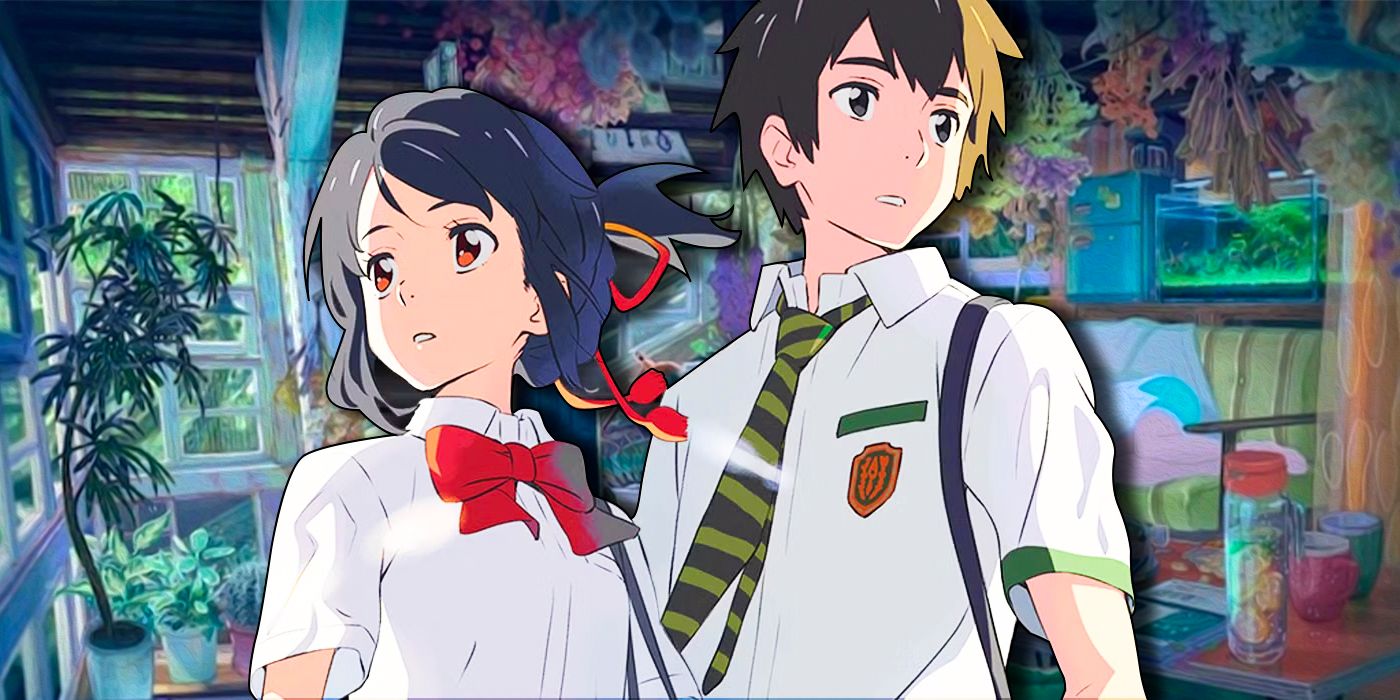
If you haven't seen the anime movie Your Name, you've probably at least seen that one shot of the two comets streaking across a twilight sky. It's everywhere. It is the kind of movie that makes you feel nostalgic for a place you’ve never been and a person you’ve never met. Honestly, when Makoto Shinkai released Kimi no Na wa back in 2016, nobody—not even the distributors at Toho—expected it to become a global juggernaut that would eventually rival Studio Ghibli’s box office records. It’s a story about Mitsuha, a girl in the rural town of Itomori, and Taki, a boy in the hyper-neon rush of Tokyo, who start waking up in each other's bodies. Sounds like a standard trope, right? Wrong.
It starts as a comedy. It ends as a cosmic gut-punch.
The Your Name Phenomenon: More Than Just Pretty Clouds
People usually talk about the "Shinkai aesthetic." You know the one—overly detailed train tracks, rain hitting puddles in 4K, and lighting so soft it looks like a dream. But the anime movie Your Name didn't become the third highest-grossing anime film of all time just because it looked good. It tapped into a very specific Japanese trauma while wrapping it in a universal "red string of fate" romance.
Think about the timeline. The movie came out five years after the 2011 Great East Japan Earthquake and Tsunami. When the comet Tiamat splits in the film and threatens a small town, Japanese audiences weren't just watching a sci-fi plot point; they were reliving a collective national memory of sudden, inexplicable loss. Shinkai has actually mentioned in interviews with outlets like The Japan Times that he wanted to create a story where a catastrophe could be averted, a sort of cinematic wish-fulfillment for a mourning nation.
Why the body-swap works here (and fails elsewhere)
Usually, body-swap movies like Freaky Friday are about "walking a mile in someone else's shoes" to learn a moral lesson. In the anime movie Your Name, the swap is a bridge across time and space. Mitsuha is bored of her shrine-maiden life. She literally screams into the void that she wants to be a handsome boy in Tokyo in her next life. Taki, meanwhile, is a frustrated architecture student (or at least he wants to be) who is disconnected from the world around him.
The brilliance is in the mundane details. Taki-as-Mitsuha makes her popular at school by being assertive. Mitsuha-as-Taki helps him get a date with his crush, Okudera-senpai, by being sensitive. They leave notes on each other's phones. They set rules. It's cute. It's lighthearted. And then, suddenly, the swaps stop.
The Twist That Everyone Forgets to Mention
When Taki tries to find Mitsuha, the movie shifts genres entirely. This is where most casual viewers get confused. He travels to the countryside only to discover that Itomori—the town he’s been "living" in—was destroyed by a comet fragment three years ago. Mitsuha has been dead the whole time he was swapping with her.
This is the "Musubi" concept the grandmother, Hitoha, explains earlier in the film. Musubi is the flow of time, the joining of people, and the braiding of cords. It’s why the film focuses so much on the kumihimo (braided silk cords) Mitsuha makes. They represent the literal fabric of time. Taki isn't just swapping bodies; he's swapping across a three-year temporal gap.
Most people think the movie is just a romance. It’s actually a heist movie where the prize is a town full of people who shouldn't exist anymore.
Breaking Down the Visual Language
Shinkai’s team at CoMix Wave Films used a mix of traditional hand-drawn animation and heavy digital compositing. If you look closely at the Tokyo scenes, the reflections on the skyscrapers are almost photorealistic. This wasn't just for "flexing." It creates a contrast between the "solid" reality of Tokyo and the "fading" memory of Itomori.
- The Colors: Notice how the comet is always depicted in teals and pinks. These colors are unnatural. They don't belong in the orange-and-blue sunset palette of the rest of the film.
- The Framing: Taki and Mitsuha are constantly separated by physical barriers—train doors, windows, or the literal edges of the frame.
- The Sound: You cannot talk about the anime movie Your Name without the band RADWIMPS. Yojiro Noda, the lead singer, wrote the music alongside the script’s development. The lyrics of "Sparkle" and "Zenzenzense" aren't just background noise; they provide the internal monologue that the characters are too shy to say out loud.
Common Misconceptions: Is It a Loop?
I’ve seen a lot of theories online claiming the movie is a time loop. It’s not. It’s a singular timeline that gets "overwritten." Think of it like a VHS tape where Taki manages to record over the tragedy of the past. When they meet on the stairs at the very end, they don't remember each other's names, but their souls recognize the "Musubi" connection.
Some critics argue the ending is too happy. They say it cheapens the tragedy. But if you look at Shinkai’s earlier work, like 5 Centimeters per Second, he’s famous for depressing, "realistic" endings where the lovers never meet. For Your Name, he intentionally chose hope. He felt that after 2011, the world needed to see two people actually find what they were looking for.
Why You Should Care Today
Even years later, the anime movie Your Name remains a gateway drug for people who "don't watch anime." It’s a masterclass in pacing. The way it handles the transition from comedy to supernatural thriller is seamless. It also captures the specific anxiety of the smartphone era—how we are more connected than ever, yet still feel incredibly lonely.
The film deals with the fear of forgetting. We've all had those dreams that feel life-changingly important, only to have them evaporate the moment we open our eyes. That’s the core of Taki and Mitsuha’s struggle. Writing "I love you" on a hand instead of a name is a desperate, flawed attempt to hold onto a feeling when the facts are slipping away. It's devastatingly human.
How to Experience the Story Fully
If you’ve already seen the movie once, watch it again and pay attention to the dates on the phones. The clues about the three-year gap are there from the very first swap.
- Watch the "Another Side: Earthbound" Light Novel: This book tells the story from the perspective of the side characters, like Mitsuha's father. It explains why he was so stern and how his own grief tied into the town's history.
- Visit the Real Locations: If you’re ever in Tokyo, the Suga Shrine staircase (the red railing stairs) is a real place in Shinjuku. Standing there makes you realize how much Shinkai loves the geometry of the city.
- Check out Weathering With You: There is a brief cameo of Taki and Mitsuha in Shinkai’s follow-up film. It confirms they stayed together in the new timeline.
The anime movie Your Name isn't just a film; it’s a mood. It's the feeling of looking for something—or someone—without knowing what it is. And honestly, isn't that just what being alive feels like most of the time?
To get the most out of your next rewatch, try to find the 4K Blu-ray version. The HDR makes the twilight scenes (Kataware-doki) look significantly more vibrant than the streaming versions on Netflix or Crunchyroll. Pay close attention to the opening sequence—it's essentially the entire movie compressed into two minutes, but you only understand the symbols once you've seen the ending. Skip the English dub for your first viewing if you can; the Japanese voice acting by Ryunosuke Kamiki and Mone Kamishiraishi carries a rhythmic quality that matches the RADWIMPS soundtrack perfectly.



