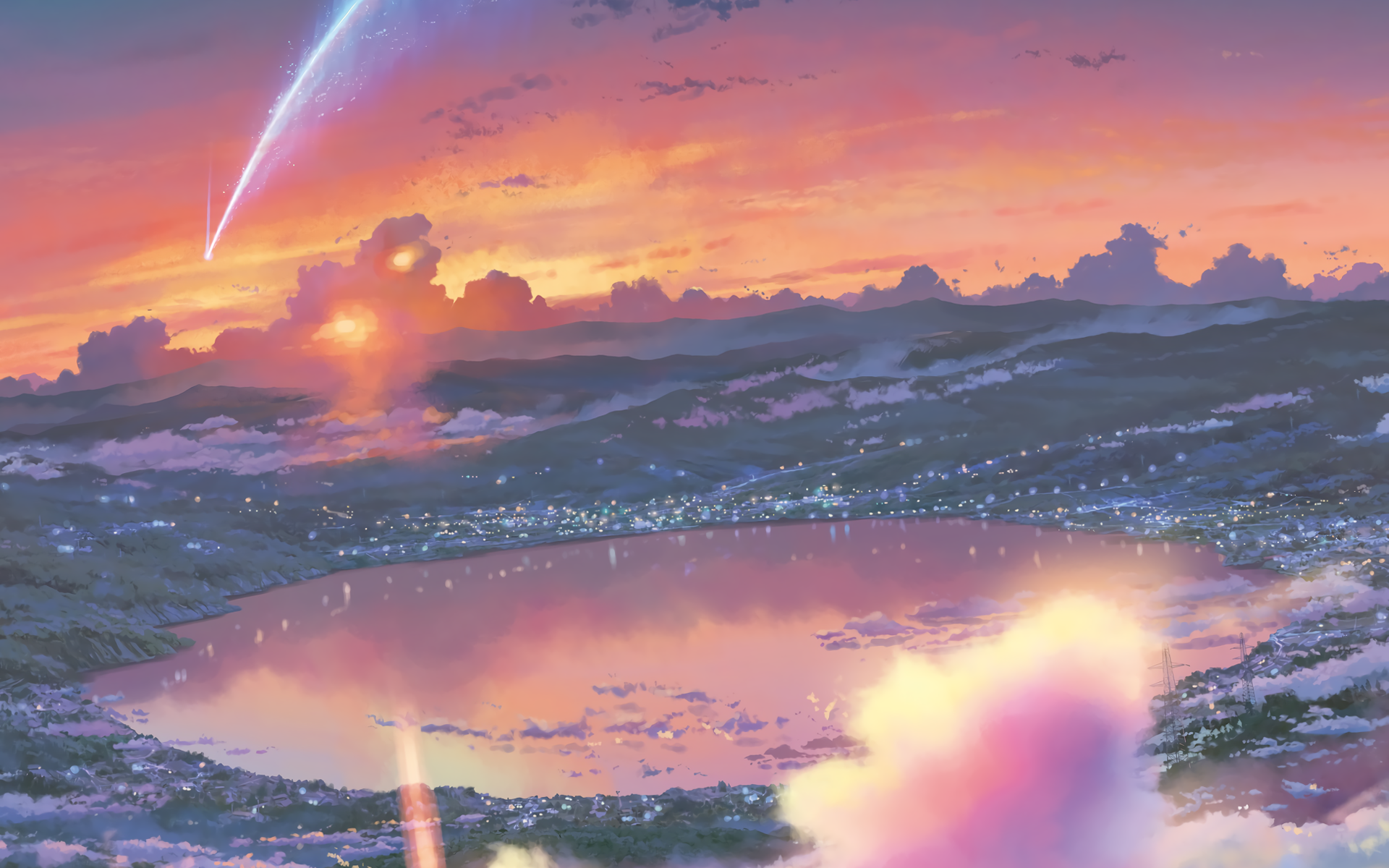
It's been years since Your Name (Kimi no Na wa) first dropped, and honestly, the world hasn't really been the same for anime fans. You've probably seen the posters. Two teenagers. A massive, glittering comet. A sense of longing that feels almost physically painful. But what is Your Name actually about? If you strip away the gorgeous Makoto Shinkai animation and the Radwimps soundtrack, you’re left with a story that’s fundamentally about how we connect with people we haven't even met yet. It’s a body-swap comedy that pivots into a supernatural disaster movie, and eventually, a meditation on memory.
The plot follows Mitsuha Miyamizu, a high school girl living in the rural, shrine-heavy town of Itomori, and Taki Tachibana, a boy working part-time at an Italian restaurant in the middle of Tokyo. They start waking up in each other's bodies. At first, it's just chaos. Taki (as Mitsuha) stands up to bullies and makes her popular; Mitsuha (as Taki) manages to land him a date with his crush, Okudera-senpai. It feels like a standard "Freaky Friday" setup. Until it isn't.
The Twist That Changed Everything
About halfway through, the movie pulls the rug out from under you. Taki realizes the body-swapping has stopped. He goes on a journey to find Itomori, only to discover that the town was destroyed by a fragment of Comet Tiamat three years ago. Mitsuha is dead. Or rather, she was dead. This is where the movie gets complicated and beautiful. The "red string of fate" isn't just a metaphor here; it's a literal connection across time.
The timeline is fractured. Taki and Mitsuha weren't just swapping across space; they were swapping across a three-year time gap. This revelation recontextualizes every single interaction they had. When Taki drinks the kuchikamizake (sake made from fermented rice chewed by a shrine maiden) in the hidden mountain shrine, he’s attempting to reconnect with Mitsuha’s soul. He’s reaching back through time to save a girl who is already gone.
Musubi and the Philosophy of Connection
The film leans heavily on the concept of Musubi. Mitsuha’s grandmother, Hitoha, explains this early on. She says that joining threads is Musubi. People connecting is Musubi. The flow of time is Musubi.
Basically, everything is tied together.
In Japanese culture, the concept of En (fate or karma) plays a huge role in how relationships are viewed. Shinkai uses the physical act of braiding cords (kumihimo) to visualize this. When Taki and Mitsuha meet at the rim of the crater during kataware-doki (twilight), the time when the boundaries between worlds blur, it’s the climax of these threads finally intertwining. It’s brief. It’s fleeting. Then, the sun sets, and they forget each other’s names.
Why Do We Keep Crying?
Seriously. Why?
It’s the forgetting. That’s the most human part of Your Name. We’ve all had that feeling—waking up from a dream that felt like an entire lifetime, only to have the details slip through our fingers like sand the moment we try to remember them. Taki and Mitsuha spend the final act of the movie desperately trying to hold onto a name they can't quite grasp.
The film also resonates because of the real-world trauma it echoes. Shinkai has been vocal about how the 2011 Great East Japan Earthquake influenced his work. The idea of a peaceful town suddenly being erased from the map by a natural disaster isn't just "anime stakes." It’s a shared cultural memory. By saving Itomori in the film, Shinkai provides a sort of catharsis—a way to rewrite a tragedy through the power of human connection.
Many people compare it to Shinkai's earlier work, 5 Centimeters per Second. That movie was famously depressing because the characters drifted apart and stayed apart. Your Name feels like Shinkai’s response to his own cynicism. It’s hopeful. Even when they forget, the feeling remains. The heart remembers what the brain can’t process.
The Technical Magic of CoMix Wave Films
We can't talk about what this movie is about without mentioning how it looks. The lighting is a character in itself. Sunlight filtering through train windows, the way the comet's tail glows with toxic beauty, the hyper-detailed Tokyo skylines—it all serves to ground the supernatural elements in a world that feels more real than our own.
The animation team at CoMix Wave Films used a mix of traditional hand-drawn techniques and digital composting that set a new standard for the industry. It’s not just "pretty." The contrast between the lush, green, organic lines of Itomori and the sharp, steel-and-glass geometry of Tokyo reflects the internal states of the characters. Mitsuha longs for the city; Taki finds peace in the country. They are two halves of a whole, searching for a place (and a person) they can't quite identify.
Cultural Impact and Global Reach
When Your Name was released in 2016, it became a massive phenomenon. It wasn't just a hit in Japan; it became the highest-grossing anime film worldwide at the time, eventually surpassed only by Demon Slayer: Mugen Train.
Why did it travel so well?
Because the "searching for something/someone" trope is universal. You don't need to know Japanese history or Shinto rituals to understand the ache of missing someone you haven't met. It tapped into a global loneliness. In an era where we are more connected than ever through screens, the film suggests that true connection requires a piece of your soul. Or at least a very long train ride and a willingness to look crazy in public.
Common Misconceptions About the Ending
Some folks walk away from the movie feeling like the ending is a bit of a cop-out. They meet on the stairs in Suga, Tokyo, and ask for each other's names. "Happily ever after," right?
Not exactly.
The ending is bittersweet because they’ve lost years of their lives. They don't have the memories of their adventure. They don't remember the comet, the body-swapping, or the mountain shrine. They only have a nagging feeling that they are looking for someone. When they finally speak, it’s a gamble. It’s an act of faith. They are starting from zero. That’s not a "cheap" happy ending; it’s a testament to the idea that some bonds are so strong they survive even when the mind fails.
Actionable Takeaways for the Viewer
If you’re planning on watching Your Name for the first time, or the tenth, here is how to actually get the most out of the experience:
- Watch it on the biggest screen possible. The scale of the comet sequence is lost on a phone. The background art is filled with Easter eggs, including a cameo from the protagonist of Shinkai's previous film, The Garden of Words.
- Pay attention to the cords. The red braided cord Mitsuha wears is the literal "red string of fate." Watch how it moves between characters throughout the movie. It’s the visual map of the plot.
- Listen to the lyrics. The Radwimps didn't just provide background music; they wrote the songs based on the script. Songs like "Zenzenzense" and "Sparkle" provide massive amounts of context for the characters' internal feelings.
- Research the concept of "Kataware-doki." Understanding the "hour of blurring" makes the mountaintop scene significantly more impactful. It’s rooted in old Japanese dialect and folklore regarding the transition between day and night.
Your Name isn't just a movie about a comet or a body swap. It's a story about the effort it takes to remember what truly matters in a world that is constantly trying to make us forget. It's about the fact that even if the world ends, we might still find a way to grab a coffee together in Tokyo a few years later. And honestly? That's a pretty comforting thought.
Check out Shinkai's follow-up films, Weathering With You and Suzume, if you want to see how he continues to play with these themes of environmental disaster and human connection. Each one adds a new layer to the "Shinkai-verse," but Your Name remains the gold standard for a reason.



