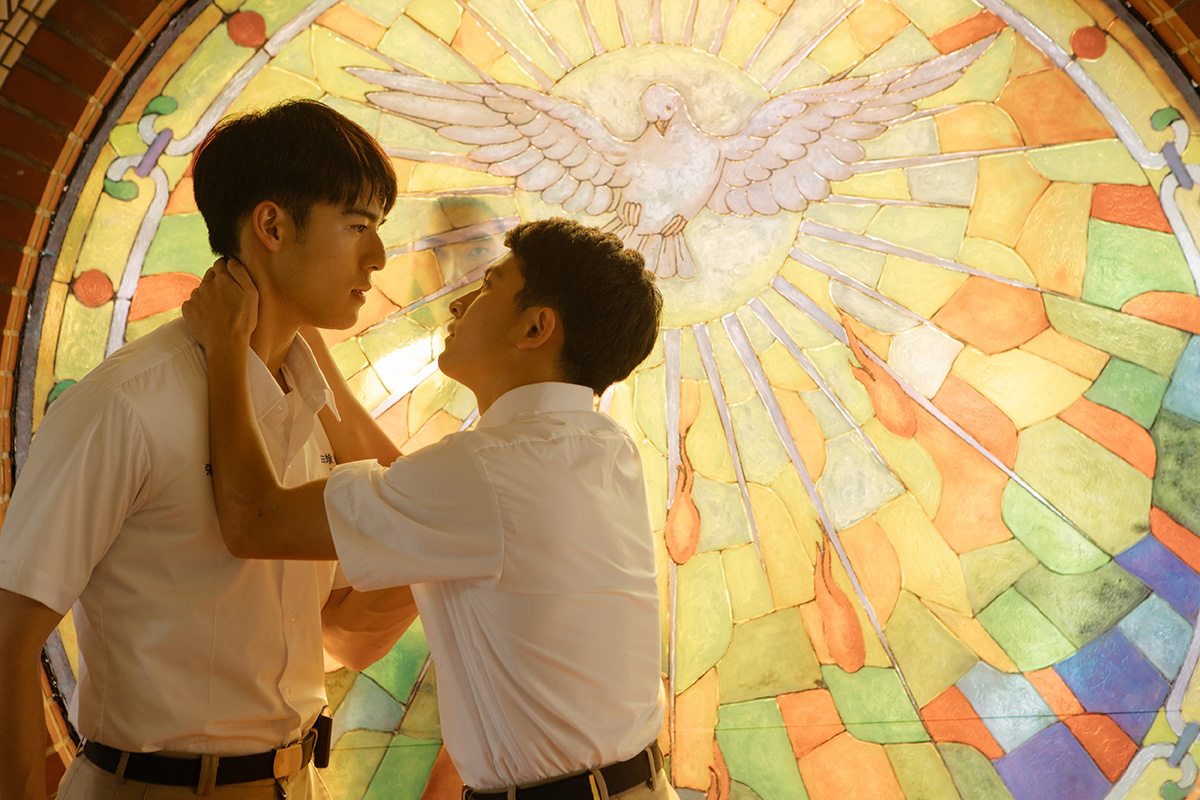
If you’ve spent any time scrolling through Netflix’s international library, you’ve probably seen the poster for Your Name Engraved Herein. It looks like a standard, gauzy coming-of-age flick. Two boys, summer heat, 1980s nostalgia. But honestly, it’s a lot more than just a "Taiwanese Call Me By Your Name." When it dropped in 2020, it didn’t just become a hit; it became the highest-grossing LGBTQ+ film in Taiwan’s history. That's a huge deal.
It’s raw. It’s loud. It’s messy.
The story follows A-Han and Birdy. They’re students at a Catholic high school right as Taiwan is transitioning out of Martial Law in 1987. You’d think the end of a decades-long military grip would mean instant freedom, but the movie shows how culture takes a lot longer to catch up than the law. While the country is screaming for democracy, these two are suffocating under the weight of "propriety" and religious guilt.
What Your Name Engraved Herein Gets Right About Memory
Director Patrick Kuang-Hui Liu didn't just pull this story out of thin air. He based it on his own life. That’s probably why the movie feels so lived-in. When A-Han, played by Edward Chen, stares at Birdy (Tseng Jing-hua) with that look of pure, agonizing desperation, it doesn’t feel like "acting." It feels like a memory that’s been playing on a loop for thirty years.
The film captures that specific brand of teenage obsession where every touch is electric and every silence is a rejection.
Most movies about the 80s focus on the neon and the synth-pop. This one focuses on the sweat. The humidity of Taiwan is practically a character itself. You can feel the stickiness of the dorm rooms and the heavy air of the city streets. It mirrors the internal state of the boys—they are trapped in a pressure cooker.
One of the most intense scenes happens in a shower. No, not like that. It’s a scene of emotional violence and physical frustration. A-Han helps Birdy wash his back, and the tension is so thick it’s actually uncomfortable to watch. It’s a masterclass in showing, not telling. You don’t need a monologue to understand that A-Han is terrified of his own desires.
The Historical Backdrop You Might Have Missed
To really understand Your Name Engraved Herein, you have to know a little bit about 1987 Taiwan. Martial Law ended on July 15 of that year. For 38 years, the island had been under strict social and political control.
Freedom was new. It was scary.
The school setting is crucial here. The instructors are often military men. The discipline is rigid. Birdy, the more eccentric of the two, constantly pushes against these boundaries. He’s obsessed with the movie Birdy (the 1984 Alan Parker film), which is where he gets his nickname. He wants to fly. He wants to be free. A-Han, on the other hand, is the "good boy" who just wants to fit in until his heart makes that impossible.
This isn't just a romance. It’s a snapshot of a society in flux.
The introduction of a female student into their circle later in the film acts as a catalyst. It’s painful to watch Birdy try to force himself into a "normal" heterosexual relationship to protect himself or perhaps to protect A-Han. It’s a classic trope, sure, but the cultural stakes in 1980s Taipei make it feel less like a cliché and more like a survival tactic.
The Music and the Father Oliver Factor
Let’s talk about Father Oliver. He’s the Canadian priest who runs the school band. He’s a complicated figure. On one hand, he represents the religious institution that tells A-Han his feelings are a sin. On the other, he’s a source of profound wisdom about what love actually looks like.
There’s a scene where A-Han confronts him, demanding to know if the "God is Love" message applies to him too. It’s heartbreaking.
The title song, performed by Crowd Lu, is basically the heartbeat of the movie. If you haven't heard it, go find it on YouTube. It won Best Original Film Song at the 57th Golden Horse Awards for a reason. The lyrics talk about the permanence of a name "engraved" on a heart. It’s sentimental, yeah, but in the context of the film’s ending, it’s a gut-punch.
The movie eventually jumps forward in time. We see the characters as older men. Some people hate this part. They think it ruins the "magic" of the youth story. But I’d argue it’s the most important part of Your Name Engraved Herein. It shows the long-term cost of repression. It shows that while you can move on, you never really forget the person who first woke you up to the world.
Why It Resonates Globally
Even if you didn't grow up in 80s Taiwan, the themes are universal. We’ve all had that "one" person.
The film explores the difference between professing love and living it. It also highlights the specific loneliness of being queer in a space where there isn't even a vocabulary for it yet. They don't even use the word "gay" for a large chunk of the movie. They just exist in this unnamed, terrifying space between friendship and something more.
Taiwan became the first country in Asia to legalize same-sex marriage in 2019. This movie came out a year later. It felt like a victory lap, but also a sober reminder of the generations of people who had to live their lives in secret before that law ever existed. It’s a tribute to the "invisible" people.
Common Misconceptions About the Ending
People often ask: "Do they end up together?"
That’s the wrong question. This isn't a Hallmark movie. Your Name Engraved Herein is about the impact of a person on your soul. The ending, set in modern-day Quebec, is quiet. It’s reflective. It doesn't give you the big, soaring cinematic kiss because that wouldn't be true to the characters' lives.
Instead, it gives you something better: recognition.
They see each other. They acknowledge the trauma and the beauty of what they had. It’s about the fact that even after decades, the "engraving" remains.
Actionable Insights for Viewers
If you’re planning to watch—or re-watch—this film, keep a few things in mind to get the most out of it:
- Watch for the color red. The director uses it strategically to signal passion, danger, and moments of truth.
- Research the "Birdy" (1984) references. Understanding the original film Birdy is obsessed with adds a layer of depth to his desire for escapism.
- Pay attention to the transition scenes. The way the film moves from the claustrophobic school hallways to the open rooftops says a lot about the characters' internal states.
- Don't skip the credits. The song continues to play, and the emotional resonance needs that time to settle.
- Look up the real-life inspirations. Patrick Kuang-Hui Liu has done several interviews about how much of the "telephone" scenes were pulled directly from his own teenage years.
The film is currently streaming on Netflix in most regions. It’s best watched late at night, when you’re in a mood to actually feel something. It’s not a background movie. It demands your attention.
Ultimately, the power of the story lies in its honesty. It doesn't pretend that love solves everything. It doesn't pretend that society changes overnight. It just says: "I saw you, I loved you, and you changed me forever." That's why people are still talking about it years later. It’s not just a movie; it’s a piece of someone’s heart put on screen.
To truly appreciate the nuances of the dialogue, try watching with the original Mandarin audio rather than the dub. The specific ways A-Han and Birdy address each other—the shifts in tone and the use of slang—carry a weight that translation often flattens. Understanding the "vibe" is just as important as understanding the plot.
Practical Next Steps:
- Contextualize the History: Briefly read up on the White Terror period in Taiwan to understand why the school atmosphere is so oppressive.
- Listen to the Soundtrack: Find Crowd Lu’s "Your Name Engraved Herein" on a streaming platform; it provides a perfect emotional bridge to the film’s themes.
- Watch the "Making Of" clips: If available, look for interviews with Edward Chen and Tseng Jing-hua to see how they built their chemistry, which was largely through immersive acting exercises.
- Explore the Genre: If this hits home, look into other "New Taiwan Cinema" works from directors like Edward Yang, who heavily influenced this style of storytelling.
This film is a heavy lift emotionally, but it’s worth the weight. It reminds us that even when the world tries to erase us, the marks we leave on each other are permanent.



