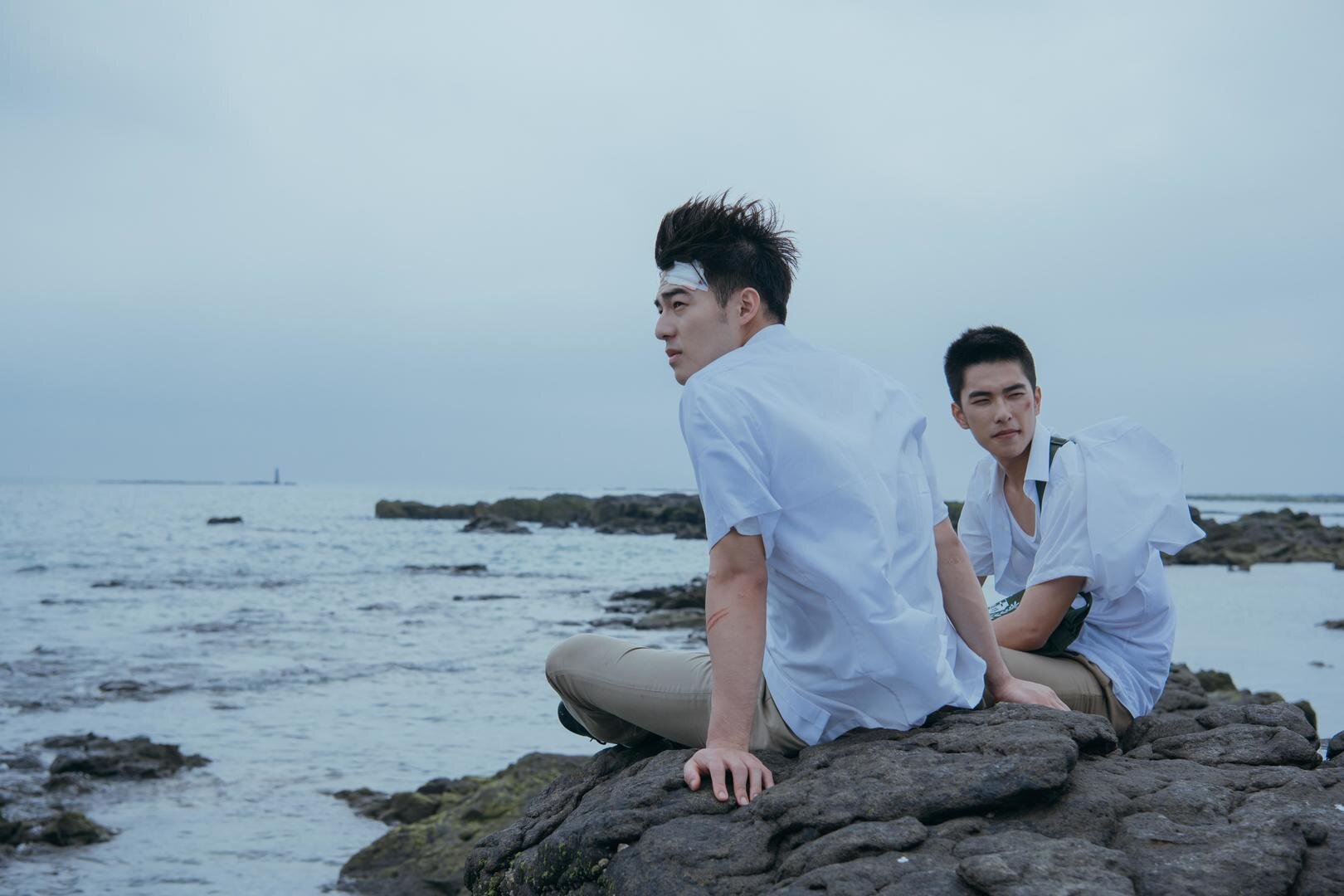
If you’ve spent any time on Netflix’s international charts over the last few years, you’ve probably seen the poster. Two boys in school uniforms. One is looking at the camera; the other is looking away. It looks like a standard coming-of-age flick. It isn't. Your Name Engraved Herein (originally K刻在你心底的名字) became a massive cultural phenomenon in Taiwan back in 2020, eventually becoming the highest-grossing LGBTQ+ film in the country's history. But its legacy isn't just about box office numbers or breaking records.
It’s about the ache.
The story follows Jia-han (played by Edward Chen) and Birdy (Tseng Jing-hua) in 1987. This was a pivotal year. Taiwan had just ended decades of martial law. You’d think that meant instant freedom, right? Wrong. The social structures didn't just evaporate overnight. The school system was still rigid, the military influence was everywhere, and being gay was still a radical, dangerous "transgression."
Honestly, the chemistry between the leads is what carries the whole thing. It’s messy. It's sweaty. It feels like high school. Director Patrick Kuang-Hui Liu based much of this on his own life, and you can tell. It doesn't feel like a polished Hollywood romance where everyone says the right thing at the right time. They scream. They cry in showers. They hurt each other because they don't have the vocabulary to do anything else.
What Your Name Engraved Herein Gets Right About 1987
Most period pieces feel like they're trying too hard to show off the costumes. Here, the setting is a character. The transition from martial law to a "free" Taiwan is a slow, painful grind. You see it in the way the teachers interact with the students. The strictness is still there, but the edges are starting to fray.
Birdy is named after the 1984 Alan Parker film Birdy. He’s the eccentric one. He jumps off balconies and starts fights. He’s trying to find a way to exist in a world that wants him to stand in a straight line. Jia-han is the opposite. He’s the observer. He’s the one who internalizes everything until he’s basically vibrating with anxiety.
The film captures a very specific type of loneliness. It’s the loneliness of being in a crowded room—or a crowded dormitory—and knowing that if you spoke your truth, the room would turn on you. There’s a scene where they go to Taipei to mourn the death of President Chiang Ching-kuo. It’s a massive historical moment, but for the boys, it’s just an excuse to be together in a city that feels slightly more anonymous than their boarding school.
The Religious Tension and Father Oliver
One of the most grounded parts of the movie involves Father Oliver, played by Fabio Grangeon. He’s the school priest and band conductor. Jia-han goes to him for confession, and these scenes are basically the emotional backbone of the film.
Jia-han asks, "Does God forgive those who love?"
It’s a heavy question. But the movie doesn't treat the church as a cartoonish villain. Father Oliver is nuanced. He’s a foreigner in Taiwan, dealing with his own layers of isolation. He understands Jia-han more than the boy realizes. These conversations highlight the conflict between spiritual faith and the institutional rules that often stifle it. It’s a recurring theme in Taiwanese cinema—this intersection of traditional values and the creeping influence of Western thought.
That Ending: The 30-Year Jump
People have strong opinions about the final act. We jump forward three decades to present-day Canada (and partially back to Taiwan). Some viewers find it jarring. They want the boys to stay young forever. But the time jump is necessary. It shows the cost of silence.
By showing the older versions of the characters, the film moves from a "teen romance" into a meditation on lost time. It connects the 1980s struggle to the modern day, where Taiwan became the first place in Asia to legalize same-sex marriage in 2019. Seeing them as older men—navigating a world that finally accepts them while carrying the scars of a world that didn't—is heartbreaking.
It’s about the "what ifs."
What if they had been born twenty years later? What if they hadn't been so afraid? The movie doesn't give you a perfect, tidy bow. It gives you a conversation on a cold street in Quebec. It’s quiet. It’s a bit awkward. It’s real.
Production Secrets and the Theme Song
You can’t talk about Your Name Engraved Herein without mentioning the song. Crowd Lu’s "Your Name Engraved Herein" (刻在你心底的名字) is everywhere. It won Best Original Film Song at the 57th Golden Horse Awards. The lyrics are essentially the internal monologue Jia-han couldn't say out loud.
- Edward Chen and Tseng Jing-hua actually lived together for a period during filming to build that intense, fraternal-yet-romantic bond.
- The shower scene took hours to film. It was physically and emotionally draining for the actors, who had to balance the violence of the moment with the underlying desperation.
- The Canadian scenes were filmed in Montreal and Quebec City, chosen for their historic feel which mirrored the "old world" sentiment of the characters' memories.
The cinematography by Yao Hung-i is lush. He uses a lot of close-ups. You see the pores on their skin, the tears, the humidity. It makes the experience visceral. You aren't just watching a story; you're trapped in that dormitory with them.
Why the Critics and Fans Disagree (Sometimes)
While it was a massive hit, some critics argued the film relies too heavily on tropes. The "rebellious manic pixie dream boy" archetype is definitely present in Birdy. Some felt the pacing in the second half dragged.
But fans don't care about pacing. They care about the feeling. The film tapped into a collective memory for many people in Taiwan and across Asia. It gave a voice to a generation that had to hide their names, their faces, and their hearts. Even if you aren't from that culture or that era, the feeling of unrequited love is universal. Everyone has a name engraved in their heart that they try to forget but can't.
Practical Ways to Experience the Story Further
If the movie left a hole in your chest, you aren't alone. Here is how to actually engage with the themes and the history behind it:
- Watch the Documentary "Taiwan Equal Love": This gives the real-world context of the marriage equality movement that serves as the backdrop for the film's modern-day conclusion.
- Listen to the Soundtrack: Beyond the main theme, the orchestral score captures the tension of 1980s Taiwan perfectly.
- Read the Novelization: There is a book version that provides a bit more internal dialogue for Birdy, who remains a bit of a mystery in the film.
- Visit the Locations: If you find yourself in Taichung or Taipei, many of the filming locations—like the Wanda Cinema or certain old schools—are still standing and have become pilgrimage sites for fans.
- Explore Patrick Liu’s Interviews: Hearing the director speak about his real-life "Birdy" adds a layer of bittersweet reality to the fictionalized version.
The film is a reminder that progress isn't a straight line. It’s a jagged, messy process. Your Name Engraved Herein isn't just a movie about two boys falling in love; it’s a tribute to the resilience of the human spirit in a world that tried to keep it quiet. It’s a loud, sobbing, beautiful mess of a film that deserves its place in the canon of great queer cinema. It stays with you because it refuses to apologize for its intensity.
Next time you watch it, pay attention to the background noise—the radio broadcasts, the school bells, the distant sirens. They are the sound of a country changing, one heartbeat at a time.


