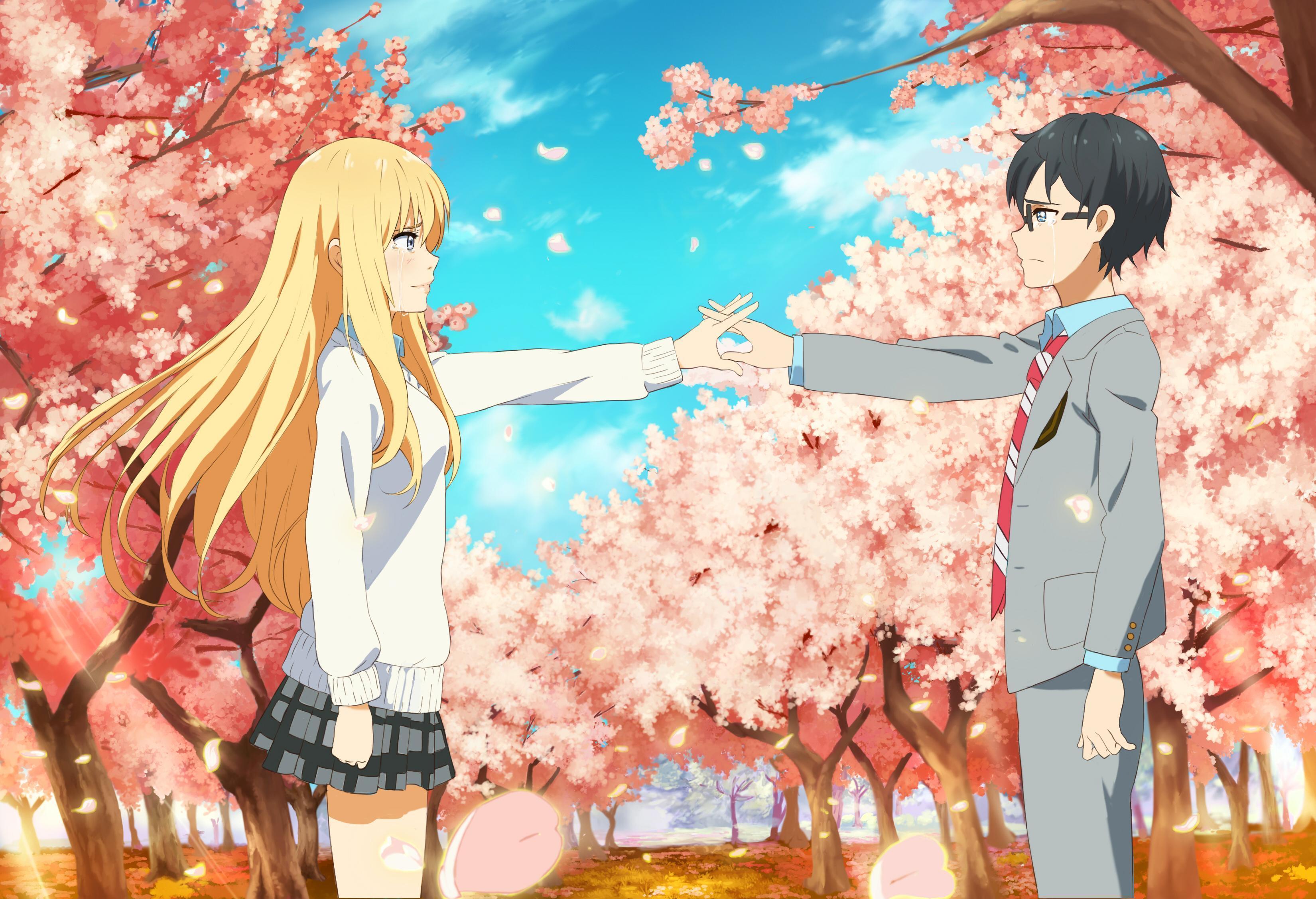
It starts with a cat. Or maybe it starts with the smell of dust on a piano bench that hasn't been touched in two years. Honestly, if you’ve seen Your Lie in April, you know it doesn't really start with a plot point—it starts with a feeling. That specific, heavy-chested sensation of being trapped underwater while everyone else is breathing just fine.
Kousei Arima is a prodigy. Or he was. They called him the "Human Metronome" because his mother, Saki, drilled him until he played every note with the surgical precision of a machine. Then she died. And the music died too. Kousei stopped being able to hear the notes he played. It’s a psychological phenomenon called conversion disorder, though the anime handles it more like a poetic haunting. He’s living in a monochrome world until a girl named Kaori Miyazono blows into his life like a hurricane made of cherry blossoms and violin strings.
The Reality of Why Your Lie in April Hurts So Much
Most people think this is just a "sad anime." It’s not. It’s a brutal examination of child abuse disguised as a musical romance. Let's talk about Saki Arima. She wasn't just a "strict" mom. She was a woman dying of a terminal illness who channeled her terror into the physical and emotional battery of her son. The trauma is so deep that Kousei literally loses his primary sense—his connection to sound—whenever he tries to perform.
Naoshi Arakawa, the mangaka behind the series, didn't just stumble into these themes. He spent immense amounts of time researching classical music competitions and the psychological toll they take on young performers. This isn't just "shonen" fluff. When you watch Kousei sink to the bottom of that metaphorical ocean mid-performance, it's a visceral representation of PTSD.
Then there’s Kaori.
Kaori is the "Manic Pixie Dream Girl" trope turned on its head. On the surface, she’s there to "save" Kousei. She’s loud, she’s violent (in that classic anime slapstick way), and she plays the violin like she’s trying to set the stage on fire. She ignores the sheet music. She makes the judges angry. She forces Kousei back to the piano. But the deeper you get into Your Lie in April, the more you realize her energy isn't just "personality." It’s desperation.
That Ending and the Truth About the "Lie"
People debate the ending constantly. Was it necessary? Could she have lived? In a 2014 interview with Comic Natalie, Arakawa hinted that the ending was decided very early on. The story was never about a miracle cure. It was about the legacy we leave behind when we know our time is short.
The "Lie" itself—the one mentioned in the title—is actually one of the most heartbreaking reveals in anime history. For twenty-one episodes, we assume the title refers to something Kousei is doing, or perhaps a general metaphor for the fleeting nature of spring.
Spoiler alert for the uninitiated: The lie was Kaori’s.
She lied about which boy she actually liked to get close to Kousei without hurting his best friend, Ryota Watari. She lied about her health to keep the people around her from mourning her while she was still alive. She lived her final year as a complete fabrication so she could finally stand on a stage with the boy who inspired her to pick up the violin in the first place.
It’s messy. It’s selfish. It’s human.
The Music is a Character, Not a Soundtrack
You can’t talk about Your Lie in April without the soundtrack. Tomoaki Koshida and the team at A-1 Pictures didn't just pick random classical pieces. They chose works that mirrored the internal decay and rebirth of the characters.
Take Chopin’s Ballade No. 1 in G Minor, Op. 23.
This piece is a monster. It’s technically demanding and emotionally volatile. When Kousei plays this during the finale, he isn't just performing; he’s saying goodbye. The animation during this sequence—where the floor turns into water and the colors bleed together—is peak 2010s anime production. It captures the "synesthesia" effect where sound becomes visual.
- Saint-Saëns’ Introduction and Rondo Capriccioso: This is Kaori’s anthem. It’s flashy, difficult, and defiant.
- Kreutzer Sonata: Beethoven’s piece represents the tension and the "duel" between the violin and piano.
- Clair de Lune: Debussy’s masterpiece is used to ground the quieter, more intimate moments of grief.
The attention to detail is insane. If you look closely at the fingerings in the animation, they actually match the notes being played. A-1 Pictures used real-life models and motion capture of pianists to ensure that musicians watching the show wouldn't be pulled out by "fake" playing. That’s a level of E-E-A-T (Experience, Expertise, Authoritativeness, and Trustworthiness) in animation that you rarely see outside of Kyoto Animation projects.
Why We Still Care in 2026
We live in a world of "content." Shows come and go. Most seasonal anime are forgotten three months after they air. Yet, Your Lie in April (Kimi ni Todoke's louder, sadder cousin) persists.
It’s because it addresses the "ugly" side of inspiration. Kaori isn't just a saint. She manipulates Kousei. She pushes him into panic attacks because she knows she’s running out of time and she refuses to let him waste his talent. It’s a morally gray area. Is it okay to traumatize someone further if it leads to their "healing"? The show doesn't give you a clean answer.
The grief in this show feels real because it doesn't end with a funeral. It ends with a letter. A letter that changes everything you thought you knew about the previous 22 episodes. It forces the viewer to re-contextualize every interaction, every smile, and every "random" encounter.
Common Misconceptions About the Series
One thing that gets lost in the memes is the idea that Kousei "got over" his mother because of Kaori. That’s a total misunderstanding of the script. Kousei didn't get over his mother; he integrated her. He realized that the music she taught him—even the parts taught through pain—was the only part of her he had left.
Another misconception? That the show is "manipulative."
Sure, it uses every trick in the book. Slow-motion tears, soaring crescendos, soft lighting. But it works because the stakes are grounded in a very real fear: the fear of being forgotten. Kaori’s greatest terror isn't dying; it’s that she’ll disappear from the hearts of the people she loved. That's a universal human anxiety.
How to Experience Your Lie in April Today
If you’re revisiting the series or watching for the first time, don't binge it in one sitting. It’s too heavy for that. You’ll get "tragedy fatigue."
- Watch the Subbed version first. Natsuki Hanae’s performance as Kousei is legendary for a reason. He captures that cracking, fragile voice of a teenage boy who is one bad day away from a total breakdown.
- Listen to the "Shigatsu wa Kimi no Uso" Tribute versions. There are several albums where the classical pieces are played in full without the dialogue. It helps you appreciate the narrative structure of the music itself.
- Read the Manga for the "Coda." The anime is a very faithful adaptation, but the manga has subtle nuances in the internal monologues that explain Kousei's mental state more clearly.
There’s also a live-action film and a stage musical. Honestly? Stick to the anime. The medium of animation allows for the surreal, colorful dreamscapes that make the story work. Real life is too "brown" for a story this vibrant.
What You Should Do Next
The impact of this story usually leaves people feeling a bit hollow. It’s called "Post-Anime Depression Syndrome." Don't just sit in the sadness.
Take a page out of the show’s book. If there is something you’ve been "lying" to yourself about—a hobby you abandoned, a person you haven't called, a talent you’re hiding because you’re scared of failing—fix it. The core message of the series isn't that everyone dies; it's that you have to play the music while you can still hear it.
Go find a copy of the Ballade No. 1 on Spotify. Put on some headphones. Walk outside. Look at the sky. Remember that spring is coming, and even if it’s bittersweet, it’s still worth seeing.
Check out the works of Naoshi Arakawa beyond this series, like Farewell, My Dear Cramer, to see how he handles different themes of youth and passion. If you need something to lift the mood after that ending, try a "palette cleanser" anime like K-On! or Spy x Family. You've earned it.



