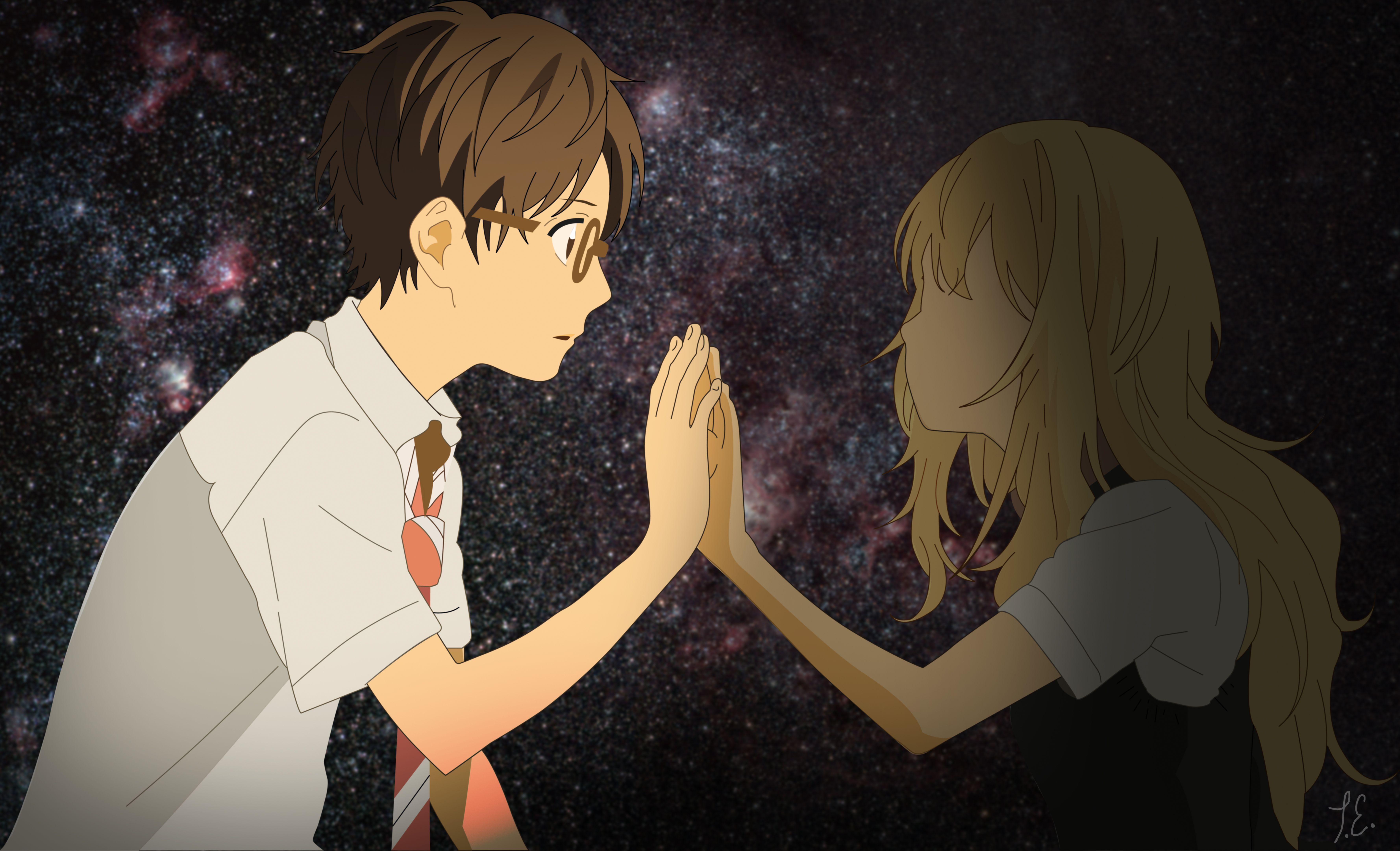
If you’ve ever sat in a dark room at 2:00 AM, staring at a blank screen while a single piano chord echoes in your head, you probably know the specific brand of heartbreak that Your Lie in April—or Shigatsu wa Kimi no Uso—inflicts. It isn’t just a "sad anime." Honestly, calling it that feels like a massive undersell. It’s a sensory assault of Chopin, Rachmaninoff, and the kind of vibrant, oversaturated cherry blossoms that make your eyes hurt.
Kosei Arima is a prodigy. Or he was, until his mother died and his world went silent. He can't hear the notes. He’s a human metronome who lost his rhythm. Then comes Kaori Miyazono, a violinist who treats a musical score like a suggestion rather than a rulebook. She's loud. She's messy. She kicks black cats and eats too many sweets.
She changes everything.
The Trauma of the "Human Metronome"
Most musical stories focus on the triumph of the performance. This one focuses on the sweat and the nausea behind the curtain. Kosei’s relationship with his mother, Saki Arima, isn't just "strict"—it’s arguably some of the most realistic portrayals of abusive "prodigy-making" ever put to animation.
Saki wasn't just a teacher. She was a woman dying of a terminal illness, terrified that her son wouldn't have a way to survive without her. So she beat the music into him. She turned the piano into a cage. When she died, the cage didn't disappear; it just turned into the "deep sea" where Kosei sinks every time he hits a key.
Naoshi Arakawa, the creator of the manga, did something brilliant here. He didn't make the music a magical cure. In the early episodes, when Kosei tries to play, the sound actually disappears. The animation shifts. Colors drain. You feel the claustrophobia. It’s a physical manifestation of PTSD. For a medium that often relies on "power of friendship" tropes, seeing a protagonist fail repeatedly on stage is jarring. It's real.
Why the classical music choices actually matter
This isn't just background noise. The soundtrack, curated and performed by actual musicians like Tomoki Sakata and Yuna Shinohara, is a narrative tool.
Take Beethoven’s Kreutzer Sonata.
In the first performance Kaori and Kosei share, she ignores the tempo. She drags him kicking and screaming into a version of the piece that is rebellious and chaotic. It’s a direct middle finger to the rigid, metronomic lifestyle Kosei used to live.
Then there’s Chopin’s Ballade No. 1 in G Minor.
If you know, you know. That final performance isn't a duet. It’s a goodbye. The way the animation syncs with the shifting difficulty of the piece—those rapid-fire scales and the heavy, mourning chords—it tells the story that the dialogue can't. You aren't just watching a kid play a piano; you’re watching a boy perform an exorcism on his own grief.
The "Lie" That Everyone Misses
People focus on the ending. The letter. The tears. But the central lie of Your Lie in April starts way before the final episode.
Kaori Miyazono is a master manipulator, but in the most selfless, heartbreaking way possible. She knew she was dying. She saw Kosei at a competition years prior and decided that before she left, she would bring him back to life.
The lie wasn't just about her liking Watari. It was the lie of her persona. She pretended to be fine. She forced herself to stand when her legs were failing. She used her remaining energy to drag a boy out of a dark room while she was heading toward a darker one herself.
Is it healthy? Probably not. Is it beautiful? Absolutely.
There's a specific tension in the way A-1 Pictures handled the art direction. The world of Your Lie in April is almost too bright. The blues are too deep, the pinks are too vivid. It creates a sense of fleeting beauty—like a firework that's about to go out. It mirrors Kaori’s philosophy: that we only have a short time, so we might as well play the music our own way.
Why the ending still sparks debate in 2026
Even now, fans argue about whether the ending was "necessary." Could Kaori have lived? Sure, in a different kind of story. But Shigatsu wa Kimi no Uso isn't a story about a girl being saved. It’s a story about a boy being given the tools to save himself.
If Kaori lives, the "Lie" loses its weight. The tragedy is the catalyst for Kosei’s growth. It’s brutal. It’s unfair. But it’s the core of the show’s identity.
The letter at the end—the one where she finally admits she loved him—is the ultimate emotional payoff. It recontextualizes every single interaction they had. Every time she got angry, every time she pushed him, every time she cried when he wasn't looking. It wasn't just a crush; it was a mission.
Essential Insights for Your Next Rewatch
If you’re planning to dive back into this emotional meat grinder, or if you’re recommending it to a friend, keep these details in mind to appreciate the depth of the production:
- Watch the eyes. Kosei’s eyes change color and saturation depending on his mental state. When he's at his lowest, they are dull and greyed out. As Kaori influences him, the "life" (and the light) literally returns to his pupils.
- The Cat Symbolism. The black cat that follows Kosei represents his guilt over his mother. Notice when the cat appears and when it disappears. It’s a direct barometer for his psychological healing.
- The Supporting Cast. Don't sleep on Tsubaki. While everyone is focused on the tragic romance of the leads, Tsubaki represents the "ordinary" pain of growing up. Her realization that her "little brother" friend has outgrown her is a different kind of heartbreak—one that is much more relatable for most people than the grand tragedy of Kaori.
- The Manga vs. Anime. While the anime is legendary for its music, the manga by Naoshi Arakawa has a different kind of grit. The line work is frantic. It captures the "noise" of the music in a way that’s uniquely visual.
Your Lie in April remains a pillar of the "tear-jerker" genre because it doesn't cheat. It doesn't give you a miracle. It gives you a reason to keep playing even when the world goes quiet.
Practical Steps for Fans of the Series
- Listen to the "Shigatsu wa Kimi no Uso" Original Song & Classical Collection. It’s available on most streaming platforms. Listening to the full, unedited versions of the classical pieces provides a much deeper appreciation for the technical skill Kosei was supposedly displaying.
- Visit the Real-Life Locations. If you’re ever in Nerima, Tokyo, many of the locations—from the park where Kaori and Kosei first met to the bridge where Tsubaki ran—are real places you can visit. It’s a popular pilgrimage for fans for a reason.
- Explore "March Comes in Like a Lion." If you loved the psychological depth of Kosei’s trauma and the "prodigy" angle, this series (Sangatsu no Lion) is the logical next step. It handles depression and the pressure of professional Shogi in a way that feels like a spiritual successor to Kosei’s journey.
- Learn the Pieces. Even if you aren't a musician, look up the history of Chopin’s Winter Wind or Kreisler’s Love’s Sorrow. Understanding why these specific composers wrote these pieces adds a layer of "Easter egg" storytelling that most casual viewers miss entirely.
The beauty of the show isn't that it makes you cry. It's that it makes you want to go out and do something—anything—with the time you have left.
Play the music. Write the letter. Stop waiting for the "right" time, because April will be over before you know it.



