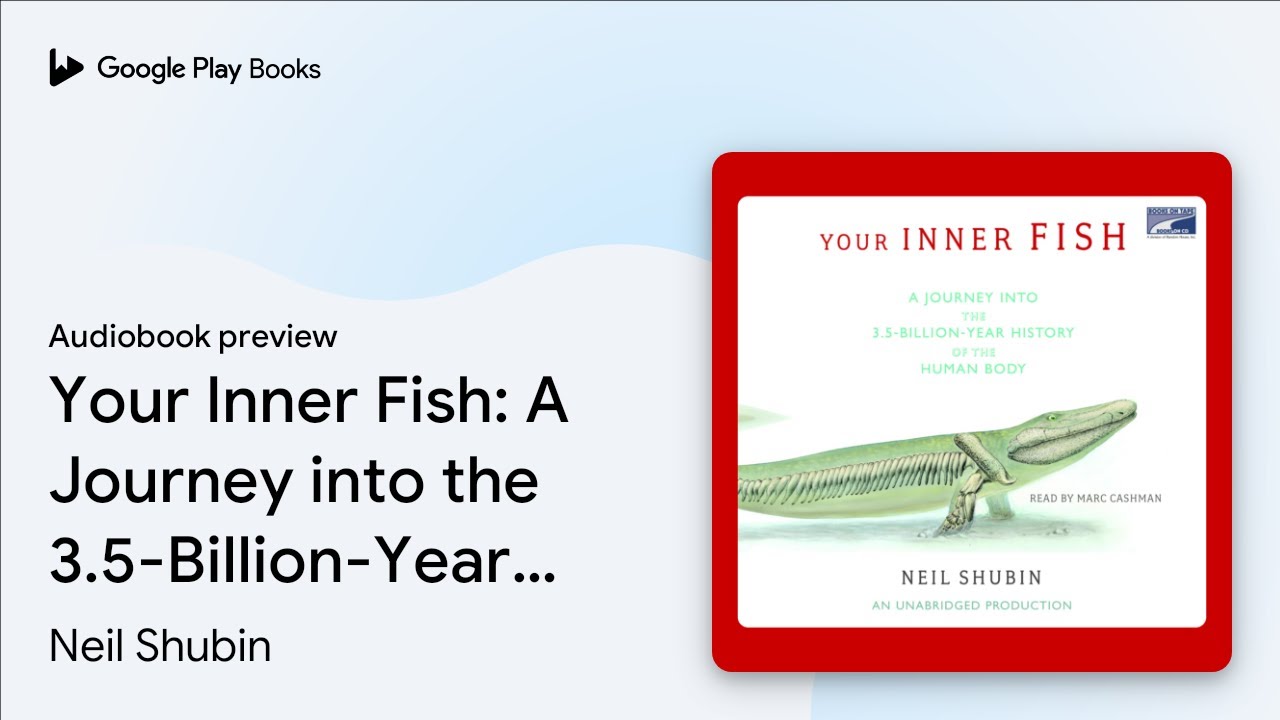
Ever looked at your hand and thought about a shark? Probably not. Most of us see our bodies as these unique, standalone masterpieces of biological engineering. But honestly, if you sit down with Neil Shubin’s Your Inner Fish, that whole perspective shifts pretty fast. Shubin, a paleontologist who spends his summers in the freezing Arctic, basically argues that we are all just "jury-rigged" fish.
It’s a weird thought. Also making headlines lately: The Death of Meaning in the Contemporary Art Market.
We think of ourselves as the pinnacle of evolution, yet our bodies are cluttered with the leftovers of creatures that lived hundreds of millions of years ago. Shubin doesn't just theorize about this in a dusty lab; he found the "smoking gun" in the Canadian Arctic. That creature, Tiktaalik, is the bridge. It’s the fish that had a neck and wrists. Think about that for a second. A fish with a neck.
Why Your Inner Fish Isn't Just for Science Geeks
You’ve probably heard of the "missing link" before. Usually, people are talking about apes and humans. But Shubin went further back. Way further. In Your Inner Fish, he explains that the fundamental blueprint of our bodies—one bone, two bones, lots of little blobs, and then digits—is the same pattern you find in the fin of a 375-million-year-old fossil. Additional details into this topic are detailed by Glamour.
The book is basically a detective story. Shubin and his team spent six years scouring Ellesmere Island. It’s a desolate, rocky place where you’re more likely to find a polar bear than a fossil. But they knew the geology was right. They were looking for rocks from the Devonian period, the specific "window" when fish started to flop onto land.
When they finally found Tiktaalik, it wasn't just a win for paleontology. It was a revelation for human anatomy. This creature had a flat head like a crocodile, but scales and fins like a fish. Most importantly, it had a functional wrist. It could do a push-up. That single ability—the power to support body weight against gravity—is the reason you can hold a coffee cup or type on a keyboard today.
The Hiccup Connection
One of the most famous parts of the book—and the part that usually gets people talking at dinner parties—is the explanation for why we hiccup. It feels like a useless, annoying glitch, right?
Well, Shubin points out that hiccups are a direct hand-me-down from our "inner fish" and "inner amphibian." The spasm is a leftover of the neural machinery that tadpoles use to breathe. When a tadpole breathes, it needs to close its glottis so water doesn't get into its lungs. In humans, that same nerve circuit gets triggered, causing the abrupt "hic" sound as the glottis snaps shut.
We aren't perfectly designed. We’re repurposed.
Beyond the Bones: The Genetic Blueprint
It isn't just about fossils, though. Shubin dives deep into DNA, specifically something called Hox genes. These are essentially the "master switches" of the body. They tell cells where to build a head, where to put a tail, and where to grow a limb.
Here’s the kicker: the genes that build a shark's fin are almost identical to the genes that build your arm.
Scientists have actually taken the "Sonic Hedgehog" gene (yes, that’s its real name) from a shark and put it into a mouse embryo. The result? The mouse developed normally. The genetic instructions for building a limb are so ancient and so fundamental that they are interchangeable across species that haven't shared an ancestor in eons.
Why we get hernias and back pain
If you’ve ever dealt with a hernia or chronic lower back pain, you can thank your fishy ancestors for that, too. Our bodies were originally designed to be horizontal. Fish have their gonads up near their hearts, which works fine in a cold-blooded animal suspended in water.
But when we stood up and became warm-blooded mammals, those organs had to migrate south. This migration leaves a weakness in the body wall. It’s a biological "shortcut" that worked well enough to keep us alive, but not well enough to keep us comfortable. We are essentially living in a body that was designed for a completely different environment.
The Practical Side of Paleontology
You might wonder why any of this matters in 2026. Is it just cool trivia?
Not really. Understanding our evolutionary history is actually a massive part of modern medicine. When researchers look for cures for things like hearing loss or blindness, they don't just look at humans. They look at the "simpler" versions of our organs in other animals.
Our inner ear bones—the malleus, incus, and stapes—were once part of the jaws of ancient fish and reptiles. By studying how these structures evolved, scientists can better understand how to fix them when they break. Shubin makes the case that you can’t truly understand human health without understanding the 3.5-billion-year history that led to it.
- Fossils as maps: They tell us where we’ve been and why we’re built this way.
- Embryos as time machines: Looking at a human embryo in its early stages is like watching evolution in fast-forward.
- DNA as a library: Our genome is a record of every ancestor we’ve ever had.
Moving Forward With Your Inner Fish
If you’re looking to get the most out of Shubin’s work, don't just stop at the book. There’s a three-part PBS series that visualizes these transitions in a way that’s honestly mind-blowing. Seeing the CGI transition from a Tiktaalik flopping on a riverbank to a modern human walking down a Chicago street makes the science feel a lot more personal.
The real takeaway from Your Inner Fish isn't that we are "just" animals. It’s that we are connected to everything. There is a profound sense of belonging that comes from realizing the bones in your hand have a history that stretches back to a muddy stream in the Devonian.
Next time you feel a bit of a "glitch" in your body—a hiccup, a knee pop, or a sore back—don't be too hard on yourself. You’re just dealing with the legacy of a fish that decided to take a walk 375 million years ago.
To truly grasp this, you might want to start by looking at your own anatomy through a different lens. Try comparing a diagram of a human arm to a whale's flipper or a bird's wing. You'll see the "one bone, two bones" pattern everywhere. Once you see it, you can't unsee it. It's the ultimate proof that we’re all part of the same big, messy, beautiful family tree.