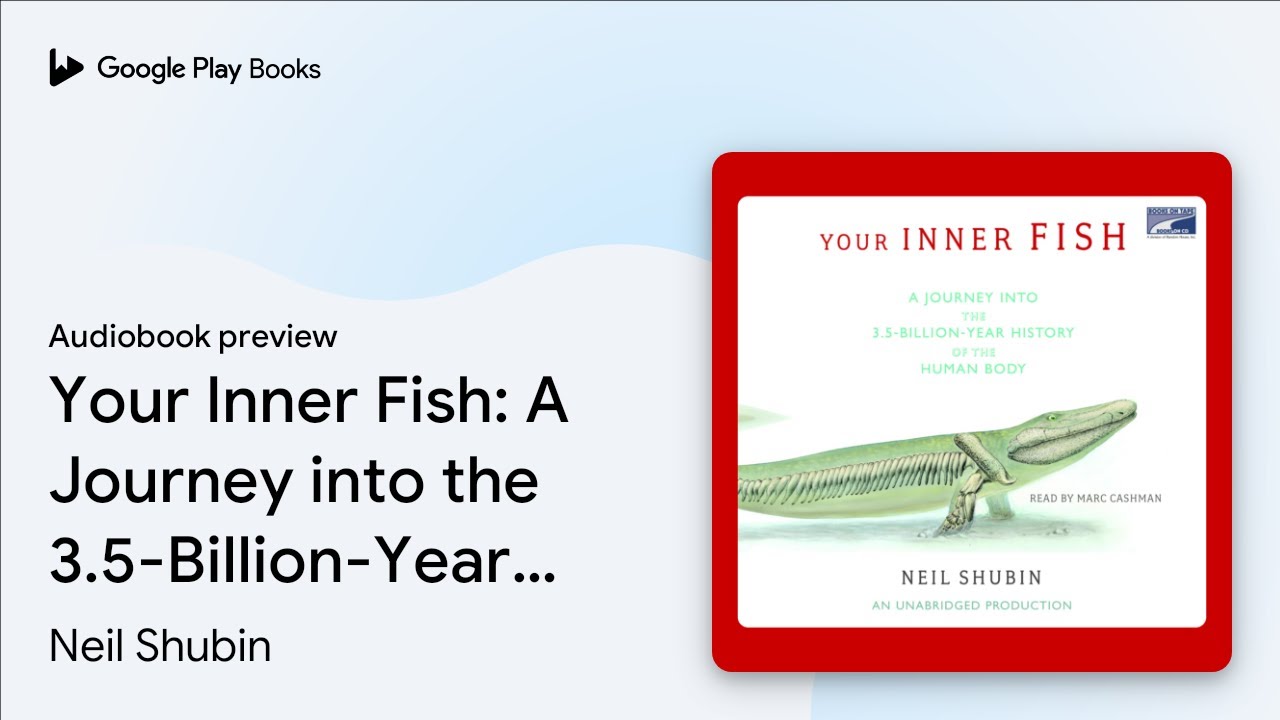
Ever wonder why your back hurts just from sitting or why humans get hiccups? Honestly, it’s because your body is basically a jury-rigged machine built from leftover parts. We aren't designed from scratch. We are "mutilated" versions of fish, worms, and sponges. Neil Shubin, a paleontologist who famously spent years shivering in the Arctic, laid this all out in his book Your Inner Fish. It’s not just some dry textbook about rocks and old bones. It is a detective story. Shubin managed to find a 375-million-year-old fossil called Tiktaalik roseae—a "fishapod" with scales and gills but also a neck and wrists. Seeing that skeleton for the first time changes how you look at your own hands.
You’ve got a fish to thank for your grip. It sounds weird, I know. But the anatomy of your arm—the one bone, two bones, lots of blobs, and digits pattern—didn't start with primates. It started in the water.
Finding Tiktaalik: The Moment Your Inner Fish Became Real
Shubin wasn't just guessing where to look for the "missing link" between water and land. He and his team, including Ted Daeschler and Farish Jenkins, used a simple logic: look for rocks of the right age, the right type (sedimentary), and rocks that are exposed at the surface. They headed to the Canadian Arctic, specifically Ellesmere Island. It was brutal. They were looking for Devonian-era rocks, roughly 365 to 385 million years old.
One day, they saw a snout sticking out of a cliff. It wasn't just any snout; it was flat. Fish snouts are usually head-on or conical. Flat heads belong to things that breathe air or peek above the water. When they cleared the rock away, they found Tiktaalik. This creature had a functional neck. Fish don't have necks; their heads are fused to their shoulders. Tiktaalik could move its head independently. It had a rib cage designed to support its weight against gravity.
This fossil bridged the gap. It showed exactly how a fin becomes a limb. If you look at the bones inside a Tiktaalik fin, you see the precursors to our own humerus, radius, and ulna. It’s the blueprint for every limb on every land-living animal today. You, me, your dog—we’re all just variations on the Tiktaalik theme.
Why Do We Get Hiccups? Blame the Amphibians
Hiccups are the absolute worst. They’re annoying, useless, and seemingly random. But Shubin explains they are actually a biological glitch. It's a "hand-me-down" from our fish and amphibian ancestors. Basically, two things are happening at once. First, there’s a sudden contraction of the muscles we use to breathe. Second, the glottis (the flap in your throat) slams shut.
In fish, the nerves that control breathing—the phrenic nerves—have a long, tortured path. They start at the brainstem and travel all the way down the neck and chest. This is a terrible design for a mammal, but it made perfect sense for a fish whose "lungs" (gills) were right next to its brain. Because our bodies moved the equipment but kept the old wiring, the phrenic nerve is prone to irritation.
The "snap" of the glottis is even weirder. It’s almost identical to how tadpoles breathe. When a tadpole uses its gills to breathe underwater, it has to close off its lungs so it doesn't drown. It uses a quick muscular reflex to snap the glottis shut. We’ve kept that reflex. It serves no purpose for us now, but it’s buried deep in our brainstem. Your hiccups are just your "inner tadpole" trying to breathe underwater.
The Messy Anatomy of Hernias and Back Pain
Human beings are essentially "modified fish" trying to stand upright on two legs. It’s a bold experiment, but the engineering is honestly kind of crappy. Our spines were originally horizontal, like a bridge. When we stood up, we turned that bridge into a vertical pillar. This puts immense pressure on our vertebrae, leading to the "bad back" epidemic.
Then there are hernias. Men, specifically, have a weird vulnerability here. In cold-blooded fish, the gonads are located up near the heart. As mammals evolved and became warm-blooded, sperm needed a cooler environment to stay viable. This meant the testes had to migrate down to the scrotum.
In humans, this migration happens during fetal development. The testes "drop," pushing through the body wall and creating a weak spot in the abdominal muscles. That's why men are so prone to inguinal hernias. It’s a direct result of moving "fish parts" to new locations to satisfy the requirements of being a mammal. Evolution doesn't create perfect solutions; it just hacks together whatever works well enough to let you reproduce.
Teeth, Hair, and the Shifting Genes
Shubin also connects things you’d never think are related, like your teeth and a shark's skin. If you look at a shark, it’s covered in small, tooth-like scales called dermal denticles. Chemically and structurally, these are almost identical to the teeth in your mouth.
The genes that tell a shark to grow scales are the same genes that tell your jaw to grow teeth. This is all controlled by a set of "architect" genes called Hox genes. These genes are like the foremen on a construction site. They don't build the house themselves; they just hold the blueprints and tell the workers where the windows go.
The Shark-Human Connection:
- The Jaw: Our lower jaw is a repurposed part of the gill arches found in ancient fish.
- The Ears: The tiny bones in your middle ear (malleus and incus) actually started as part of the jaw joint in reptiles, which themselves evolved from fish structures.
- The Senses: Our ability to smell is governed by a massive family of genes that have been expanding and specialized since our ancestors were sniffing out chemicals in the Devonian seas.
Seeing the World Through Shubin's Eyes
When you read Your Inner Fish, you start to see the world differently. You don't just see a person; you see a walking history book. Every wrinkle, every quirk of our anatomy, is a record of an obstacle our ancestors overcame millions of years ago.
Shubin’s work is a massive reality check for anyone who thinks humans are the pinnacle of "perfect" design. We are actually just a very successful collection of compromises. Our eyes are wired backwards, our sinuses drain upward (which is why they get clogged so easily), and our knees are a disaster waiting to happen.
But there’s a beauty in that mess. It connects us to every other living thing on the planet. We aren't separate from nature; we are deeply, biologically a part of it. When you look at a goldfish in a tank, you're looking at a very distant cousin who kept the original blueprints while you went for the "land-dwelling" upgrade.
Actionable Insights from the Science of Our History
Understanding your "Inner Fish" isn't just a fun trivia fact. It changes how you approach health and movement.
- Respect Your Spine: Since our backs are "hacked" fish bridges, stop treating them like unbreakable pillars. Prioritize core strength and posture. Your "Inner Fish" wasn't meant to sit in an office chair for nine hours a day.
- Understand Your Limits: Recognizing that many of our ailments—like hernias, hemorrhoids, and knee injuries—are "evolutionary leftovers" can help reduce the frustration of why our bodies "fail." Often, it’s not a failure; it’s just the limit of our current biological iteration.
- Explore the Fossil Record: If you ever get the chance, visit a natural history museum to see the Devonian exhibits. Seeing Tiktaalik or its relatives in person makes the 375-million-year timeline feel much more visceral.
- Watch the Documentary: If the book feels too heavy, Shubin hosted a three-part PBS series based on the book. It’s visually stunning and uses high-end CGI to show the transition from fish to human in a way that’s easy to digest.
- Think Genetically: Remember that we share about 70% of our DNA with zebrafish. When scientists study fish to cure human diseases, they aren't just guessing. They are using the shared history that Shubin uncovered to find real solutions for the modern human body.
The story of your body didn't start at your birth. It didn't even start with the first humans. It started in the ancient, murky waters of a world that looked nothing like ours. Neil Shubin just gave us the map to find our way back home.