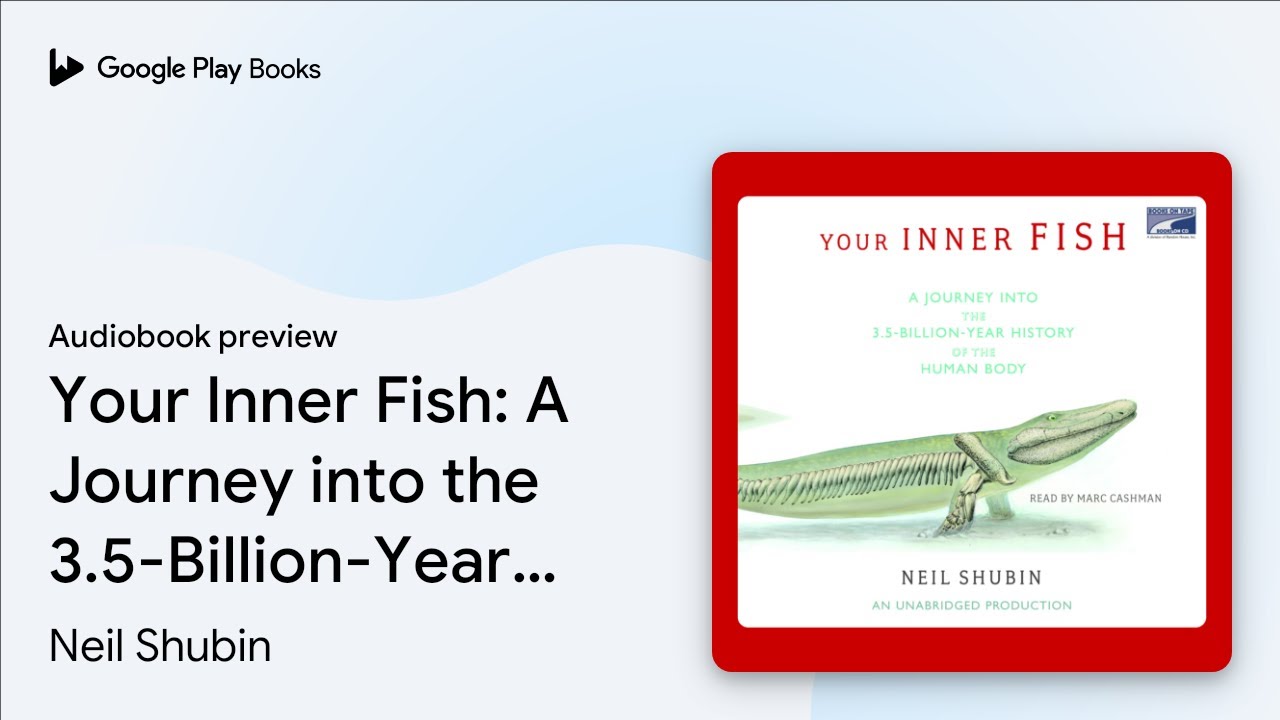
You’re basically a high-tech fish. That sounds like a weird insult, but it’s just the biological truth. If you look at your hand right now, you aren't just looking at skin and bone; you're looking at a structural blueprint that was drafted in a swamp 375 million years ago. Neil Shubin, a paleontologist who spent years shivering in the Arctic looking for rocks, changed everything we know about this connection when he discovered Tiktaalik roseae. His book, Your Inner Fish, isn't just a science text. It’s a roadmap to why your back hurts, why we get hiccups, and why our bodies are essentially a "jury-rigged" mess of ancient parts.
Most people think evolution is this clean, upward climb toward perfection. It isn't. It’s more like a chaotic episode of a home renovation show where the contractor decided to keep the 1920s plumbing while installing a smart fridge. Shubin’s work proves that we carry the baggage of every ancestor we’ve ever had, from jawless fish to tiny insect-eating mammals.
The Arctic Gamble That Found Your Inner Fish
The story of how we found our connection to the water starts in the Canadian Arctic. Specifically Ellesmere Island. Shubin and his team weren't there because they liked the cold; they were there because the geology of the rocks matched a very specific time window in the Devonian period. They needed a "transitional fossil." They needed the middle man.
Imagine looking for a needle in a haystack, but the haystack is thousands of miles of frozen rock and the needle is a piece of bone the size of a postage stamp. For years, they found nothing. It was frustrating. Then, they saw it—a snout. A flat head.
This was Tiktaalik. It had scales and gills like a fish, but it also had a neck. It had ribs. Most importantly, it had a wrist. Before Tiktaalik, the leap from fins to limbs was a massive "how did they do that?" moment in science. Your Inner Fish explains that this creature was doing "push-ups" in the shallows, using its fleshy fins to navigate muddy bottoms. That wrist is the direct ancestor of the one you use to scroll through your phone.
Why Your Hiccups Are a Relic of the Swamp
Have you ever wondered why hiccups are so annoying and hard to stop? It’s because the nerve pathway is a total disaster. In fish, the nerves that control breathing (which they do with gills) take a very short trip from the brainstem to the throat. In humans, because we evolved necks and shifted our hearts lower in our chests, those same nerves—the phrenic nerves—have to take a long, winding detour.
It's a design flaw.
When that nerve gets irritated, it triggers a spasm. The "gulp" sound of a hiccup is actually a primitive reflex. It's almost identical to how amphibians like tadpoles breathe. Tadpoles need to close their lungs while they gulp water over their gills so they don't drown. We've kept the hardware for that reflex, even though we haven't had gills for millions of years. Honestly, your body is just a collection of these weird, leftover habits.
Hernias and the Price of Walking Upright
Our ancestors lived in the water. Gravity isn't really a thing when you're buoyant. But once we started walking on land—and eventually on two legs—our internal organs had to deal with a lot of downward pressure.
Consider the "inner fish" anatomy of the human male. In sharks and other fish, the gonads are located high up in the body cavity, near the heart, where it stays cool. In humans, we still start out that way as embryos. But because sperm needs a cooler temperature than our warm mammalian bodies provide, the testes have to descend into the scrotum. This creates a weak spot in the abdominal wall. That's why men get inguinal hernias so easily. It's a direct consequence of taking a fish’s body plan and trying to make it stand up on a sidewalk.
The One Bone That Changed Everything
If you touch the area just above your "Adam's Apple," you're feeling the hyoid bone. It’s the only bone in your body not connected to another bone. It just hangs there, supported by muscles.
In a shark, the structures that correspond to our hyoid and our jaw bones are part of the apparatus that supports the gills. Shubin meticulously breaks down how these arches in an embryo—the branchial arches—reorganize themselves. What starts as a gill support in a fish embryo becomes the bones of your middle ear, your jaw, and your voice box in a human embryo.
- First Arch: Becomes your upper and lower jaw.
- Second Arch: Becomes a small ear bone (the stapes) and part of the throat.
- Third and Fourth Arches: Form the rest of your larynx.
It’s a bizarre recycling program. Nature doesn't start from scratch; it tweaks what’s already there. If you want to understand why your ears are shaped the way they are, you have to look at the gill slits of an ancient lamprey.
Shubin’s "Inner Fish" and the DNA Connection
We aren't just linked by bones. We are linked by the "toolkit" of genes that build those bones. Shubin points to the Sonic Hedgehog gene (yes, scientists have a weird sense of humor). This gene is responsible for telling a limb which side is the pinky and which side is the thumb.
What’s wild is that you can take the "hand-building" DNA from a shark and put it into a mouse embryo, and it works. The mouse will grow a limb. The genetic code for "build an appendage" is so ancient and so fundamental that it hasn't changed much in hundreds of millions of years. This realization shattered the idea that humans are genetically "special" or built from a different set of instructions than the rest of the animal kingdom. We're just a variation on a theme.
Dealing With the "Common Sense" Skeptics
A lot of people struggle with the idea that we came from fish because they don't see fish turning into monkeys at the zoo. That's not how it works. Evolution happens in the margins. It happens over spans of time that the human brain isn't really wired to comprehend.
When Shubin talks about Your Inner Fish, he isn't saying a goldfish gave birth to a person. He’s saying that if you trace the lineage back far enough, the features that define "us"—heads, limbs, specialized teeth, complex eyes—first appeared in the water.
There are skeptics who point to "irreducible complexity," the idea that some organs are too complex to have evolved. But the fossil record, specifically the discovery of Tiktaalik, filled one of the biggest "missing link" holes in history. It showed a creature that was half-built for land and half-built for water. It wasn't perfect at either, but it was good enough to survive. Survival is the only metric that matters in biology.
Making Sense of Your Own Anatomy
So, what do you do with this info? It changes how you look at yourself in the mirror. You start to realize that your "flaws" aren't actually flaws.
- Your back pain: Likely because your spine is a modified horizontal bridge that we forced into a vertical pillar.
- Your knees: They're a mess because they were originally designed for a much more flexible, sprawling gait, not the rhythmic pounding of a 5k run on pavement.
- Your teeth: We have different types of teeth (incisors, molars) because our mammalian ancestors needed to process food efficiently to maintain a high metabolism. Our "inner reptile" only had one type of tooth.
Actionable Steps to Connect With Your Biology
Understanding your evolutionary history isn't just for academics. It helps you navigate your own health and perspective on life.
Look at embryonic development. If you’re ever curious, look up time-lapse videos of human embryos. You’ll see the "gill slits" (pharyngeal arches) form and then transform. It’s the most visceral way to see your "inner fish" in real-time.
Adjust your movement. Knowing that your back and knees are "jury-rigged" should change how you exercise. Focus on core stability to support that vertical spine. Realize that our bodies aren't designed to sit in a chair for 8 hours; we're designed for the varied, complex movement of a creature that has to navigate uneven terrain.
Read the source material. Pick up Neil Shubin’s book or watch the PBS series. He has a way of explaining the "Shubin inner fish" concept that makes you feel like a part of a massive, epic story rather than just a random accident of nature.
Pay attention to your senses. Your sense of smell, for instance, is a shadow of what it used to be. We have hundreds of "dead" genes for smelling because our ancestors started relying more on vision. We're "color-vision" specialists who traded our noses for a better view of the fruit.
Your body is a historical document. Every ache, every weird reflex, and every bone is a chapter written by an ancestor who survived just long enough to pass the blueprints to you. You aren't just a person; you're a 3.5-billion-year-old success story. Recognize the fish in you, and you'll finally understand why being human is so weird and wonderful at the same time.