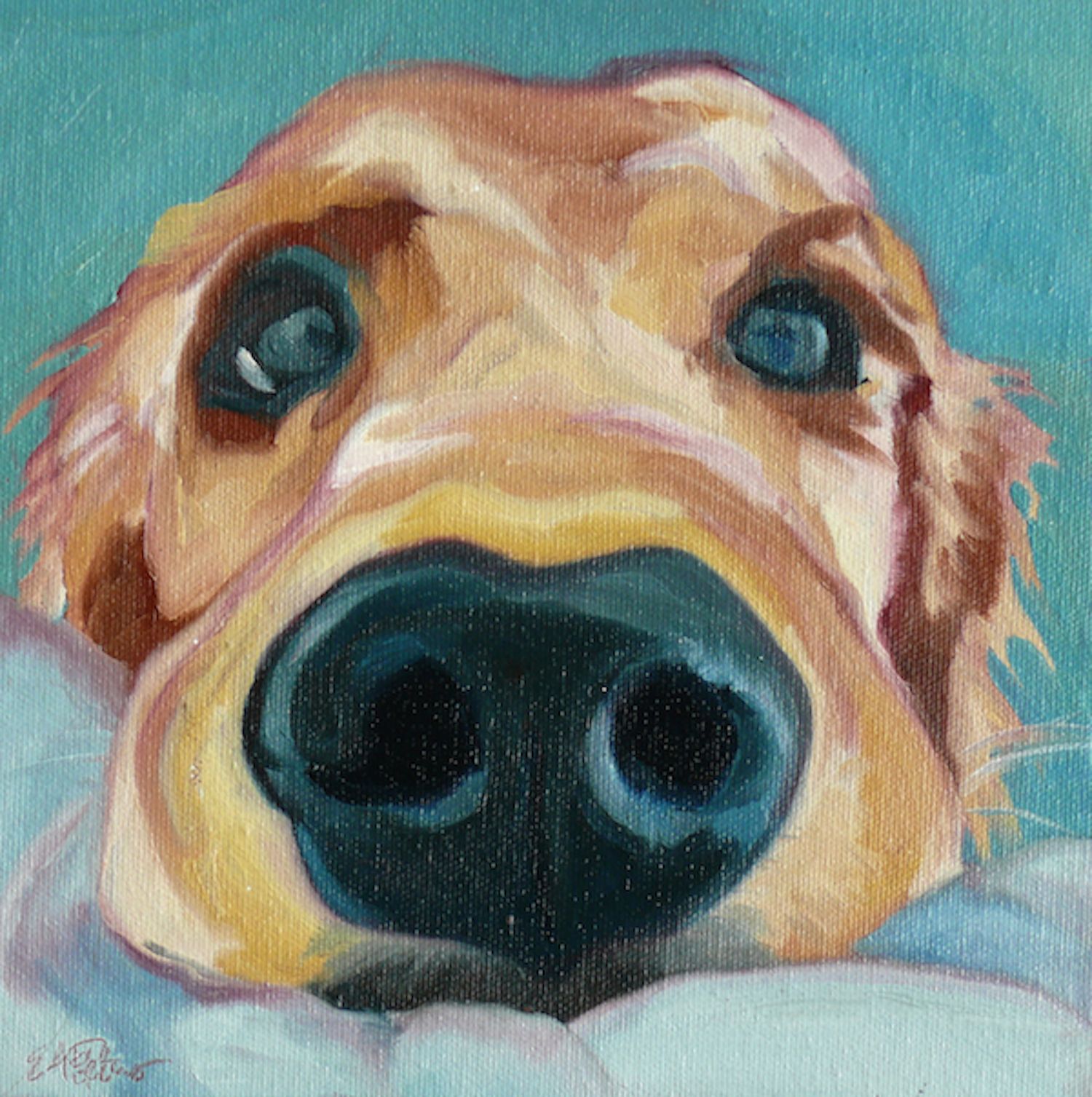
You’ve seen the viral TikToks. A Golden Retriever holds a brush in its mouth, swipes a messy streak of teal across a canvas, and suddenly the comments section is screaming about the next Picasso. It looks cute. It’s definitely "likes" gold. But what’s actually happening when you see a dog painting a picture? Is it artistic expression, or is it just a very elaborate version of "sit" and "stay"?
Honestly, the answer is a mix of both, and it’s way more fascinating than just a gimmick.
Iris, a rescued dog from South Africa, became a global sensation for her "abstract" works. Her owner used positive reinforcement to help her guide a brush. Then there’s Dagger, a Lab-Chesapeake mix known as "DogVinci," who transitioned from being a service-dog-in-training to a full-time artist when his owner realized he was obsessed with her studio work. These aren't just isolated flukes. There is a legitimate psychological framework for why dogs engage with color and movement this way.
Why Dogs Actually "Paint" (And No, They Aren't Colorblind)
We need to clear up one massive myth right now. People used to think dogs see the world in black and white. They don't. While they lack the photoreceptors for red and green, they see blues and yellows quite vividly. This is why most "professional" canine artists tend to produce work that leans heavily into those cool tones. When a dog painting a picture chooses a blue pigment, they are seeing a distinct contrast against the white canvas that they simply wouldn't get with a red or orange.
It’s about high-contrast visual stimulation.
Beyond the eyeballs, there’s the cognitive aspect. Dr. Stanley Coren, a renowned expert in canine intelligence, has written extensively about how dogs have the mental capacity of a human toddler. If you’ve ever seen a two-year-old with a finger paint set, you know it’s not about the final product. It’s about the sensory experience. The "squish" of the paint. The way the brush drags. For a dog, the "art" is a high-level enrichment activity that fires up their motor skills and problem-solving centers.
The Dopamine Loop of the Brush Stroke
Dogs are reward-driven. Obviously. But "art" offers a unique type of reward called "autotelic" activity—doing something because the act itself is satisfying. When a dog realizes that their physical movement leaves a permanent mark on a surface, it creates a feedback loop. They aren't trying to paint a bowl of fruit. They are exploring the physical law of cause and effect.
Think about it this way.
Most of a dog’s life is reactive. We tell them when to eat, where to walk, and when to sleep. Painting is one of the few moments where they are the primary "actor" in their environment. It’s an agency-building exercise. When a dog painting a picture moves the brush, they are exerting control over their surroundings in a way that fetching a ball doesn't quite replicate.
Setting Up a Canine Studio Without the Mess
If you’re thinking about trying this at home, don't just hand your dog a wet brush and hope for the best. You'll end up with blue paw prints on your white sofa. Trust me. There are two main ways people do this: the "True Brush" method and the "Clean Lick" method.
The True Brush method requires a custom-built brush holder. Most dogs find it uncomfortable to grip a thin wooden handle directly. You can use a PVC pipe or a foam grip to make it easier for them to hold. It’s basically the same tech used for adaptive tools for humans with limited grip strength.
Then there’s the "Mess-Free" hack that’s dominated Instagram. You put dollops of non-toxic acrylic paint on a canvas, wrap the whole thing in plastic cling film, and then smear peanut butter on top. As the dog licks the peanut butter, they move the paint underneath.
Is it "cheating"?
Maybe. But the dog doesn't care. To them, they are engaging in a tactile, tasty puzzles that results in a swirl of colors. From a behavioral standpoint, this is a form of "nose work" or "licking therapy," which is known to lower cortisol levels in high-anxiety breeds like Border Collies or German Shepherds.
The Ethics of Selling Dog Art
We have to talk about the money. Some dog paintings sell for hundreds, even thousands of dollars. Dagger’s work has raised significant funds for animal charities. However, there’s a fine line between enrichment and exploitation.
Expert trainers, like those at the Victoria Stilwell Academy, emphasize that the dog must always have the "opt-out" choice. If the dog drops the brush and walks away, the session is over. Art should never be a forced labor. If a dog is showing signs of stress—lip licking, yawning, or pinned-back ears—they aren't "concentrating" on their masterpiece. They’re stressed.
True canine art is about the bond between the handler and the animal. It’s a collaborative performance. You’re the curator; they’re the talent. You choose the colors (to ensure they aren't toxic and look halfway decent together), and they provide the kinetic energy.
Real-World Benefits You Didn't Expect
It isn't just about the canvas. Engaging in these kinds of complex tasks has been shown to slow down cognitive decline in senior dogs. Much like "brain games" for humans, the coordination required for a dog painting a picture keeps neural pathways firing.
It’s also an incredible tool for "difficult" dogs. Shelter dogs often struggle with boredom and "kennel craze." Giving them a creative outlet—even if it's just the peanut-butter-smear method—can significantly improve their adoptability by making them calmer and more focused. It gives them a "job," which is something many working breeds desperately crave.
Getting Started: Your 3-Step Action Plan
- Safety First: Use only "AP Non-Toxic" certified paints. Even then, don't let them ingest it. If you're doing the brush method, use water-based tempera; it's easier to wash out of fur.
- Short Bursts: Keep sessions under five minutes. Dogs have a "flow state," but their physical stamina for holding a brush is low. You want them to leave the "studio" wanting more, not exhausted.
- Focus on the Process: Don't worry about it looking like a "thing." It’s going to be a mess. Embrace the mess. The goal is the mental workout and the bonding time, not a spot in the MoMA.
If you want to try the "Clean Lick" method today, grab a canvas, some blue and yellow paint (since they see those best!), and a roll of cling wrap. Put the paint on, wrap it tight, add a thin layer of Greek yogurt or peanut butter on the outside, and let them go to town. It’s the easiest way to see if your dog actually enjoys the sensory input of "making" something. Just keep the camera ready—it’s probably going to be the most adorable thing you see all week.