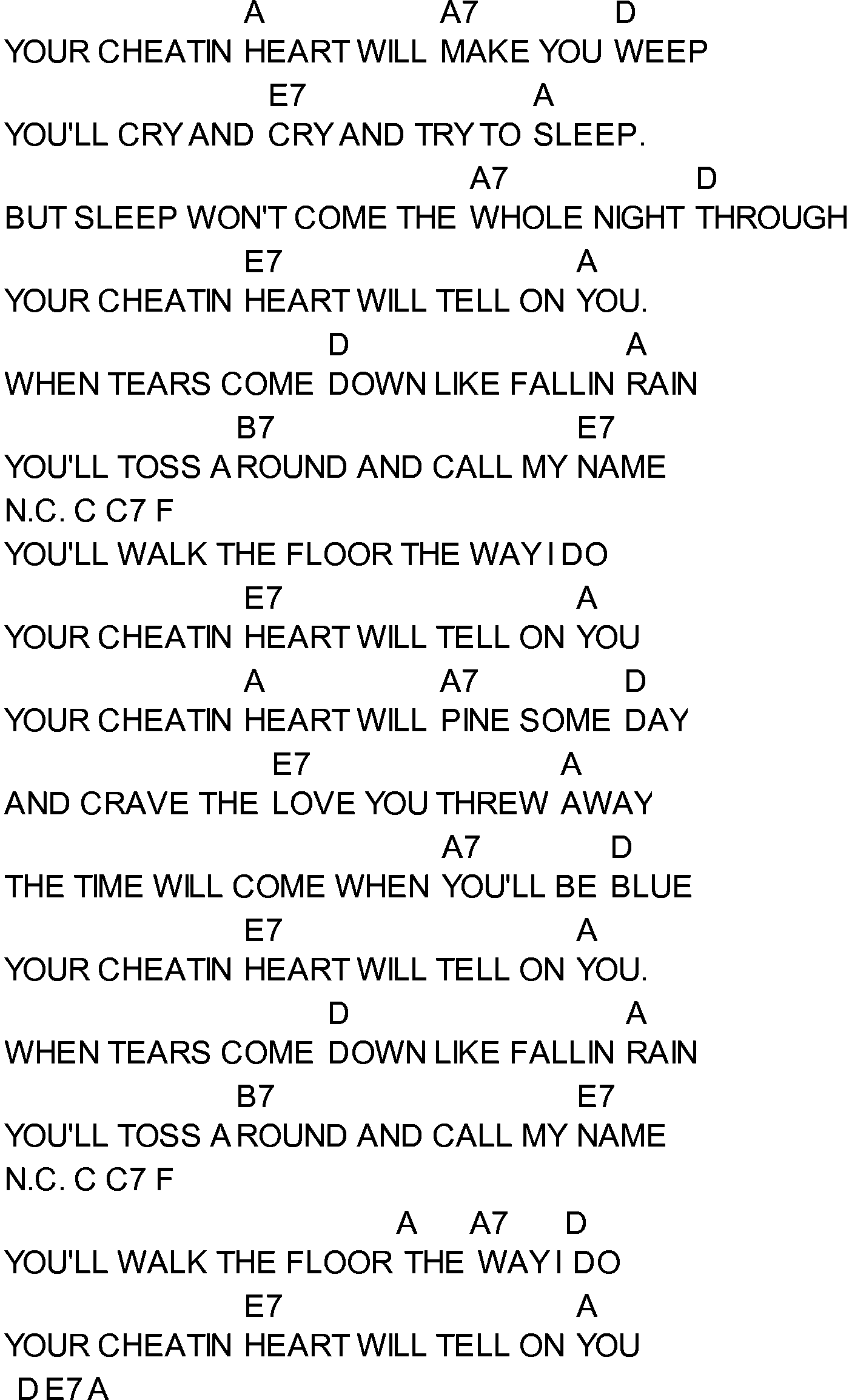
Hank Williams didn't just write songs; he wrote ghosts. When you sit down and really look at the Your Cheatin Heart lyrics, you aren't just looking at a country standard. You’re looking at a man’s final, bitter prophecy. He recorded it in September 1952. By New Year's Day 1953, he was dead in the back of a Cadillac.
It’s eerie.
The song feels like a curse. While other breakup songs of the 1950s were often polite or melodramatic, Hank went for the jugular. He wasn't asking for his girl back. He was telling her—with terrifying certainty—that she was going to ruin herself. Honestly, it’s one of the meanest songs ever written, wrapped in the most beautiful, weeping melody.
The Story Behind the Spite
To understand why the Your Cheatin Heart lyrics resonate so deeply, you have to know about Audrey Sheppard. She was Hank’s first wife, his muse, and his greatest headache. Their relationship was a chaotic mess of booze, infidelity, and screaming matches. By the time 1952 rolled around, they were finally, officially done.
Hank was driving to meet his new fiancé, Billie Jean Jones, when the idea hit him. He reportedly turned to Billie Jean and started describing how Audrey would eventually suffer for her choices. He called her a "cheatin' heart."
The lyrics didn't come from a place of "I miss you." They came from "You’ll get what's coming to you." That distinction is why the song survived the shift from honky-tonk to pop. It’s raw. It’s human. We’ve all felt that petty desire to see an ex realize they messed up. Hank just had the genius to put it over a steel guitar.
Breaking Down the Verse
"Your cheatin' heart will make you weep / You'll cry and cry and try to sleep."
Look at the simplicity there. Short words. Monosyllabic. It’s almost like a nursery rhyme, which makes the threat feel even more inevitable. He’s not using flowery language. He’s telling her that the guilt is going to keep her awake.
In the second verse, he hits the most famous line: "You'll walk the floor the way I do." This is the pivot. This is where he admits he’s already in hell. He’s inviting her to join him there. It’s a shared misery that he knows is coming for her because, in his mind, the universe has a way of balancing the scales.
Why These Lyrics Changed Country Music Forever
Before Hank, country music (or hillbilly music, as they called it then) was often about mother, home, and religion. Or it was novelty comedy. Hank brought the "confessional."
When people search for the Your Cheatin Heart lyrics, they usually find different versions—Patsy Cline, Ray Charles, Elvis Presley. Everyone wanted a piece of it. But why?
- The Universality of Guilt: Most breakup songs are about the victim's pain. This song is about the perpetrator’s future pain. It’s a psychological flip.
- The "Blue" Note: Hank had this "catch" in his voice. When he sang the word "weep," it sounded like he was actually choking back a sob. It made the lyrics feel like a diary entry rather than a commercial product.
- The Production: Recorded at Castle Studios in Nashville, the arrangement is sparse. There’s nowhere for the lyrics to hide. The steel guitar mimics the crying he’s describing.
I’ve always found it fascinating that Fred Rose, Hank’s producer and mentor, knew immediately this was a hit. Rose was a sophisticated songwriter from the Tin Pan Alley tradition, but even he recognized that Hank’s "low-brow" honesty was more powerful than anything polished.
The Technical Brilliance of the Songwriting
Let's get nerdy for a second. The rhyme scheme is AABB, which is the most basic structure in poetry. But notice the internal rhythm.
"Your cheatin' heart (pause) will tell on you."
The silence in the song is just as important as the words. Hank used those pauses to let the listener fill in their own memories of betrayal. It’s a trick used by the best writers—don't over-explain. Just give the skeleton and let the audience put the meat on the bones.
Kinda amazing how a guy who could barely read music wrote a melody that fits perfectly over a 12-bar blues progression while staying firmly in the country-folk camp. It’s the bridge between genres. When Ray Charles covered it in 1962 for his Modern Sounds in Country and Western Music album, he didn't have to change much. The soul was already there in the words.
A Masterclass in Foreshadowing
"Your cheatin' heart will tell on you."
The heart isn't just an organ here; it's a witness. It’s a snitch. He’s saying that even if she hides her secrets from the world, her own body will betray her. That’s heavy stuff for 1952. It’s almost Shakespearean.
Misconceptions About the Recording
A lot of people think this was his last recording. It wasn't, but it was part of that final, incredible burst of creativity. It was released posthumously, which fueled the legend. People heard it on the radio right after he died and thought he was singing from the grave.
Imagine hearing "You'll cry and cry and try to sleep" while the guy who wrote it is being buried. It changed the context of the song from a bitter breakup track to a haunting epitaph.
Another thing? People think it’s a slow ballad. Original versions were actually mid-tempo. It has a "swing" to it. It’s meant to be danced to in a smoky bar, which makes the sadness of the lyrics even more biting. You’re dancing to a song about a ruined life. That’s the "honky-tonk" irony.
The Impact on Pop Culture
From The Blues Brothers to Star Trek, the Your Cheatin Heart lyrics have popped up everywhere. It’s the shorthand for "you're gonna regret this."
I remember seeing a documentary where Bob Dylan talked about Hank. He basically said Hank’s words were like fire. You couldn't touch them without getting burned. Dylan, Joni Mitchell, Bruce Springsteen—they all owe a debt to this specific song. It proved that you could be simple and profound at the same time. You don't need a thesaurus to break someone's heart.
What We Can Learn From Hank’s Writing
If you're a songwriter or just someone who loves the craft, there’s a massive takeaway here. Don't hide the ugly parts.
Hank was a flawed man. He was an alcoholic, he was unreliable, and he was often miserable. But he was honest. The Your Cheatin Heart lyrics work because he wasn't trying to be a hero. He was being a hurt guy who wanted his ex to feel what he felt.
There is a power in that kind of vulnerability that "perfect" pop music can’t touch.
- Keep the language simple. Use words that everyone knows but put them in an order they haven't heard.
- Focus on the physical sensation. "Walk the floor," "try to sleep," "weep." These are things people do, not just things they feel.
- Trust the silence. Don't overfill the track. Let the listener sit with the thought.
Actionable Insights for Music Lovers
If you want to truly appreciate the depth of this track, do these three things:
- Listen to the 1952 original back-to-back with Ray Charles’ 1962 version. Notice how the meaning shifts when the "twang" is replaced by "soul," yet the pain remains identical.
- Read the lyrics without the music. It reads like a poem. Look at how the repetition of "your cheatin' heart" acts like a hammer, hitting the same nail over and over.
- Research the "Drifting Cowboys." That was Hank's band. Their specific style of playing—the "sock rhythm"—is what gave the lyrics the platform to shine.
The Your Cheatin Heart lyrics aren't just a relic of the past. They are a warning. They remind us that our actions have a psychological cost. Whether it's 1952 or 2026, the feeling of a "cheatin' heart" telling on you is universal. Hank knew it then, and honestly, we still know it now.
To get the full experience, find a mono recording of the original. The lack of stereo separation makes the vocals feel like they’re coming from right inside your own head. It’s uncomfortable. It’s brilliant. It’s Hank.
Next time you hear it, don't just hum along. Think about the man in the back of that car, knowing he was at the end of his rope, and finding the strength to write one last "I told you so" to the world. It’s the ultimate parting gift.



