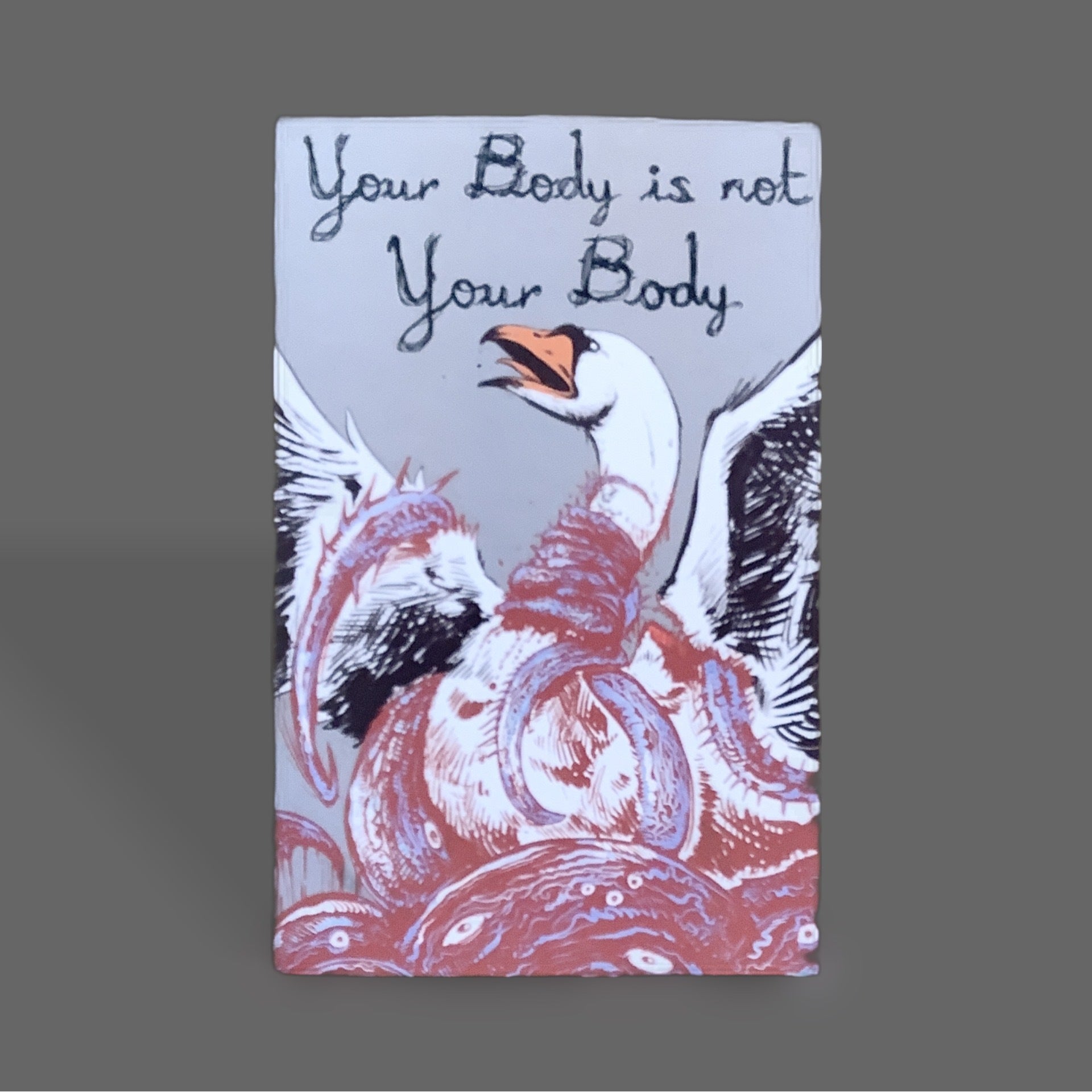
You think you're looking at "you" in the mirror. It's a natural assumption. You see skin, eyes, maybe a few stray hairs, and you assume that's a singular organism. But honestly? You're basically just a high-end apartment complex for trillions of things that aren't you. When people say your body is not your body, they aren't being metaphorical or poetic. They’re being literal.
Biologically speaking, you are a "holobiont." That’s a fancy term scientists use to describe a host and the sea of microscopic life living in and on it. If we’re counting by cell numbers, you’re actually outnumbered. Current research suggests that the human body contains roughly 30 trillion human cells, but it also hosts about 39 trillion microbial cells. You’re more "them" than "you."
It’s a bit of a mind-trip.
The trillions of strangers living in your gut
The microbiome is where the your body is not your body reality hits hardest. Most of these microbes live in your large intestine. They aren’t just hitching a ride; they’re running the show. They digest the fiber you can’t, they manufacture vitamins like B12 and K, and they train your immune system to tell the difference between a harmless piece of pollen and a deadly pathogen.
Dr. Rob Knight, a leading researcher at the University of California San Diego and co-founder of the American Gut Project, has often pointed out how little of our genetic material is actually human. If you look at the genes, it’s even weirder. Your human genome has about 20,000 to 25,000 genes. The microbes living inside you? They bring about 2 million to 20 million genes to the party.
Think about that.
The vast majority of the "instructions" being carried out inside your physical form aren't even coming from your own DNA. They're coming from bacteria. These microbes influence your weight, your cravings, and even how you respond to certain medications. If you’ve ever had a sudden, inexplicable craving for sugar, it might not be your brain talking—it might be a specific strain of yeast or bacteria in your gut demanding a snack.
Your brain isn't exactly calling all the shots
There’s this thing called the gut-brain axis. It sounds like sci-fi, but it’s just biology. The vagus nerve acts like a massive data cable running between your digestive system and your head. But the traffic isn’t one-way. About 90% of the fibers in the vagus nerve are actually carrying information up from the gut to the brain, not the other way around.
Serotonin is a great example. You probably think of it as a brain chemical—the "feel-good" neurotransmitter. Well, roughly 95% of your body's serotonin is produced in your gut, largely influenced by microbial activity. When the balance of your microbiome shifts, your mood shifts. You might feel anxious or depressed not because of a "chemical imbalance" in your brain, but because the "not-you" part of your body is having a bad day.
It makes the concept of "free will" feel a little slippery. If a bacterial colony can nudge your mood or influence your anxiety levels, who is really in the driver's seat?
The foreign DNA hiding in your own cells
Even if we zoom in past the bacteria and look at your "actual" human cells, the your body is not your body theme continues. Let’s talk about mitochondria. You probably remember from 10th-grade biology that they’re the "powerhouse of the cell."
What the textbooks often gloss over is the Endosymbiotic Theory. Billions of years ago, mitochondria were likely independent bacteria. At some point, they were engulfed by another cell, and instead of being digested, they stayed. They kept their own separate DNA. To this day, the mitochondria in every single one of your cells have a different genetic code than the DNA in your nucleus. They are foreigners that moved in and never left.
And then there are the viruses.
A massive chunk of the human genome—roughly 8%—is made up of "Endogenous Retroviruses" (ERVs). These are literal remnants of ancient viral infections that happened to our ancestors millions of years ago. These viruses "pasted" their DNA into ours, and it got passed down through generations. Some of this viral DNA is actually essential now. For instance, a protein called syncytin, which is necessary for the development of the placenta in pregnancy, is actually derived from an ancient virus. Without that "non-human" DNA, human birth wouldn't even be possible.
Microchimerism: You are a mosaic of your family
This is where it gets knd of emotional. If you are a mother, or if you have ever been a fetus (which, last I checked, covers everyone), you are likely a chimera.
During pregnancy, cells pass back and forth through the placenta. Some of the baby's cells end up in the mother's blood, and some of the mother's cells end up in the baby. This is called microchimerism. These cells don't just float around and die. They migrate. They settle in the heart, the lungs, and even the brain.
A study published in PLOS ONE back in 2012 found male DNA in the brains of women, some of whom were in their 90s. This DNA likely came from their sons during pregnancy decades earlier. These foreign cells can persist for a lifetime.
So, if you’re a woman who has been pregnant, you literally carry the living cells of your children within your organs. If you are a child, you carry cells from your mother. You aren't a single biological unit; you are a mosaic of the people who came before you and the people you brought into the world. It’s a beautiful, slightly eerie reminder that the boundaries of the self are incredibly porous.
The skin is a shifting border
We think of skin as a wall. It’s the barrier between "me" and "the world."
In reality, your skin is a crowded marketplace. It has its own microbiome, distinct from your gut. The bacteria on your left hand are likely very different from the bacteria on your right hand. If you live with a partner or a dog, your skin microbiomes start to blend. You literally swap "selves" with the people and animals you touch.
And let’s not forget the Demodex mites.
I’m sorry to be the one to tell you this, but you almost certainly have microscopic, eight-legged mites living in your hair follicles and oil glands, especially around your nose and eyelashes. They’re called Demodex folliculorum. They come out at night to crawl around and find mates. They are an inseparable part of the human experience. You can’t scrub them off. They are part of the "not-you" that makes up "you."
Why this actually matters for your health
Understanding that your body is not your body isn't just a fun dinner party fact. It changes how we treat disease.
For a long time, Western medicine treated the body like a machine with isolated parts. If you had a skin issue, you looked at the skin. If you had a mood issue, you looked at the brain. Now, we're realizing that's a narrow way to look at it.
- Fecal Transplants: This is the ultimate proof that you are an ecosystem. Doctors can treat life-threatening infections like C. difficile by taking the "not-you" (stool/bacteria) from a healthy person and putting it into a sick person. The success rate is staggering—often over 90%. It’s not a drug; it’s a community of organisms fixing a broken ecosystem.
- The Hygiene Hypothesis: We’ve become so obsessed with killing germs that we’ve accidentally damaged our own internal forests. This lack of microbial diversity is being linked to the rise in allergies, asthma, and autoimmune diseases. Our human cells are bored and confused because their microbial partners are missing.
- Dietary Shift: When you eat, you aren't just feeding your human cells. You're farming. If you eat a lot of processed sugar, you're "fertilizing" the microbes that thrive on sugar, which can then send signals to your brain to make you want even more.
Actionable steps to embrace your ecosystem
Since you’re basically a walking planet, you might as well be a good landlord. You can’t control your mitochondrial DNA or the viral remnants in your genome, but you can influence the 39 trillion microbes that call you home.
- Feed the "Not-You": Focus on prebiotics. These are fibers found in things like onions, garlic, leeks, and asparagus. Your human body can’t digest these, but your beneficial bacteria love them. If you don't feed them, some strains will actually start eating the mucus lining of your gut for fuel.
- Stop over-sanitizing: You don't need to kill 99.9% of germs on every surface. Frequent use of antibacterial soaps can disrupt the delicate balance of your skin's microbiome. Plain soap and water are usually enough.
- Get outside: Soil is incredibly diverse. Spending time in nature, gardening, or even just being around animals introduces "old friends"—microbes that humans evolved with over millions of years. This helps keep your immune system calibrated.
- Diverse diet, diverse self: The American Gut Project found that people who eat more than 30 different types of plants per week have significantly more diverse microbiomes than those who eat fewer than 10. Variety is the key to a stable ecosystem.
- Listen to your "second brain": Pay attention to how your mood fluctuates based on what you eat. If you feel "brain fog" after a week of poor eating, it's not a moral failing. It’s a biological signal from the trillions of organisms that are currently unhappy with their environment.
The idea that your body is not your body can feel a bit de-centering. It’s weird to think of yourself as a collection of viruses, bacteria, and foreign cells. But there’s also something incredibly grounding about it. You are never truly alone. You are a collaborative effort—a complex, thriving, breathing community that has been millions of years in the making.
Stop trying to be a singular entity. You’re a crowd. And once you start treating that crowd with a little more respect, your "human" half usually starts feeling a whole lot better.
/i.s3.glbimg.com/v1/AUTH_08fbf48bc0524877943fe86e43087e7a/internal_photos/bs/2025/H/e/ewwgKCQCSopdUJUwy6DA/imagem-2025-04-27-114802986.png)


