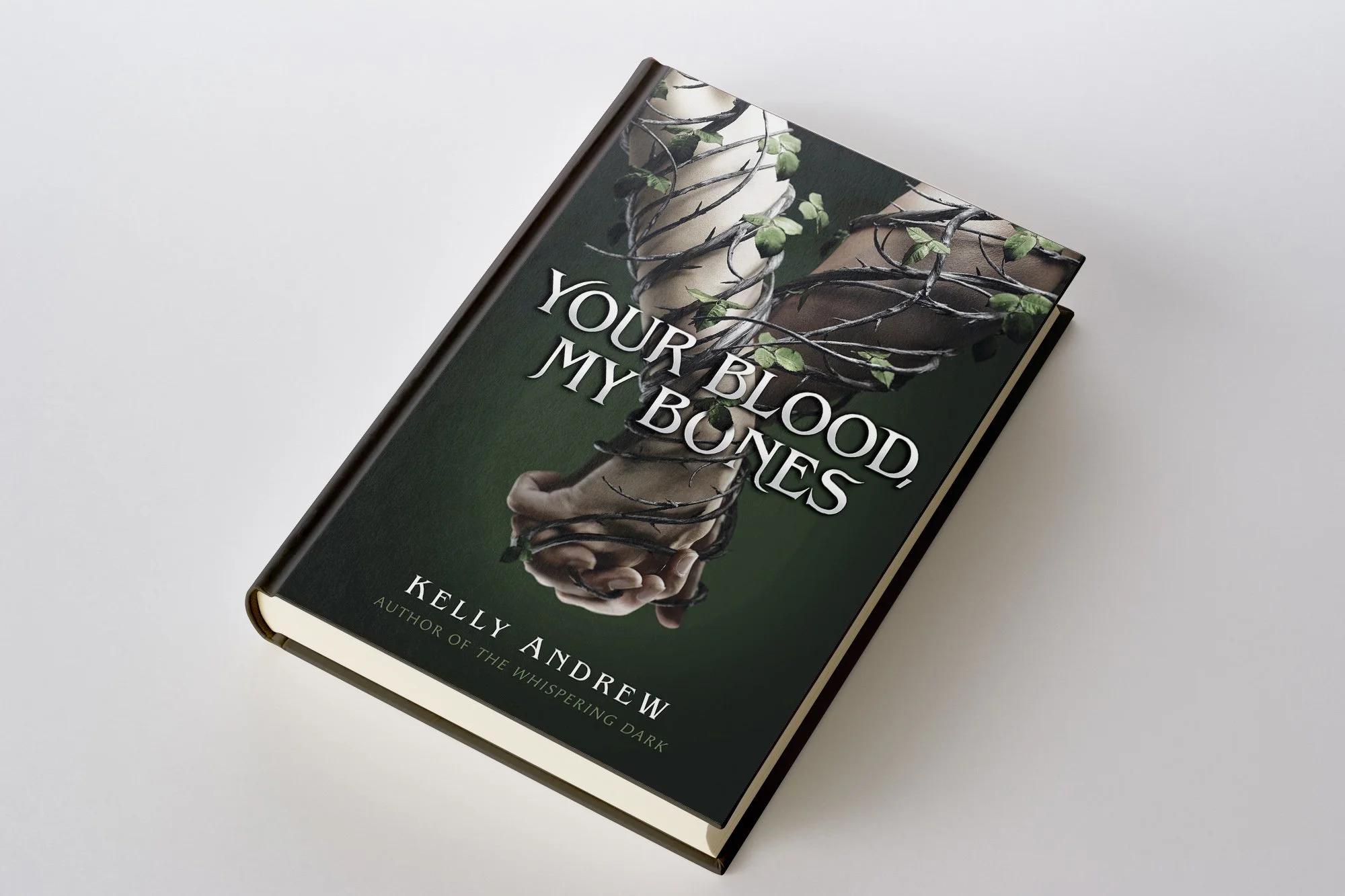
Let’s be real for a second. Most young adult thrillers follow a predictable recipe. You've got the brooding love interest, a "shocking" family secret that everyone sees coming by page fifty, and a protagonist who somehow makes every wrong decision possible. Then there’s Your Blood My Bones by Kelly Andrew. This book doesn't just lean into the tropes; it drags them out into the woods, buries them, and then invites you to dance on the grave. It's messy. It’s loud. It’s visceral in a way that most "dark" fiction is too scared to be.
If you haven't read it yet, you're missing out on a specific kind of literary trauma. Andrew, who previously gave us The Whispering Dark, has this uncanny ability to make the atmosphere feel like a physical weight on your chest. The story follows Wyatt Westcott, a girl who returns to her family’s farm after her father’s death, only to find the boy she thought she killed—Peter—is very much alive. And also, he’s basically her inheritance. It’s a premise that sounds like it could be a Hallmark movie if Hallmark were run by a cult of eldritch deities.
People are still talking about this book because it scratches an itch for "folklore horror" that isn't just about jump scares. It’s about the inherited rot of a family tree.
The Raw Appeal of Wyatt and Peter’s Toxic Bond
Look, we need to talk about the "romance" in Your Blood My Bones. I use air quotes because calling it a romance feels a bit like calling a hurricane a "light breeze." It’s a symbiotic, terrifying connection. Peter is literally tied to the land and to Wyatt’s family line. He isn't the sparkling vampire or the misunderstood bad boy. He’s a monster. But the kicker? Wyatt is arguably just as dangerous.
The power dynamic is constantly shifting. One minute you think Wyatt is the victim of her father’s legacy, and the next, you realize she’s the one holding the leash. Andrew writes their interactions with a jagged edge. There’s no soft landing here. Fans of the "enemies-to-lovers" trope often complain that the "enemies" part ends too quickly. That isn't a problem here. The animosity is baked into their very marrow.
What makes this work for a modern audience is the lack of sanitization. We live in an era where everyone wants characters to be "likable." Wyatt isn't always likable. She’s grieving, she’s angry, and she’s fundamentally broken by a father who viewed her more as a tool than a daughter. Peter is a reflection of that damage. Their relationship functions as a metaphor for how we carry the sins of our parents in our own veins.
Folk Horror and the Gothic Farmhouse
Setting is everything. If this story took place in a high-tech city, it wouldn’t work. The Westcott farm is its own character. It’s a place where the dirt feels hungry. Kelly Andrew uses the "Gothic" label effectively, but it’s more than just old houses and shadows. It’s "Rural Gothic"—a subgenre that acknowledges that the countryside isn't peaceful; it's a place where things go to die and decompose.
The magic system—if you can even call it that—is intentionally vague and bloody. It’s based on sacrifice and legacy. In Your Blood My Bones, magic isn't something you learn from a dusty book in a library. It’s something you pay for. Usually in red. This groundedness makes the supernatural elements feel terrifyingly possible. When the ground starts demanding its due, you aren't thinking about sparks and light shows; you’re thinking about the smell of wet earth and copper.
Why the Ending of Your Blood My Bones Divides Readers
No spoilers here, but the conclusion of this book is a polarizing topic in book clubs across the internet. Some people find it devastatingly beautiful. Others find it infuriating. Why? Because it refuses to give the reader a "clean" win.
In a typical YA novel, the hero defeats the evil, saves the world, and gets the guy. Andrew doesn't play that game. The resolution is as tangled as the briars surrounding the Westcott estate. It forces the reader to confront a hard truth: sometimes, the only way to survive a cycle of abuse is to burn the whole thing down, even if you’re still standing inside the building.
This complexity is why the book has such a high "re-read" value. You go back looking for the clues you missed. You realize that the foreshadowing wasn't just in the plot points, but in the very cadence of the prose. The way Andrew describes Peter’s movements or Wyatt’s internal monologue changes once you know where the path ends. It’s a masterclass in atmospheric tension.
Comparing Kelly Andrew to Other Dark Fantasy Heavyweights
If you like Your Blood My Bones, you’ve probably already devoured everything by V.E. Schwab or Holly Black. But Andrew brings something different to the table—a certain "crunchiness" to the writing. While Schwab is lyrical and Black is sharp, Andrew is heavy. There’s a weight to the sentences.
Think about The Cruel Prince. It’s about political intrigue and faerie malice. Your Blood My Bones feels more intimate, like a secret whispered in a dark room. It shares DNA with The Raven Cycle by Maggie Stiefvater in its exploration of "boys born to die" and magical landscapes, but it strips away the whimsical elements and replaces them with a grit that feels more akin to a slasher film.
It’s also worth noting how the book handles disability. Kelly Andrew is a d/Deaf author, and she brings a unique sensory perspective to her writing. This isn't just about representation; it’s about how the characters experience their environment. The focus on vibrations, tactile sensations, and visual cues makes the horror feel more immediate. You don’t just see the monster; you feel the floorboards hum when it moves.
Digging Into the Symbolism: Blood, Bone, and Soil
The title isn't just a catchy phrase. It’s a literal description of the themes.
- Blood: Represents the biological tether. You can’t escape your DNA.
- Bones: Represents the structure of the past. The foundations we build our lives on.
- Soil: The hungry maw that waits for both.
The narrative constantly circles back to the idea that we are made of the people who came before us. If your ancestors were monsters, what does that make you? Wyatt’s struggle is the central heart of the book. She is trying to find a way to be herself while carrying the literal and metaphorical "blood" of a man she despised.
It's a heavy topic for a YA book, but teenagers (and adults who read YA) aren't stupid. They know that life is complicated. They know that families are messy. By leaning into the darkness, Andrew actually creates something more "real" than a sanitized contemporary drama.
Common Misconceptions About the Plot
People often go into this thinking it’s a standard "ghost story." It’s not. If you’re looking for a traditional haunting with translucent figures and rattling chains, you’re going to be surprised. The "ghosts" in this book are very much flesh and blood. Or, at least, they were once.
Another misconception is that it’s a "romance first" book. While the relationship between Wyatt and Peter is central, the primary focus is Wyatt’s autonomy. It’s about her reclaiming her life from a dead man’s grip. The romance is a byproduct of two broken people trying to find a reason to keep breathing in a place that wants them dead.
Actionable Steps for Your Next Read
If you’ve finished Your Blood My Bones and you’re currently staring at a wall wondering what to do with your life, here’s a roadmap for your next literary fix.
- Read The Whispering Dark: If you liked the atmosphere, Andrew’s debut is a must. It deals with a prestigious academy, parallel dimensions, and a similar sense of creeping dread.
- Dive into Folk Horror: Check out Starling House by Alix E. Harrow or Small Favors by Erin A. Craig. These books share that "hungry land" vibe that makes Andrew’s work so compelling.
- Listen to the Audiobook: The narrator for Your Blood My Bones does an incredible job of capturing Wyatt’s weariness and Peter’s otherworldly nature. It changes the experience entirely.
- Annotate Your Copy: This is one of those books that rewards deep dives. Look for the recurring motifs of "hunger" and "debt." You’ll find that almost every scene serves a dual purpose.
- Explore the "Southern Gothic" Genre: Even though this is set in the rural Midwest/East, it shares the DNA of Southern Gothic literature. Pick up some Flannery O’Connor or Shirley Jackson to see where these tropes originated.
Ultimately, Your Blood My Bones is a reminder that the most terrifying things aren't hiding under the bed. They’re inside us. They’re in the way we love people who hurt us and the way we try to outrun a past that is literally part of our anatomy. It’s a brutal, beautiful read that deserves every bit of the hype it has generated. Just don’t expect to feel "fine" after you close the back cover. You aren't supposed to. Instead, you’ll feel a little more aware of the dirt under your fingernails and the history in your veins.



