If you’re staring at your 90-pound Golden Retriever or your massive Great Dane and trying to do the "seven years for every human year" math, stop. Just stop. Honestly, that old rule is a total myth, especially for the heavyweights of the canine world. It’s misleading. It's actually kinda dangerous because it masks how quickly senior health issues can sneak up on a large animal.
Big dogs live on a completely different biological clock than a Chihuahua or a Yorkie. They age faster. They hit "senior" status while smaller dogs are still basically in their prime. If you want to understand the big dog age chart, you have to look at the cellular level, not just a simple multiplication table.
The Biology of Why Big Dogs Age Faster
It’s one of nature’s weirdest ironies. In the wild, larger mammals—like whales and elephants—usually live much longer than small ones like mice. But with dogs? Everything is flipped. Researchers like Dr. Cornelia Kraus, an evolutionary biologist at the University of Göttingen, have looked into this extensively. Her research suggests that large dogs age at an accelerated pace.
Basically, their lives unwind in fast-forward.
Think about the sheer growth a Mastiff puppy goes through. They go from a tiny five-pound peanut to a 150-pound giant in less than two years. That's explosive. That rapid cell division is taxing. It increases the risk of abnormal cell growth, which is why cancer is such a heartbreakingly common reality for big breeds. Their bodies are working overtime just to maintain that mass.
Because they grow so fast, their bodies seem to wear out sooner. You’ll see it in their joints. You’ll see it in their hearts. A Great Dane is often considered "old" by age six or seven. Meanwhile, a Toy Poodle is just hitting middle age at ten. It’s a massive gap that most owners aren't ready for.
Reading the Real Big Dog Age Chart
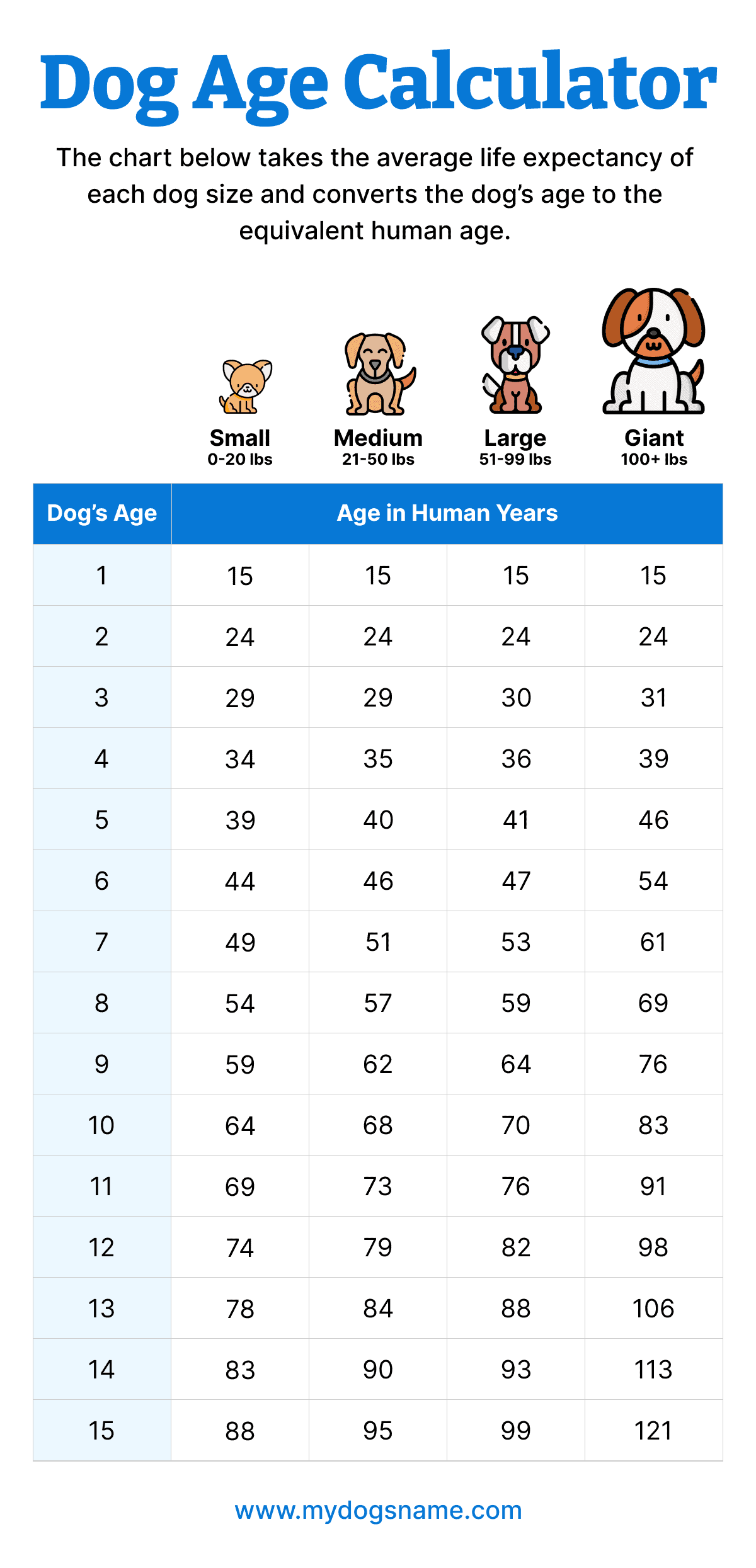
Forget the old charts you saw at the vet's office in 1995. The modern understanding of canine geriatrics breaks things down by weight class. A "big dog" usually refers to anyone over 50 pounds, but once you cross the 100-pound "giant breed" threshold, the numbers shift again.
For a dog between 50 and 90 pounds: By the time they hit age 2, they are roughly 24 in human years. At age 5, they are about 45. By age 8, they’ve jumped to 64. At age 10, they are effectively 78 years old.
Now, look at the giant breeds (100+ pounds): At age 2, they are already 24. By age 5, they’ve accelerated to 49. By age 8, they are essentially 76. If a giant breed makes it to 10, they are effectively 96 years old in terms of wear and tear on their organs and bones.
You see the jump? The heavier the dog, the steeper the curve. That’s why you can’t treat a 7-year-old Lab the same way you treat a 7-year-old Beagle. The Lab’s "biological odometer" has way more miles on it.
The Health Milestones You Actually Need to Watch
Since the big dog age chart tells us these dogs enter their senior years around age 5 or 6, your vet visits need to change early. You can't wait until they look "old" to start senior screenings. By then, it’s often too late to manage chronic conditions effectively.
Joint Health and Mobility
Large dogs are heavy. Gravity is their enemy. Most big dogs will develop some form of osteoarthritis. It isn't just "slowing down." It’s pain.
Watch for the "bunny hop" when they run. Watch for them hesitating at the stairs or taking longer to stand up on a cold morning. These aren't just signs of getting older; they’re clinical symptoms. Using supplements like glucosamine, chondroitin, and Omega-3 fatty acids early—like, age 3 or 4—can actually change the trajectory of their mobility.
The Silent Threat of Bloat
Gastric Dilatation-Volvulus (GDV), or bloat, is the nightmare of every big dog owner. It’s when the stomach fills with gas and twists. It’s fatal within hours without surgery. Deep-chested dogs like Great Danes, Weimaraners, and Saint Bernards are the highest risk. As these dogs age and their tissues lose elasticity, the risk doesn't go away.
Heart Function
Big dogs have big hearts, literally. But those hearts have to work incredibly hard to pump blood across a large body. Dilated Cardiomyopathy (DCM) is a major concern. It’s basically when the heart muscle becomes thin and weak. If your big dog is coughing more than usual or getting tired after a short walk, don't ignore it. It’s not just "old age." It’s a pump that’s struggling.
Weight Management: The Only "Fountain of Youth"
If there is one thing that actually slows down the big dog age chart, it’s keeping them thin. Honestly, most people overfeed their big dogs because we love seeing them "robust." But every extra five pounds on a senior Mastiff is like twenty pounds on a human frame.
A famous long-term study by Purina (the Lifespan Study) followed Labradors for 14 years. They found that dogs kept at a lean body condition lived nearly two years longer than their slightly overweight counterparts. For a big dog, two years is a lifetime.
You should be able to feel your dog’s ribs easily. If you have to dig through a layer of "padding" to find them, your dog is overweight. Cutting back on kibble and replacing it with green beans is an old vet trick that works wonders for keeping the calories down while keeping the stomach full.
Creating a Senior-Friendly Environment
Since we know a 7-year-old big dog is basically a retiree, you have to adjust your house.
Stop making them jump into the car. Get a ramp. Every jump puts hundreds of pounds of pressure on those aging carpal and shoulder joints. It might look silly, but your dog's future mobility depends on it.
Orthopedic beds are a requirement, not a luxury. A thin rug on a hardwood floor is basically like sleeping on concrete for an 80-pound dog with hip dysplasia. They need 4 to 6 inches of high-quality memory foam to take the pressure off their pressure points.
Also, consider the floor. Hardwood and tile are like ice rinks for a senior dog. If they slip and tear a ligament (like the CCL), the recovery for a giant breed is brutal and expensive. Yoga mats or cheap runners from a hardware store can give them the "traction" they need to move confidently through the house.
Realities of the End Stages
It's the part nobody wants to talk about, but with big dogs, the conversation happens sooner than we'd like. Because they age so rapidly on the big dog age chart, their decline can sometimes feel sudden. One month they're hiking, the next they're struggling to get to the backyard.
Quality of life isn't just about "is the dog still eating?" It’s about "is the dog still being a dog?"
Vets often use the HHHHHMM scale (Hurt, Hunger, Hydration, Hygiene, Happiness, Mobility, More Good Days than Bad). For a big dog, mobility is usually the first thing to go. When a 120-pound dog can no longer stand up to go outside, it becomes a major management issue for the owner and a distress issue for the dog. Planning for this stage—knowing your boundaries and your dog's "must-have" activities—is part of being a responsible owner of a large breed.
Actionable Steps for Owners of Large Breeds
The numbers on a chart are just averages. You can influence how your specific dog handles the aging process by being proactive rather than reactive.
- Switch to Senior Labs Early: Start doing "senior blood work" at age 6 for large breeds and age 5 for giant breeds. This catches kidney and liver changes before the dog shows outward symptoms.
- Audit Their Weight Monthly: Don't rely on your eyes; use your hands. If the ribs are disappearing, cut the food by 10% immediately.
- Invest in Traction: Put down rugs or runners on slippery floors today. Don't wait for the first fall.
- Prioritize Low-Impact Exercise: Swap the high-intensity fetch games for long, slow walks or swimming. Swimming is the gold standard for big dogs because it builds muscle without crushing their joints.
- Check for Lumps: Large breeds are prone to lipomas (fatty tumors) but also more dangerous growths. Do a "hand-over-body" check once a week. If you find something new, get it aspirated by a vet.
Understanding the way big dogs age isn't about being morbid. It’s about respecting the fact that their time is compressed. By acknowledging that your 6-year-old giant is actually a senior citizen, you can provide the medical care, nutrition, and environmental support they need to make those years as comfortable as possible.