You’re sitting on the couch, scrolling through your phone, and you feel that familiar little thud in your chest. Or maybe your smartwatch buzzed because your heart rate dipped to 48 while you were watching Netflix. Naturally, you panic. You start Googling an average resting heart rate chart to see if you’re dying or if you’re secretly an Olympic athlete.
Most people think a "normal" heart rate is 72 beats per minute. That’s the magic number we all learned in middle school health class, right? Well, it’s not that simple.
Your heart is basically a high-tech pump that responds to everything—your last cup of coffee, how much sleep you got, and even that passive-aggressive email from your boss. A "normal" range is actually quite wide. According to the American Heart Association, a typical resting heart rate (RHR) for adults ranges from 60 to 100 beats per minute (bpm). But honestly? If you’re a runner, 40 bpm might be your normal. If you’re stressed and dehydrated, 95 bpm might be yours.
It’s about trends, not just a single snapshot on a chart.
Why an Average Resting Heart Rate Chart Is Just a Starting Point
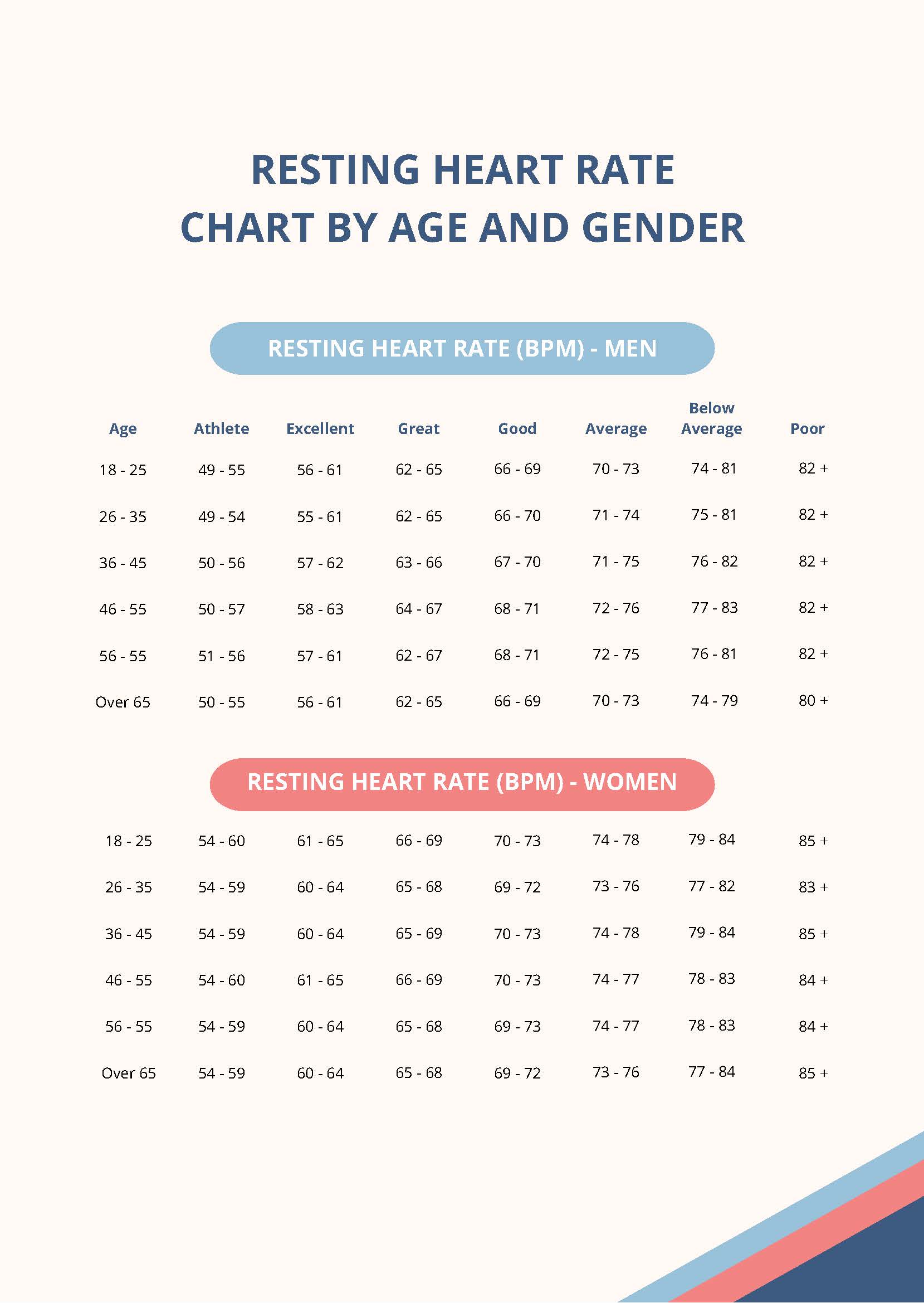
If you look at a standard average resting heart rate chart, you’ll see rows for age and columns for fitness levels. It looks clean. It looks scientific. But these charts are based on massive population averages. They don't know you. They don't know your genetics or your medication list.
Take a look at how these numbers usually break down for adults:
For elite athletes, a "good" resting heart rate is often between 40 and 50 bpm. Think of people like Miguel Induráin, the legendary cyclist; his resting heart rate was reportedly 28 bpm. That’s nearly a "flatline" for a normal person, but for him, it was a sign of a massive, hyper-efficient heart.
For the rest of us mere mortals who aren't winning the Tour de France, "excellent" is usually 50 to 60 bpm. "Normal" or "Average" sits in that 60 to 80 bpm pocket. Once you start creeping into the 80s and 90s, you’re in the "Below Average" or "Sedentary" category. If you’re consistently over 100 bpm while sitting perfectly still, doctors call that tachycardia.
It's a lot to track.
Age Doesn't Change Things as Much as You Think
Surprisingly, your RHR doesn't actually skyrocket just because you've had more birthdays. While your maximum heart rate drops as you age (that's the $220 - \text{age}$ formula we've all heard), your resting rate stays relatively stable across your adult life. A 25-year-old and a 65-year-old could both have an RHR of 62 and be perfectly healthy.
Children are the exception. Their hearts are smaller and beat much faster. A newborn’s heart might race at 130 bpm just lying there. By age 10, they start settling into the adult range.
The Hidden Factors That Mess With Your Numbers
You can’t just look at a chart and call it a day because your heart is sensitive. It’s reactive.
Stress and Anxiety This is the big one. When your sympathetic nervous system kicks in—the "fight or flight" mode—your adrenal glands dump cortisol and adrenaline into your bloodstream. Your heart rate climbs. You might be sitting still, but your heart thinks you're being chased by a tiger.
Dehydration When you’re dehydrated, your blood volume actually decreases. This makes your blood thicker and harder to move. Your heart has to beat more often to circulate that "sludge" around your body. If your RHR is 5–10 beats higher than usual, go drink a glass of water. Seriously.
Temperature and Humidity In extreme heat, your body sends more blood to your skin to help you cool down. This puts an extra load on the pump. It’s not uncommon to see your RHR jump by 10 bpm when it’s 95 degrees outside with high humidity.
Medications and Supplements Beta-blockers, often used for blood pressure, will artificially lower your heart rate. On the flip side, ADHD medications (stimulants) or even over-the-counter decongestants can send it soaring. And let’s not forget caffeine. That double espresso stays in your system for hours, keeping your ticker moving faster than the average resting heart rate chart suggests it should.
When Should You Actually Worry?
Numbers are just numbers until they come with symptoms.
If your heart rate is 55 but you feel energetic and clear-headed, you're likely just fit. But if your heart rate is 55 and you feel dizzy, faint, or short of breath, that’s called bradycardia. That’s a "call your doctor" situation.
The same goes for the high end. A resting rate consistently over 100 (tachycardia) can wear out the heart muscle over time. It’s inefficient. It’s like idling your car engine at 4,000 RPM while parked in the driveway. It's going to cause problems eventually.
The "Athletic" Misconception
A lot of people think having a low heart rate is always a badge of honor. It’s usually a sign of a strong heart muscle (stroke volume), but not always. Sometimes a low RHR is a sign of an electrical issue in the heart or a thyroid problem (hypothyroidism).
Dr. Eric Topol, a renowned cardiologist, has often noted that digital health tools give us more data than we know what to do with. We see a dip on our Apple Watch at 3 AM and we freak out. But your heart rate should drop while you sleep. It’s the body’s chance to recover. Seeing 38 or 42 bpm during deep sleep is actually pretty normal for many people.
How to Get an Accurate Reading
Don't check your heart rate right after you've walked up the stairs or finished an argument. You’ll get a junk reading.
- Morning is king. The most accurate RHR is taken the moment you wake up, before you even get out of bed.
- Find your pulse. Use your index and middle fingers (not your thumb, it has its own pulse) on your wrist or the side of your neck.
- Count for 60 seconds. Or count for 15 seconds and multiply by four, though a full minute is more precise if you have an irregular rhythm.
- Consistency matters. Do this for three days in a row and average the numbers. That is your true baseline.
Improving Your Numbers Without Medication
If you’ve looked at the average resting heart rate chart and realized you're in the "Poor" category, don't spiral. Your RHR is one of the most "trainable" biometrics we have.
Cardio is the obvious answer. When you do aerobic exercise—swimming, brisk walking, cycling—you are literally training your heart to be a bigger, stronger pump. A stronger heart pumps more blood with every single beat. Therefore, it doesn't have to beat as often. It’s pure efficiency.
Sleep hygiene is the underrated answer. Chronic sleep deprivation keeps your body in a state of low-level stress. This keeps your RHR elevated. Just getting an extra hour of sleep can sometimes drop your RHR by 3–5 beats over a few weeks.
Magnesium and Potassium. These electrolytes are responsible for the electrical signals that tell your heart when to beat. Many people are slightly deficient in magnesium, which can lead to "palpitations" or a slightly higher resting rate. Focus on leafy greens, nuts, and avocados.
The Bottom Line on Heart Rate Charts
A chart is a map, but it’s not the terrain.
Don't obsess over being exactly at 60 or 70. Instead, look for shifts. If your baseline is usually 62 and suddenly you're hovering at 75 for a week, your body is trying to tell you something. Maybe you’re overtraining. Maybe you’re fighting off a cold before the symptoms even hit. Maybe you're just really, really stressed.
Your heart is the ultimate storyteller of your internal health. Listen to it, but don't let a generic chart define your fitness.
Actionable Next Steps
- Establish your true baseline: Measure your heart rate manually for three consecutive mornings before getting out of bed to find your "real" number.
- Audit your lifestyle: If your RHR is consistently 10+ beats higher than the "fit" category for your age, track your caffeine and alcohol intake for one week to see if there's a correlation.
- Incorporate "Zone 2" training: Aim for 150 minutes a week of steady-state cardio where you can still hold a conversation; this is the most effective way to lower a high RHR over time.
- Check your medications: Review any stimulants or blood pressure meds with a pharmacist to understand how they might be skewing your heart rate data.
- Watch for symptoms: If your heart rate stays above 100 or below 50 while resting—and you feel "off"—schedule an EKG to rule out underlying electrical issues.
/i.s3.glbimg.com/v1/AUTH_08fbf48bc0524877943fe86e43087e7a/internal_photos/bs/2025/H/e/ewwgKCQCSopdUJUwy6DA/imagem-2025-04-27-114802986.png)


