You probably think you know your sign. You’ve checked the back of a magazine or a TikTok filter and settled on being a "typical" Leo or a "classic" Scorpio. But here’s the thing—the astrological signs dates list most people use is based on a system that hasn’t moved in two thousand years. While the Earth wobbles on its axis, the calendar we use for Western astrology stays fixed to the seasons. It’s kinda wild when you think about it. You’re looking at a map of the sky that doesn't actually match the sky above your head right now.
Most of us use Tropical astrology. This system anchors the start of the zodiac to the Vernal Equinox. When the sun hits that specific point in March, it's Aries season, period. It doesn't matter if the constellation of Aries has drifted a few degrees over the last few centuries. It’s about the cycle of the sun and the Earth’s relationship to it. It's a symbolic language. It’s math, but with a soul.
The Standard Astrological Signs Dates List Used Today
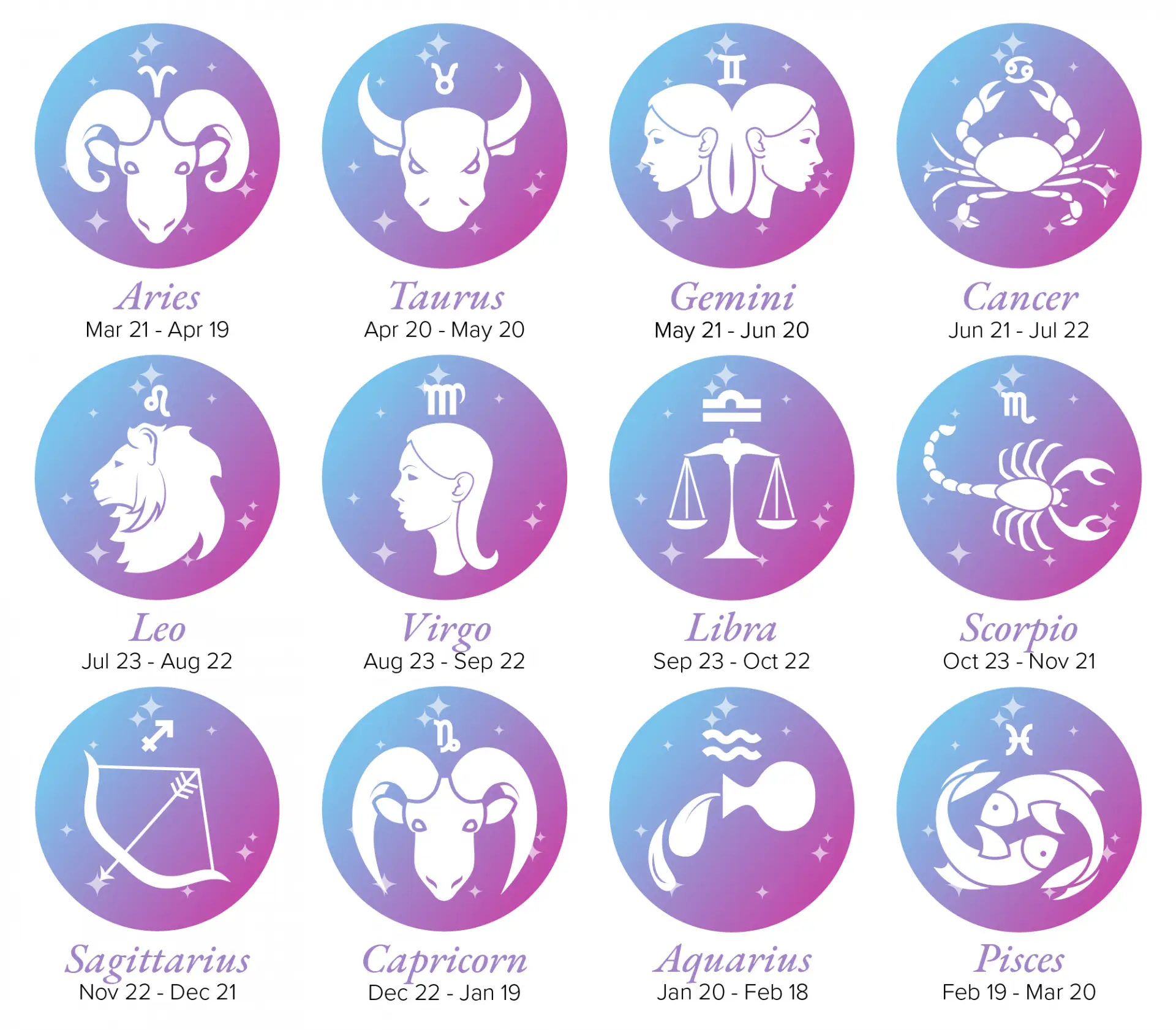
If you’re looking for the quick answer, here’s the breakdown. Most Western astrologers, including big names like Susan Miller or the writers at Astrology Zone, stick to these specific windows. These dates represent when the Sun enters and exits each sign’s "territory" in the 360-degree circle of the zodiac.
Aries: March 21 – April 19. This is the spark. It’s the beginning of the astrological year. If you’re born on the "cusp," say April 19th, you might feel like a mix, but technically the Sun is in one place or the other at the exact minute of your birth.
Taurus: April 20 – May 20. Fixed earth. It’s about stability. People born in this window often get labeled as "stubborn," but honestly, it’s just a high level of persistence.
Gemini: May 21 – June 20. The first of the air signs. Gemini is the reason your group chat is always popping off. It’s about duality and information.
Cancer: June 21 – July 22. This kicks off the Summer Solstice. It’s deep, emotional, and protective. Think of the crab—hard shell, soft inside.
Leo: July 23 – August 22. The peak of summer. It’s ruled by the Sun. It’s about visibility.
Virgo: August 23 – September 22. This is the harvest season. It’s analytical and grounded.
Libra: September 23 – October 22. Balancing the scales at the Equinox. It’s the sign of "the other," focusing on partnerships and aesthetics.
Scorpio: October 23 – November 21. Intensity. It’s the mid-point of Autumn. Everyone’s scared of Scorpios, but they’re just the ones willing to look at the stuff nobody else wants to talk about.
Sagittarius: November 22 – December 21. The Archer. It’s about expansion, travel, and maybe a bit of bluntness that gets them into trouble.
Capricorn: December 22 – January 19. The Winter Solstice. This is the goat-fish. It’s about climbing the mountain and building a legacy.
Aquarius: January 20 – February 18. The rebel. It’s fixed air, meaning they have very firm ideas about how to change the world.
Pisces: February 19 – March 20. The end of the cycle. It’s the collective unconscious. It’s dreamy, it’s messy, and it’s deeply empathetic.
What’s the Deal With Ophiuchus?
Every few years, a NASA post goes viral and everyone has a collective meltdown because they think their sign changed. You've seen the headlines. "NASA adds 13th sign!" "Your life is a lie!"
Relax.
NASA is concerned with astronomy—the actual physical location of stars. Astrology is a separate system of symbols. Ophiuchus is a real constellation. It sits between Scorpio and Sagittarius. If you look at the ecliptic (the path the sun appears to take), it does technically pass through Ophiuchus. But Western astrology is based on twelve 30-degree segments. Adding a 13th sign would break the geometry of the entire system.
Ancient Babylonians knew Ophiuchus was there. They just chose twelve signs because it fit their 12-month calendar and the math worked out perfectly. So, if you see an astrological signs dates list that includes November 29 to December 17 as "Ophiuchus," just know that’s a different system entirely. You’re still a Sagittarius in the Western tradition. Don't go burning your birth chart just yet.
Tropical vs. Sidereal: The Great Debate
There are actually two main "lists" of dates.
- Tropical Astrology: Used by most Westerners. It’s seasonal.
- Sidereal Astrology: Used in Vedic (Indian) astrology. It accounts for "precession."
Precession is the Earth’s slow "wobble." Over 26,000 years, the Earth’s axis completes a full circle. This means the stars behind the sun on your birthday are actually about 24 degrees off from where they were 2,000 years ago. If you look at a Sidereal astrological signs dates list, your sign might shift back by nearly an entire month. Most people who think they’re an Aries in the West are actually a Pisces in the Vedic system.
Which one is right? Honestly, both. They just measure different things. Tropical astrology measures our relationship to the Sun and the seasons on Earth. Sidereal measures our relationship to the distant stars. It’s like using two different maps for the same city—one shows the transit lines, the other shows the historic landmarks. Both get you where you're going.
Why the Cusp is Kinda a Myth
You’ll hear people say, "I’m on the cusp of Leo and Virgo, so I’m both."
In professional astrology, there is no such thing as being "both." The Sun can only be in one sign at a time. If the Sun moves from Leo to Virgo at 4:12 PM on August 23rd, and you were born at 4:11 PM, you are a Leo. Period.
However, you might feel like a Virgo. Why? Because Mercury and Venus are never very far from the Sun. If you’re a late-degree Leo, there’s a massive chance your Mercury or Venus is already sitting in Virgo. That’s where the "overlap" feeling comes from. It's not that the signs are blending; it's that your entire chart is a cocktail of different energies. To get your actual sign, you need your exact birth time and city. A few minutes can literally change your entire identity in the eyes of an astrologer.
How to Actually Use This Information
Knowing your dates is just the "Hello World" of astrology. It’s the bare minimum. If you want to actually use this for self-reflection or planning, you have to look beyond the Sun sign.
- Check your Rising Sign: This is the sign that was coming over the horizon the second you took your first breath. It changes every two hours. This is arguably more "you" than your Sun sign because it determines the layout of your entire birth chart.
- The Moon Matters: Your Sun sign is your ego and your "will." Your Moon sign is how you feel when you’re alone in your room at 2 AM. It’s your emotional safety.
- Look at the Degrees: If you are at 0 degrees of a sign, you are "fresh." You’re learning that sign’s lessons for the first time. If you’re at 29 degrees (the "anaretic degree"), you’re at a point of mastery or crisis with that energy.
Astrology isn't about "this is going to happen to you today." It’s more about "this is the weather you’re walking into." If the astrological signs dates list tells you it’s Mercury Retrograde in a fellow air sign, maybe don't sign that contract without a lawyer. It’s about timing.
Practical Steps for Your Chart
- Find your birth certificate. You need the exact minute. Don't guess. Don't ask your mom—she was busy that day and might be off by an hour.
- Use a reputable calculator. Sites like Astro.com or Astro-Charts are the gold standard. They use the Swiss Ephemeris, which is the most accurate data available.
- Ignore the "Horoscopes" in the Sunday paper. Those are written for 1/12th of the population. They’re too broad to be useful. Look for "Transit reports" instead, which compare where the planets are today to where they were when you were born.
- Observe the shifts. Notice how you feel when the Sun moves from a fire sign (Aries, Leo, Sag) into an earth sign (Taurus, Virgo, Cap). Does the energy feel slower? More productive? Start tracking your own moods against the calendar.
The dates are just the entry point. The real magic happens when you stop looking at the list and start looking at how those cycles actually show up in your life. You aren't just a paragraph in a book; you're a complex, moving map of the moment you arrived. Use the dates as a guide, but don't let them box you in. The stars impel, they do not compel. You’ve still got the wheel.