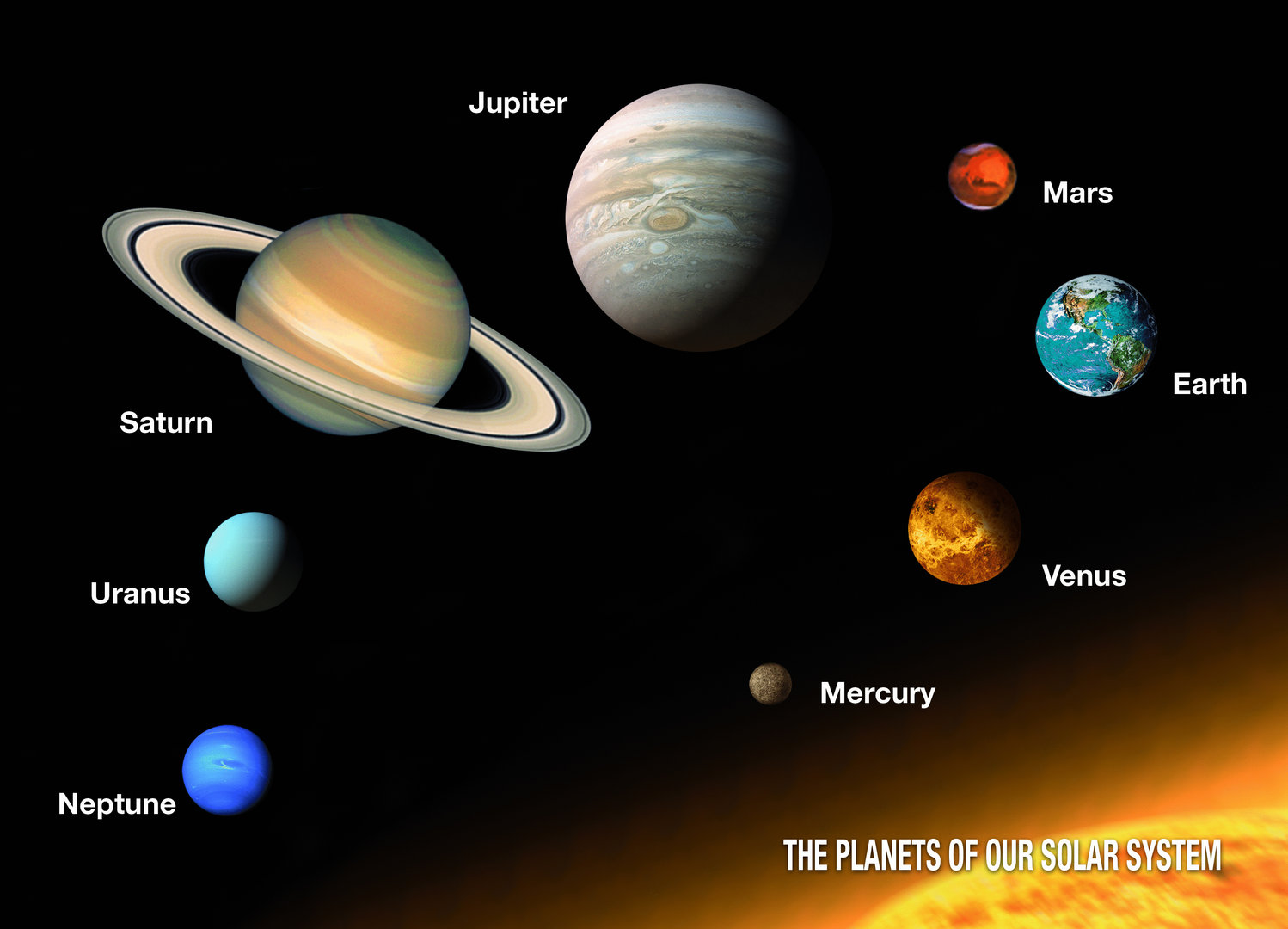
Time is weird. We think of a "year" as this fixed, universal constant, but it’s actually just a local measurement based on how fast our specific rock happens to be spinning around a specific star. If you moved to Venus tomorrow, your birthday cake would need way more candles—or maybe none at all for a very long time. Honestly, calculating your age on other planets isn’t just a fun party trick; it’s a deep dive into the chaotic mechanics of our solar system.
Most people assume that because we live in a 365-day cycle, the rest of the universe follows suit. It doesn't. Not even close. Space is messy.
The Physics of Aging (Off-World)
To understand why your age changes, you have to look at Kepler’s Laws of Planetary Motion. Basically, the closer a planet is to the Sun, the faster it has to travel to avoid being sucked into the fiery abyss. Mercury is screaming through space. Neptune, on the other hand, is just vibing in the suburbs of the solar system, taking its sweet time.
When we talk about a "year," we are talking about an orbital period. On Earth, that’s roughly 365.25 days. But on Mercury, a year is only 88 Earth days. If you’re 30 years old right now, you’ve actually seen 124 Mercury years go by. You’d be a centenarian. You’d probably be retired. On the flip side, if you were born on Neptune, you wouldn’t even be one year old yet. You’d be a literal infant in Neptunian time because it takes that planet 165 Earth years to finish a single lap.
Why Mercury Makes You Feel Old
Mercury is the solar system's speed demon. It orbits at about 47 kilometers per second. Because it's so close to the Sun, the gravitational pull is intense. If you want to calculate your age on other planets starting with Mercury, the math is simple: divide your current Earth age by 0.241.
Wait. It gets weirder.
Mercury’s "day" (rotation) is actually longer than its "year" (orbit) in some contexts. It takes 59 Earth days to rotate once, but only 88 to orbit. Imagine a world where you have a birthday more often than you see a sunrise. It’s enough to give anyone an existential crisis.
Venus: The Retrograde Outlier
Venus is a nightmare for timekeepers. It rotates backward compared to most other planets. This is called retrograde rotation. It also rotates incredibly slowly. It takes 243 Earth days to spin once on its axis, but only 225 Earth days to orbit the Sun.
So, on Venus, a day is literally longer than a year.
If you lived there, you’d celebrate your first birthday before the first day was even over. If you're 25 on Earth, you're about 40 in Venusian years. But you wouldn't even be 40 days old in Venusian time. Think about that next time you’re complaining about a long Monday.
How to Calculate Your Age on Other Planets Without a Degree in Astrophysics
You don’t need to be Neil deGrasse Tyson to figure this out. You just need the orbital ratios. NASA and the Exploratorium provide the specific decimals that define how these planets stack up against Earth.
If you want the DIY approach, here’s how the math breaks down:
The Inner Planets (The Fast Ones) Mercury: Earth Age / 0.241 Venus: Earth Age / 0.615 Mars: Earth Age / 1.881
The Gas Giants (The Slow Burners) Jupiter: Earth Age / 11.86 Saturn: Earth Age / 29.46 Uranus: Earth Age / 84.01 Neptune: Earth Age / 164.8
Let’s look at Mars for a second. Mars is the one we’re actually thinking about moving to, thanks to SpaceX and various Mars missions. A Martian year (a "sol") is almost double an Earth year. If you’re a 40-year-old executive on Earth, you’re a 21-year-old "youth" on Mars. You could basically start your whole career over.
The Jupiter Jump: Middle Age Disappears
Jupiter is massive. It’s so big that it doesn't even technically orbit the center of the Sun; they both orbit a point just outside the Sun's surface called the barycenter. Because it’s so far out, a year takes nearly 12 Earth years.
If you're 36, you’ve only been around the sun three times in Jupiter years.
This is where the concept of your age on other planets gets practical for science fiction writers and futurists. If humans ever become a multi-planetary species, we’re going to have to decide which clock we use. Do we keep "Earth Standard Time," or do we adapt to the local orbit? Imagine the legal headaches of trying to determine the drinking age on a colony orbiting Saturn. You’d have to wait nearly 600 Earth months to turn 21 in Saturnian years. No one is waiting that long for a beer.
Saturn and the Long Wait
Saturn is famous for its rings, but its orbital period is equally impressive. 29.5 Earth years. If you are currently experiencing a "Saturn Return" in astrology, it’s because Saturn has finally made it back to the spot in the sky where it was when you were born.
Essentially, a Saturnian year is an entire human generation.
If you lived on Saturn (which you can't, because you'd fall through the gas and be crushed by pressure, but let's pretend), you would only see two or three birthdays in a very long life. It puts our frantic Earthly pace into perspective. We’re rushing around trying to get things done in 365 days, while the outer planets are taking decades to complete a single cycle.
Beyond the Giants: Uranus and Neptune
Uranus takes 84 years to orbit. If you were born on Uranus, and you lived a decent, long life by Earth standards, you might—just maybe—celebrate your first birthday on your deathbed.
Then there’s Neptune. 165 years. Since Neptune was discovered in 1846, it has only completed about one and a bit orbits. Humans haven't even known about Neptune's existence for two full Neptunian years yet.
And Pluto? Don’t even get me started on Pluto. Even though it was demoted to a dwarf planet (a controversial move by the IAU in 2006 that people are still mad about), its year is 248 Earth years long. Since its discovery in 1930, Pluto hasn't even made it halfway around the Sun.
Why We Struggle to Visualize This
Our brains are hardwired for Earth's rhythm. Circadian rhythms dictate our sleep, our hormones, and our perception of time. When we look at your age on other planets, we’re confronting the fact that time is a construct of our environment.
Astronauts on the International Space Station (ISS) experience 16 sunrises and sunsets every 24 hours. They have to stick to a strict artificial schedule just to keep their bodies from falling apart. If we ever go to Mars, the "day" is about 24.6 hours. That’s close enough that humans can adapt, but those extra 40 minutes a day eventually add up to a massive shift in the calendar.
Practical Steps: Finding Your Space Age
If you want to dive deeper into this, you can actually use real-time data to track where the planets are right now. This isn't just about dividing numbers; it’s about understanding where you are in the cosmic neighborhood.
1. Use a dynamic calculator. The Exploratorium has a famous tool that does the math for you, including your weight on other planets (which is much more depressing on Jupiter, trust me).
2. Track the "Opposition." This is when Earth is between a planet and the Sun. It’s usually the best time to see these planets and realize just how far they’ve moved since your last birthday.
3. Adjust your perspective. Next time you feel like you’re "running out of time," remember that in the eyes of the solar system, you’re either a hyper-speed blur (on Mercury) or a frozen statue (on Neptune).
Time is relative. Your age is a reflection of your home, not your worth. If you feel old at 40, just move your mental headquarters to Jupiter. You’re only 3.3 years old there. You’ve barely learned to walk.
Go look at the night sky. Find Jupiter—it’s usually the brightest thing out there that isn’t a plane or the moon. Realize that while you’ve been through dozens of birthdays, heartbreaks, and job changes, that giant gas ball has only moved a fraction of its way around the Sun. It’s a humbling way to view a calendar.
For the most accurate results, you should use the orbital periods listed by the NASA Jet Propulsion Laboratory (JPL). They track these down to the second. While your Earthly age is determined by the Gregorian calendar, your cosmic age is a matter of pure celestial mechanics. It’s the one thing you can’t argue with.
To get started, take your age in days (multiply your years by 365.25) and divide that by the length of the year on your target planet in Earth days.
- Mercury: 88 days
- Mars: 687 days
- Jupiter: 4,333 days
- Saturn: 10,759 days
It’s a quick way to realize that "getting old" is just a matter of where you’re standing. In the grand scheme of things, we’re all just blinking in and out of existence in the time it takes Neptune to finish a single lap. Stay curious, keep looking up, and don't let a number on a calendar dictate how much energy you have. You’re technically a toddler somewhere in this galaxy.
Actionable Next Steps:
- Audit your "mental age": If you are feeling burnt out, calculate your Mars age. It’s a psychological trick that helps reframe your life stages.
- Download a Sky Map app: Use it to locate Saturn. Seeing the planet that takes 29 years to orbit makes your annual "busy season" feel a lot smaller.
- Check the JPL Solar System Dynamics site: If you want the raw, non-simplified data for dwarf planets like Ceres or Eris, this is the gold standard for factual accuracy.



