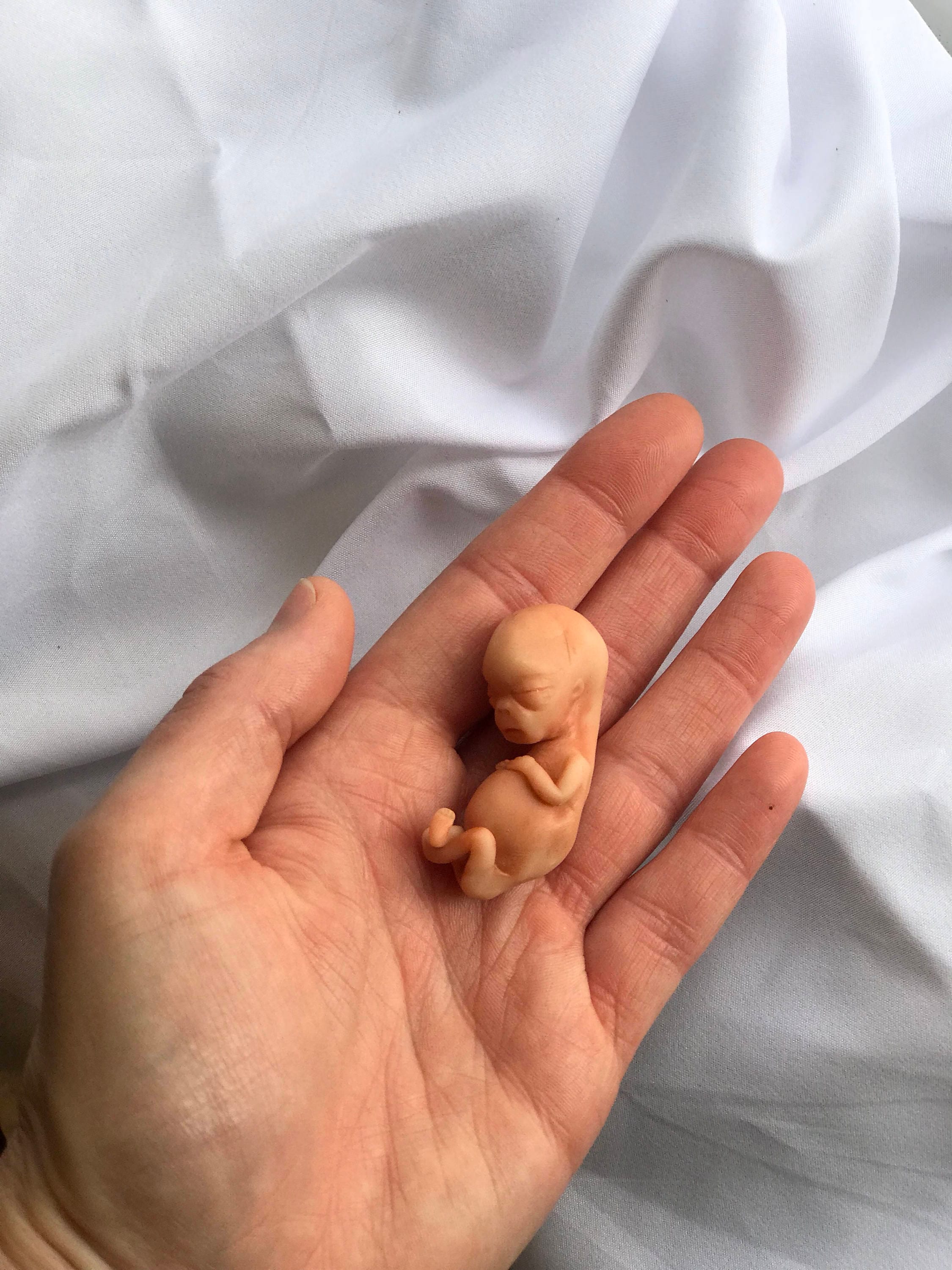
You just saw those two pink lines, or maybe you've known for a bit, and now you're staring at an app that says your 6 week old fetus is the size of a sweet pea. It sounds tiny. It is tiny. But honestly, calling it a "sweet pea" doesn't even come close to describing the chaotic, high-speed construction project happening inside your uterus. At six weeks, we aren't just talking about a clump of cells anymore; we are talking about the foundation of a human being.
It’s wild. If you found value in this piece, you might want to read: this related article.
Right now, that little speck is roughly 5 to 6 millimeters long. If you looked at it—and you might, if you have an early ultrasound scheduled—it wouldn't look like a baby yet. It looks more like a curled-up shrimp or a tadpole, complete with a little tail. That tail eventually becomes the coccyx (your tailbone), but for now, it’s a visible reminder of our evolutionary journey.
The heart is already putting in work
The biggest milestone this week? The heart. It’s basically the headline news. While it’s technically a tube-like structure at this stage rather than the four-chambered organ we recognize in adults, it is beating. It pulses. According to the American College of Obstetricians and Gynecologists (ACOG), by the end of the sixth week, the heart is beating anywhere from 100 to 160 times per minute. For another look on this story, see the latest coverage from World Health Organization.
That is nearly double your own heart rate.
If you get a transvaginal ultrasound this week, you might see a tiny flicker on the screen. It’s rhythmic. It’s fast. Seeing that flicker is often the moment it feels real for most people. However, don't freak out if your doctor can't find it yet. Sometimes ovulation happens later than you think, and being off by just two or three days can make the heart invisible on a scan. It’s just too small.
Building a brain from scratch
While the heart gets all the glory, the neural tube is doing the heavy lifting. This tube is closing up, and the top part is expanding to form the brain. We’re talking about the development of the forebrain, midbrain, and hindbrain. It’s sophisticated. It’s also why experts like those at the Mayo Clinic emphasize folic acid so much; that neural tube needs to close perfectly to prevent complications like spina bifida.
Face, limbs, and those weird little buds
If you could zoom in with a microscope, you’d see the beginnings of a face. There are little indentations where the eyes will eventually be, and tiny folds that will become the jaw and neck. It’s kinda incredible how early the blueprint is laid out.
And then there are the limb buds.
They look like tiny paddles or flippers sticking out from the sides. These will eventually become arms and legs, but right now, they’re just little nubs of tissue. The blood is circulating through a rudimentary system. The liver is starting to form. The lungs? They’re just tiny buds too, waiting for their turn to develop much later in the game.
Why you probably feel like a zombie
Let’s talk about you for a second, because a 6 week old fetus doesn't exist in a vacuum. It’s an energy vampire. A cute one, sure, but it’s draining you.
Your progesterone levels are skyrocketing. This is great for maintaining the pregnancy, but it’s terrible for your energy levels. You might feel like you’ve been hit by a truck. Then there’s the "morning sickness," which is the biggest lie in medical history because it usually lasts all day.
- Nausea: Blame the hCG hormone.
- Sore Breasts: They might feel heavy or tingly.
- Frequent Urination: Your kidneys are processing more waste, and your uterus is starting to press against your bladder.
Some people feel absolutely nothing at six weeks. They worry. "If I'm not puking, is the baby okay?" Honestly, everyone’s body reacts differently to hormones. Lack of symptoms doesn't automatically mean something is wrong, just like having severe symptoms doesn't mean everything is perfect. It’s just how your specific biology handles the surge.
The myth of the "perfect" pregnancy diet
You’ve probably seen the lists. Eat kale. Eat wild-caught salmon. Avoid everything fun.
But at six weeks, when the 6 week old fetus is demanding all your resources, you might only be able to stomach beige foods. Crackers. Toasted bread. Plain pasta. Nutritionists will tell you to eat a balanced diet, but real-world OB-GYNs will tell you that in the first trimester, survival is the goal. If you can take your prenatal vitamin and keep down some saltines, you’re doing okay.
The baby is tiny. It doesn't need 500 extra calories yet. It needs the micronutrients you've already stored in your body.
When to actually worry
It is completely normal to be anxious. You're thinking about miscarriage, chromosome issues, and every "what if" in the book.
Spotting can happen. About 25% of pregnant people experience some bleeding in the first trimester. Sometimes it’s "implantation bleeding," or maybe your cervix is just sensitive because it’s engorged with blood. However, if the bleeding is heavy—like a period—or accompanied by intense cramping, you need to call your doctor.
Also, watch out for ectopic pregnancy signs. If you have sharp, one-sided pain in your abdomen or shoulder pain, get checked out immediately. These are rare, but they’re serious.
Realities of the first ultrasound
Many clinics won't even see you until you are 8 or 10 weeks along. This wait is agonizing. If you do get an early scan at 6 weeks, manage your expectations.
You aren't going to see a baby. You are going to see a "gestational sac" and hopefully a "yolk sac." The yolk sac is what's nourishing the 6 week old fetus before the placenta fully takes over. If you're lucky, you'll see the "fetal pole," which is the actual embryo. It looks like a little white grain of rice.
Your Actionable Checklist for Week 6
Forget the generic advice. Here is what you actually need to do right now to support your pregnancy and your sanity.
- Switch to a "Gummy" Prenatal if needed. If the big horse-pill vitamins are making you gag, the gummies are a lifesaver. Just make sure they have folic acid.
- Hydrate like it's your job. Progesterone slows down your digestion, which leads to constipation. Water is the only way to keep things moving.
- Check your meds. Call your doctor about any prescriptions you’re on. Don't just stop them, but verify they are safe for the first trimester.
- Buy a better bra. Your breasts are likely going to grow a full cup size (or more) very quickly. A soft, wire-free nursing bra or sports bra can save you a lot of misery this week.
- Stop "Googling" every cramp. Seriously. Every pregnancy has weird twinges. Unless there’s heavy blood or fever, try to breathe.
The first trimester is a marathon of waiting. Between the fatigue and the constant checking of toilet paper for spots, it’s a mental grind. But inside, that little pea-sized embryo is busy building a brain, a heart, and a future. You're doing the hard work of growing a human. Go take a nap. You've earned it.
Next Steps for You: Schedule your first prenatal appointment if you haven't yet. Start a simple log of your symptoms—not for "data," but so you can accurately tell your midwife or doctor how you've been feeling when you finally see them. If you’re struggling with morning sickness already, try Vitamin B6 and Ginger supplements, which are widely recommended by the ACOG as first-line defenses against nausea.
/i.s3.glbimg.com/v1/AUTH_08fbf48bc0524877943fe86e43087e7a/internal_photos/bs/2025/H/e/ewwgKCQCSopdUJUwy6DA/imagem-2025-04-27-114802986.png)


