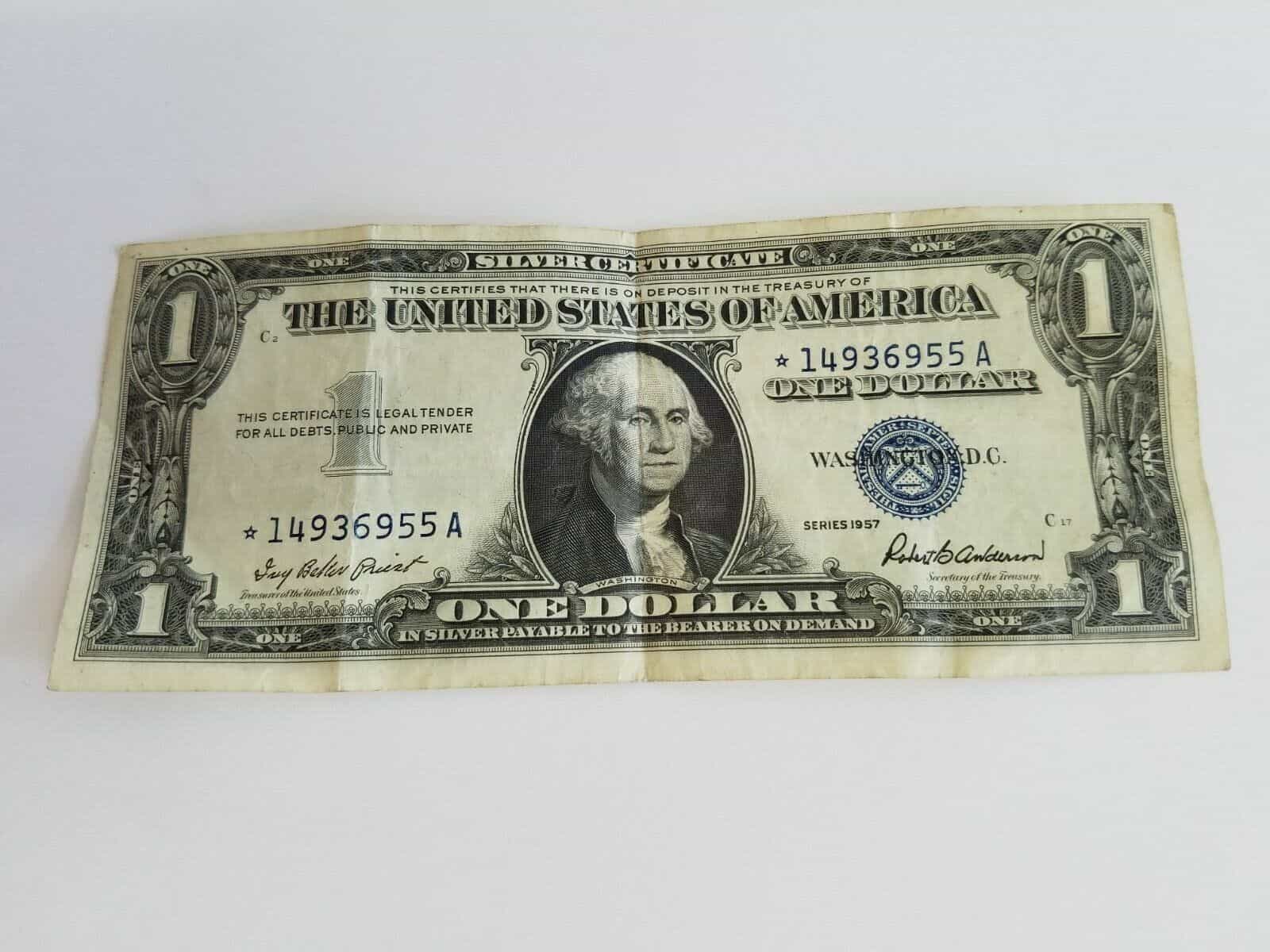
You found one. Maybe it was tucked inside an old birthday card from your grandmother, or perhaps it’s been sitting in a shoebox at the back of your closet for a decade. It looks like a normal dollar bill at first glance, but then you notice the blue seal instead of the usual green one. The words "Silver Certificate" sit boldly across the top. Now you're wondering: how much is a one dollar 1957 silver certificate worth and can I actually retire on this thing?
The short answer is usually a bit of a letdown. Most of these bills are worth about $1.25 to $2.00.
That’s the reality for about 95% of the notes out there. But, honestly, the world of paper money collecting—known as numismatics—is rarely that simple. While most 1957 ones are common, there are specific quirks, serial numbers, and "star" designations that can push that value much higher. We’re talking about the difference between a bill that buys you a candy bar and one that pays for a nice steak dinner.
Why the Blue Seal Even Exists
To understand the value, you have to understand why these things were printed. Back in the day, the U.S. dollar was actually backed by physical precious metals. If you held a Silver Certificate, you could technically walk into a bank or the Treasury and demand a dollar's worth of silver bullion or silver coins in exchange for that piece of paper.
It was a different era of finance.
The 1957 series was actually the very last "standard" issue of these notes. By the early 1960s, the price of silver was climbing too high for the government to keep the exchange going. In 1964, the Treasury stopped trading them for silver coins, and by 1968, the "silver" part of the certificate became a legacy feature only. Today, they are still legal tender. You could go to 7-Eleven right now and buy a soda with one, but please don't. Even the most beat-up, wrinkled 1957 dollar is worth at least a 25% premium over its face value.
Determining Condition: The "Fold" That Costs You Money
When you ask how much is a one dollar 1957 silver certificate worth, the first thing a dealer will look at is the crispness. Collectors are obsessed with condition. In the industry, we use a 70-point scale established by the Professional Coin Grading Service (PCGS) or Paper Money Guaranty (PMG).
If your bill has been in a wallet, it’s likely "Circulated." A bill with heavy creases, rounded corners, or—heaven forbid—a small tear is considered "Good" or "Very Good," which despite the names, are actually low grades. These are the $1.25 to $1.50 bills.
Then you have "About Uncirculated" (AU). These look fresh but might have one tiny fold from someone counting the money. These might fetch $3 to $5.
The "Uncirculated" (CU) notes are the holy grail for the 1957 series. These have never been folded. They are perfectly flat, the ink is embossed and slightly raised to the touch, and the corners are sharp enough to prick a finger. A 1957 silver certificate in Choice Uncirculated 63 or higher can easily sell for $10 to $15. If it gets into the "Superb Gem" 67+ range? Now you’re looking at $50 to $100 depending on the specific sub-series (1957, 1957A, or 1957B).
The Magic of the Star Note
Take a close look at the serial number. Does it end with a little five-pointed star instead of a letter?
If it does, you just found a "Star Note."
These are replacement bills. When the Bureau of Engraving and Printing messes up a sheet of currency during the printing process, they can't just print the same serial numbers again. Instead, they swap in a sheet of Star Notes to keep the count accurate. They are significantly rarer than the standard print runs.
A 1957 Star Note in decent condition usually starts at around $3.00, but an uncirculated one can jump to $20 or $30 quite quickly. It’s a supply and demand game. Millions were printed, but far fewer survived in a collector's album.
1957 vs. 1957A and 1957B
If you look at the bottom right or left of the bill, you’ll see the year. Sometimes it’s just 1957. Sometimes there is a small "A" or "B" next to it. These letters indicate a change in the Treasury Secretary or the Treasurer of the United States.
- 1957: Robert B. Anderson and Ivy Baker Priest.
- 1957A: Robert B. Anderson and Elizabeth Rudel Smith.
- 1957B: C. Douglas Dillon and Kathryn O'Hay Granahan.
In terms of raw value, there isn't a massive gap between these three for a common, circulated bill. However, the 1957B is technically the rarest of the three series in terms of total production numbers. If you're looking at high-grade Uncirculated notes, the 1957B often commands a slightly higher price because fewer were saved before the transition to Federal Reserve Notes.
Fancy Serial Numbers: The Hidden Jackpot
This is where the real money is. Forget the year for a second. Look at the numbers.
Collectors love "Fancy Serials." Even if the bill is a 1957 series, the right number can make it worth hundreds.
Low Serial Numbers: If your serial number is 00000500 or lower, you’ve got a winner. People love the "zeros." A number like 00000001 is the ultimate prize, often worth thousands of dollars.
Radars: These numbers read the same forward and backward (like 12344321).
Solid Serials: Every digit is the same (like 55555555). These are incredibly rare and highly sought after.
Ladders: Numbers that go in order, like 12345678.
I once saw a 1957 silver certificate with a "Solid 9" serial number sell at auction for a staggering amount because it combined a popular historical note with a nearly impossible-to-find serial sequence. Check your numbers carefully before you spend it.
Where to Sell and Avoid Getting Ripped Off
So you’ve identified what you have. You think it's worth $10. Where do you go?
Don't go to a pawn shop. They are in the business of buying low and selling high; they will likely offer you face value or maybe $1.10.
Local coin shops are a better bet. They will be honest about the grade, but remember they need to make a profit, so they might offer you $2 for a bill they plan to sell for $5. It’s fair, but not the max profit for you.
eBay is the "true" market. If you want to know how much is a one dollar 1957 silver certificate worth right this second, go to eBay, search for the bill, and filter by "Sold Items." This shows you what people are actually paying, not just what sellers are dreaming of.
Common Misconceptions
People often think because it’s "silver," it contains silver. It does not. It was a promise.
Others think that because it’s old, it must be rare. The U.S. printed billions of these. They were the standard pocket change of the late 50s and early 60s. Because so many people realized they were being phased out in the 60s, everyone saved them. That’s why the market is flooded with "Crisp Uncirculated" 1957 dollars—they were pulled straight from bank bundles and put into drawers for sixty years.
The Actionable Verdict
If you have a 1957 silver certificate, here is your step-by-step checklist:
- Check the Seal: Confirm it is blue. (Green is a Federal Reserve Note, Red is a United States Note).
- Look for the Star: Is there a star at the end of the serial number? If yes, the value just doubled.
- Assess the "Crispness": If it feels like a napkin, it’s worth $1.25. If it feels like it just came off the press, it’s worth $10+.
- Scan the Serial Number: Look for patterns (radars, repeaters, low numbers).
- Protect it: If it's in good shape, put it in a PVC-free plastic sleeve. Do not use paperclips or staples, as rust and indentations will destroy the value instantly.
Holding onto a 1957 silver certificate is more about holding a piece of American economic history than it is about a massive financial windfall. It’s a reminder of a time when money was "real" in a sense we don't see today. Keep it for the story, or sell it to a collector who will appreciate the blue ink and the history it represents.
If you're looking to sell, your best path is to bundle it with other old coins or notes to save on shipping, or simply keep it as a conversation piece. Most collectors start their journey with exactly this bill. It’s the "gateway drug" of paper money collecting, and for that reason, there will always be a market for it.