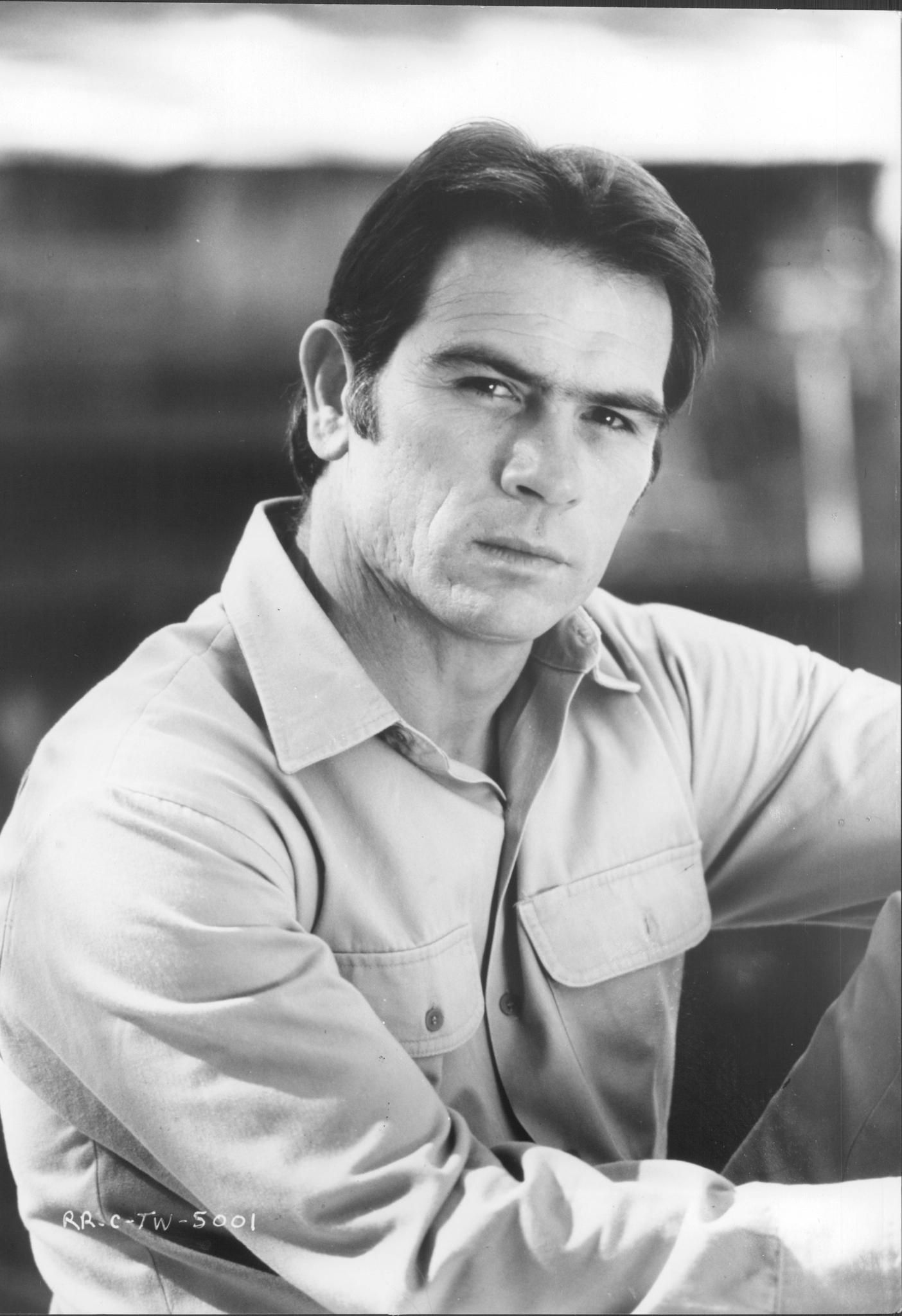
Most people think of Tommy Lee Jones and immediately see the craggy, granite-faced lawman from The Fugitive or the deadpan Agent K from Men in Black. It’s like he was born seventy years old with a permanent scowl and a U.S. Marshal’s badge. But if you look back at the 1970s and 80s, you’ll find a younger Tommy Lee Jones who was essentially a different human being. He was a long-haired, Ivy League-educated athlete with a lean frame and a surprisingly high-pitched intensity that didn't always involve grumbling at Will Smith.
Honestly, the "grumpy old man" trope is a relatively recent development.
Back in the late 60s, Jones was a powerhouse offensive guard for the Harvard Crimson. He wasn't just some guy on the bench, either. He was first-team All-Ivy League. He played in the legendary 1968 "The Game" where Harvard scored 16 points in the final 42 seconds to tie Yale 29-29.
If you watch the documentary Harvard Beats Yale 29-29, you see a version of him that feels alien. He’s sharp, academic, and physically imposing in a way that’s purely athletic rather than "weathered."
The Al Gore Connection and the Harvard Years
The weirdest trivia bit that everyone eventually stumbles upon is his roommate. For four years at Harvard, Tommy Lee Jones lived with Al Gore. Yeah, that Al Gore.
They lived in Dunster House. They were close friends. Jones even told stories about how Gore used to play "Dixie" on a touch-tone telephone to entertain people. It’s a bizarre mental image: a future Vice President and a future Oscar winner hanging out in a dorm room, probably arguing over English literature or football plays.
Jones actually graduated cum laude with a degree in English. His senior thesis? It was on "the mechanics of Catholicism" in the works of Flannery O’Connor.
This isn't the resume of a guy who was born to play cowboys. He was an intellectual. A jock-poet. He moved to New York right after graduation and landed a role on Broadway within ten days.
Ten days. That’s insane.
A Soap Opera Star? Believe It.
If you want to truly break your brain, look up clips of a younger Tommy Lee Jones in One Life to Live. From 1971 to 1975, he played Dr. Mark Toland.
He had this thick, dark hair and a much softer face. He was a daytime heartthrob. He spent years navigating the melodrama of soap operas before he ever stepped foot in a major Hollywood blockbuster. It gave him a technical discipline that a lot of "method" actors of that era lacked. He knew how to hit a mark and deliver lines under pressure.
The Gritty Transition to Film
The move to film wasn't an immediate explosion of fame. He had a tiny role in Love Story (1970) as—get this—a Harvard student. The author of the book, Erich Segal, later said he based the lead character of Oliver partly on Jones and Gore.
But the 70s were mostly about "grit" for him.
- Jackson County Jail (1976): He played a convict on the run. This was a Roger Corman production, meaning it was lean, mean, and low-budget.
- Rolling Thunder (1977): He played a Vietnam vet alongside William Devane. His performance is chilling because he barely says a word. You can see the "silent intensity" archetype starting to form here.
- The Amazing Howard Hughes (1977): He played the lead. He actually pulled off the eccentric billionaire's descent into madness quite well, proving he had range beyond just being a "tough guy."
One of his most underrated early roles was in Eyes of Laura Mars (1978). He played a detective opposite Faye Dunaway. He looked like a 70s fashion icon—leather jackets, slim-fit trousers, and that piercing gaze that hadn't yet been buried under deep wrinkles.
Why 1980 Changed Everything
Everything shifted with Coal Miner's Daughter. Jones played Doolittle "Mooney" Lynn, the husband of country legend Loretta Lynn.
He was 34. Still "younger Tommy Lee Jones" by most standards, but he was starting to age into that rugged, Texas-born authenticity that would define his later career. He earned his first Golden Globe nomination for this. He was charismatic, volatile, and deeply human. It was the first time the general public realized he wasn't just a character actor; he was a force of nature.
Two years later, he won an Emmy for The Executioner's Song. He played Gary Gilmore, the first person executed in the U.S. after the reinstatement of the death penalty.
It was a terrifying performance.
He didn't play Gilmore as a monster. He played him as a man who was profoundly "done" with the world. This is where the world started to see the Tommy Lee Jones we know today—the man who can say more with a silent stare than most actors can with a five-minute monologue.
The Myth of the "Overnight Success"
By the time he won the Oscar for The Fugitive in 1993, he was 47 years old.
People treated him like a new discovery, but he’d been working for over twenty years. He’d done the soaps, the Broadway plays, the B-movies, and the TV miniseries like Lonesome Dove. He’d paid his dues in the Texas oil fields (where he worked briefly before Harvard) and on the stage.
Practical Insights from the Jones Career Path
If you're looking at the trajectory of a younger Tommy Lee Jones, there are a few real-world takeaways that apply to more than just acting:
- Don't pigeonhole yourself early. He was a football star and an English major. Those things seem contradictory, but they gave him the physical presence and the intellectual depth to handle complex scripts.
- The "Slow Burn" is okay. He didn't become a household name until his late 40s. In a world obsessed with 20-something influencers, his career is a reminder that mastery takes time.
- Intensity is a tool, not a mood. Jones is famous for being "difficult" in interviews, but that same uncompromising nature is why his performances feel so authentic. He doesn't do "fluff."
If you want to see the real range of the man, don't just watch No Country for Old Men. Go back. Find the footage of him as a doctor in 1972 or a race car driver in The Betsy. You’ll see a man who spent decades building the face that eventually became a Hollywood monument.
Next Steps for the Tommy Lee Jones Enthusiast:
To get the full picture of his evolution, track down a copy of the 1982 film The Executioner's Song. It’s often overshadowed by his 90s hits, but it remains his most raw and haunting performance. After that, watch the documentary Harvard Beats Yale 29-29 to see the athlete-scholar who existed before the cameras ever started rolling. Seeing the physical transformation from the lean Harvard guard to the weathered Texas rancher provides a perspective on his career that most casual fans completely miss.



