You don't expect to find new life floating in a pool of raw wastewater. Yet, that's exactly what happened at the Totnes Sewage Treatment Works in Devon when a pair of utility workers stumbled upon a fragile nest of eggs bobbing precariously on industrial debris.
Most stories about infrastructure and wildlife end in tragedy, but this one took a bizarrely heartwarming turn. Catchment Technician James Blakesley and Wastewater Treatment Operator Josh Corderoy were setting up for routine maintenance when they noticed seven eggs floating on a precarious mass of surface matter inside a treatment tank. The nest was on the verge of toppling into the murky water, which would have meant instant destruction for the unborn birds.
Instead of turning a blind eye, the South West Water team engineered an impromptu rescue mission using the tools at their disposal.
The MacGyver Rescue at Totnes Treatment Plant
The mechanics of saving fragile eggs from an industrial wastewater tank require a delicate touch and serious creativity. You can't exactly wade into a sewage tank with a net.
Blakesley and Corderoy used what they had on hand. They took a standard heavy-duty rubble sack, padded it out to cushion any impact, and tethered it tightly with a rope so it could float across the surface. Using a long sampling pole, they slowly and meticulously nudged the seven eggs out of the crumbling nest and into the floating sack.
Against all odds, not a single shell cracked during the process.
Knowing the treatment plant was no place for vulnerable wildlife, Blakesley took the seven eggs home and set up an incubator. Anyone who has ever tried to hatch wild waterfowl knows the odds are stacked against you. Eggs exposed to fluctuating temperatures and industrial environments rarely make it.
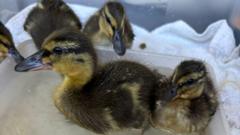
Out of the seven recovered eggs, six managed to hatch. Five of those ducklings survived the critical first few days and are now thriving.
Why Wild Birds Keep Nesting in Sewage Infrastructure
It sounds disgusting to us, but to a wild mallard, a wastewater treatment facility looks like a premium piece of real estate. This wasn't an isolated incident. South West Water notes that birds frequently attempt to nest in various parts of their treatment works.
If you look at it from an avian perspective, it actually makes sense.
- Isolation from natural predators: Large, concrete treatment tanks keep foxes, badgers, and rats at bay.
- Constant warmth: The biological processes involved in breaking down sewage generate consistent ambient heat, creating a microclimate that can be attractive to birds looking for a warm nesting site.
- Abundant insects: The organic material in the open tanks attracts a massive population of flies and midges, offering an endless buffet for hungry adult birds.
The massive downside is that these facilities are highly mechanical, industrial zones. Floating crusts of organic material move, tanks drain, and automated scum skimmers sweep across the surfaces. It's a classic ecological trap. Animals are drawn to the habitat because it checks all their boxes, but the hidden artificial hazards make survival nearly impossible without human intervention.
From Industrial Waste to Backyard Playhouse
The five surviving ducklings have successfully traded a sewage tank for a rather upscale domestic life. Blakesley's family has fully integrated the birds into their home.
Initially, his daughter claimed the backyard playhouse for the birds, repurposing it into a secure outdoor shelter so the ducklings could safely experience the warmer daytime weather. Right now, the birds are spending their days splash-testing a plastic paddling pool and getting used to human interaction.
As they grow, their housing will scale up. The family plans to transition them into a larger indoor enclosure to protect them during their awkward adolescent feather growth stage. The final goal is to move them into an old chicken coop situated directly next to a natural stream and pond on the property.
They won't be domestic pets forever. The long-term plan is to let them utilize the natural waterways around the garden, allowing them to transition back into the wild naturally once they have their adult flight feathers.
What to Do If You Find an Orphaned Nest
While the Totnes rescue is an incredible feel-good story, managing wild eggs is incredibly difficult and often legally complex. If you happen to discover an endangered or abandoned nest on your property or at a workplace, you shouldn't just grab a homemade incubator.
First, verify if the nest is actually abandoned. Duck mothers regularly leave their nests for hours at a time to feed, relying on down feathers to keep the eggs warm. If you track the nest and confirm the mother hasn't returned for over 24 hours, or if the nest is in immediate physical danger like the one in Devon, contact a local wildlife rehabilitator or organizations like the RSPCA immediately. They have specialized high-humidity incubators and species-specific diets necessary to give wild birds a real chance at survival.