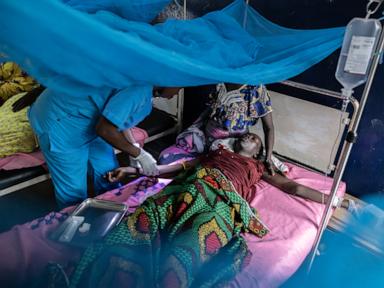
The heat inside a layers-thick yellow protective suit is not a theoretical concept. It is a suffocating, blinding reality. Within ten minutes, sweat pools in your rubber boots. Within twenty, the condensation inside your goggles turns the world into a blurred, terrifying watercolor. You are breathing your own trapped air, listening to the rhythmic, amplified sound of your own panic.
For the medical teams in the eastern Democratic Republic of Congo, this is the daily price of admission to the frontline.
The numbers coming out of North Kivu province are stark. The official tally of Ebola cases is creeping toward 300. In the sterile language of international public health bulletins, it reads like a math problem: 298 cases, 171 deaths, 267 confirmed via laboratory testing. It is a dry ledger of mortality.
But data cannot sweat. Data does not have a family waiting behind a plastic barricade, terrified that a fever is a death sentence. To understand what is actually happening in places like Beni and Butembo, you have to look past the spreadsheets and look at the hands shaking through layers of nitrile rubber.
The Geography of Fear
Ebola does not travel in a vacuum. It travels along red-dirt roads, on the backs of motorbike taxis, and through the crowded markets of towns that have already been broken by decades of armed conflict. This isn't just a health crisis; it is an active war zone.
Imagine trying to track a deadly virus when the sound of gunfire routinely forces isolation centers to go into lockdown.
The mechanics of transmission are brutal in their simplicity. The virus waits in bodily fluids. It thrives on the very things that make us human: the urge to nurse a sick child, the ritual of washing a deceased parent before burial, the instinctive urge to touch someone who is suffering. In the Congo, the response teams are fighting two outbreaks simultaneously—the virus itself, and the profound, understandable mistrust of the communities they are trying to save.
When strangers arrive in pristine white SUVs, wearing suits that make them look like astronauts, shouting directives through megaphones, the natural human reaction is not compliance. It is terror. Rumors spread faster than the hemorrhagic fever. Some believe the treatment centers are where people go to die, or worse, that the virus was brought in by foreigners for profit.
That resistance has a body count. It means contact tracers are turned away at machete-point. It means patients flee into the dense forest, carrying the virus to the next village.
The View from the Inside
Let us look at a nurse we will call Dr. Jean-Paul. He is not a statistic. He is a twenty-eight-year-old physician from Goma who volunteered to go north.
For Jean-Paul, the turning point was not a lecture on virology. It was a six-year-old girl named Alphonsine. She arrived at the treatment center with the telltale signs: bloodshot eyes, a raging fever, and a profound lethargy that made her look like a discarded ragdoll. Her mother had already died in the village.
Jean-Paul spent four hours a day inside the high-risk zone, a place where a single tear in a glove can mean a death warrant. He learned to read the progression of the disease through the shifting shadows under Alphonsine’s eyes. He learned the specific, metallic smell of an Ebola ward—a mix of chlorine, heavy bleach, and sickness.
The work is a psychological meatgrinder. You cannot touch a patient with bare skin. You cannot offer the simple comfort of a human hand on a fevered brow without three layers of synthetic material acting as a barrier. The patients look up at you and see no face, only glinting plastic visors and masked expressions. You are a specter to them.
Then, something shifted.
After twelve days of aggressive hydration and experimental monoclonal antibody treatments, Alphonsine sat up. She asked for porridge. Two days later, her blood tests came back negative. Twice.
The protocol for discharge is a strange, beautiful ritual. The survivor is brought to a transition zone. They are sprayed down with chlorine solution one last time. They step out of the red-zone gate, leaving behind everything they owned inside—their clothes, their shoes, their letters, all burned in a pit out back. They are given a new set of clothes and a certificate of clearance.
When Alphonsine walked out, Jean-Paul was waiting on the clean side of the fence, finally free of his yellow suit. For the first time, the little girl saw his face. She didn't see an alien. She saw a man with tired eyes and a crooked smile. She hugged his knees.
The Living Proof
These are the stories that the aggregate data misses. The true turning point in the outbreak near Beni is not the arrival of more experimental vaccines, though those are vital. The real shift is the sudden, quiet presence of the recovered.
The locals call them les vainqueurs—the victors.
There are now dozens of them walking back into the communities that once shunned them. They are the most valuable weapon the medical teams have. Why? Because they possess something the international experts do not: biological immunity and total credibility.
When a doctor in a white suit says the treatment center will save you, the village listens with skepticism. When a neighbor who was carried out on a stretcher two weeks ago walks back into the village on her own two feet, healthy and vibrant, the argument is over. The narrative changes from a story about a slaughterhouse to a story about a hospital.
Consider what happens next when a survivor walks into a hostile neighborhood. They don't just talk; they work. Because they are immune, they can care for infected children who cannot be touched by their own terrified parents. They can feed patients, clean up fluids, and provide the human contact that the protective suits deny. They bridge the gap between the sterile world of medicine and the raw reality of human grief.
The survivor numbers are rising alongside the case counts. Every person who walks out alive is a living, breathing contradiction to the rumors of hopelessness.
The Long Road to Zero
The math of an epidemic is unforgiving. To stop Ebola, the reproduction number must drop below one. Every single chain of transmission must be hunted down, cornered, and broken.
It is exhausting, grinding work that happens one temperature check at a time. It happens at the dirt-road checkpoints where travelers wash their hands in chlorinated water and have laser thermometers pointed at their foreheads. It happens in the laboratories where technicians process blood samples under intense pressure, knowing a delayed result could mean dozens of new exposures.
The global community looks at the number 300 and sees a crisis. The people on the ground look at that same number and see 300 individual battles, some lost, some won, but each one a testament to an extraordinary stubbornness. The panic that defined the early weeks of the outbreak is slowly being replaced by a methodical, furious resolve.
The yellow suits will remain. The sweat will continue to pool in the boots. The risk will not drop to zero today, or next week, or next month.
But the silence of the villages is breaking. In its place is the sound of survivors returning home, their voices carrying through the red dust, proving to anyone who will listen that the virus is not invincible.
A young man stands at the edge of a market in Beni, holding his discharge certificate aloft like a trophy, his laughter cutting through the heavy, humid air.