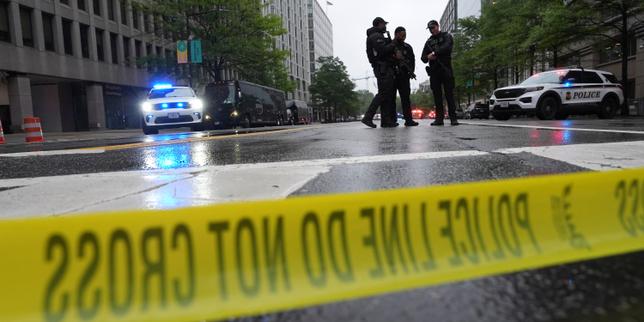
The media loop is entirely predictable. A firearm discharges near a high-profile government perimeter. Secret Service assets neutralize the threat. Within minutes, the headlines pivot to a comforting, reductionist narrative: "The shooter had a history of violence."
We see this exact framing deployed in the recent coverage of the security incident near the White House. The public is told that the perpetrator possessed a documented track record of aggression, as if this piece of retroactive data explains the breach or offers a blueprint for prevention. It is a lazy consensus designed to soothe public anxiety by suggesting the system works, that the bad actors are obvious, and that threat mitigation is simply a matter of connecting visible dots.
It is an absolute illusion.
As someone who has spent two decades analyzing physical security architecture and threat-detection systems, I can tell you that relying on "a history of violence" as a predictive vector is a fundamental failure of logic. The security apparatus does not fail because it misses the obvious targets. It fails because the entire premise of behavioral threat profiling is structurally flawed.
The Hindsight Bias of Radicalization
When an incident occurs at a heavily fortified perimeter like the White House, the immediate institutional reaction is to build a retrospective timeline. Investigators dig through public records, social media feeds, and police logs to find the flashpoints. Once found, these flashpoints are assembled into a neat, linear progression toward violence.
This is pure hindsight bias.
In the real world, the data stream is deafeningly noisy. Millions of individuals exhibit "antécédents de violence" or express radicalized rhetoric online. Only an infinitesimal fraction ever attempts to breach a hard target. Traditional profiling mechanisms treat a low-probability, high-impact event as if it were a linear math problem.
Consider the mathematics of predictive policing. If you run a predictive model across a population of 300 million to identify potential perimeter threats based on past violent behavior, your false-positive rate will sit comfortably above 99%. You cannot build an actionable defense grid on a data pool where almost every red flag is a false alarm.
The media focuses on the one individual who crossed the line, declaring that the signs were there all along. They ignore the millions who hit the exact same criteria but stayed home. By framing the problem around the perpetrator's history, we ask the wrong question entirely. We ask "Who did this and why?" when we should be asking "Why did our spatial defense layer allow them to get close enough to try?"
The Danger of the Predictable Perimeter
Physical security is not a behavioral science problem. It is a spatial engineering problem.
When you rely on threat lists, watchlists, and behavioral indicators, you create a reactive defense posture. You are constantly looking backward, trying to match faces against a database of known variables. This approach fails to account for the insider threat, the unflagged actor, or the individual experiencing a sudden, unrecorded psychological break.
The Secret Service does not neutralize threats because they read a suspect's rap sheet in real-time. They neutralize threats because their kinetic response protocols are absolute.
[Threat Approaches Perimeter] -> [Kinetic Breach Attempt] -> [Immediate Neutralization Response]
The breakdown occurs in the zone of approach. The current White House security posture relies heavily on a visible, deterrent perimeter designed to dissuade rational actors. The flaw? A shooter with a severe grievance or an active death wish is, by definition, an irrational actor. Deterrence is completely useless against someone whose explicit goal is to be neutralized on camera.
We need to abandon the comforting idea that better data sharing or more comprehensive mental health tracking will stop a determined attacker at a public fence line. It will not.
Dismantling the Public Safety FAQs
The public discussions following a high-profile shooting usually center on flawed premises. Let us address the standard questions with brutal clarity.
Why didn't the authorities intervene earlier if the suspect was known?
Because having a history of violence is not a crime that permits indefinite pre-emptive detention. The legal system requires an overt act or a specific, credible threat to trigger law enforcement intervention. Critics demand total pre-emption after an event, yet they reject the authoritarian surveillance state required to actually execute it. You cannot have both a free society and a zero-risk environment.
Can AI and predictive analytics solve this issue?
Absolutely not. The tech sector loves to pitch predictive algorithms as a silver bullet for threat detection. They claim their systems can scan crowds, analyze facial micro-expressions, and cross-reference criminal databases in microseconds to flag anomalies.
I have watched tech firms burn hundreds of millions of venture capital trying to deploy these systems in high-density environments. They fail universally because human behavior does not conform to clean algorithmic modeling. A citizen running because they are late for a train displays similar biometric spikes to an individual experiencing an adrenaline rush prior to an attack. The result is an avalanche of false positives that paralyzes tactical teams.
Should we expand the security perimeter further outward?
Expanding the physical perimeter merely moves the target zone. If you push the security fence two blocks back from the White House, the soft-target area simply shifts to the new checkpoint. You have not eliminated the point of vulnerability; you have merely changed its coordinates on a map.
The Operational Reality of Hard Targets
To truly secure an asset of immense symbolic and political value, you must strip sentimentality and behavioral guesswork out of the equation.
The uncomfortable truth is that the public portions of Pennsylvania Avenue and Lafayette Park are inherently incompatible with absolute security. You cannot maintain an open, democratic space that doubles as a tourist destination while simultaneously demanding an impenetrable shield around the executive mansion.
True security requires a shift from threat profiling to vulnerability mitigation.
- De-escalate the Symbolic Value: The more a location is treated as a high-stakes stage, the more it attracts actors looking for a global platform.
- Automate Kinetic Barriers: Instead of relying on human recognition of a threat, perimeters must utilize passive, automated physical barriers that neutralize the physical capabilities of a threat long before a weapon can be brought to bear.
- Accept the Static Attrition Rate: This is the hardest pill for the public to swallow. In an open society, there is a baseline level of risk that cannot be engineered down to zero without destroying the open nature of the society itself.
The competitor article wants you to feel safe by believing that this shooter was a known anomaly who slipped through the cracks. It suggests that if we just patch the database, we can prevent the next incident.
That is a dangerous lie. The next attacker might have a clean record, a spotless background, and zero history of violence. If your entire defensive philosophy is built on spotting the "bad guy" before he acts, you are completely defenseless against the anonymous actor.
Stop looking at the biography of the shooter. Look at the architecture of the zone. The problem isn't that we failed to predict a violent human being; the problem is we still believe human behavior can be predicted at all.