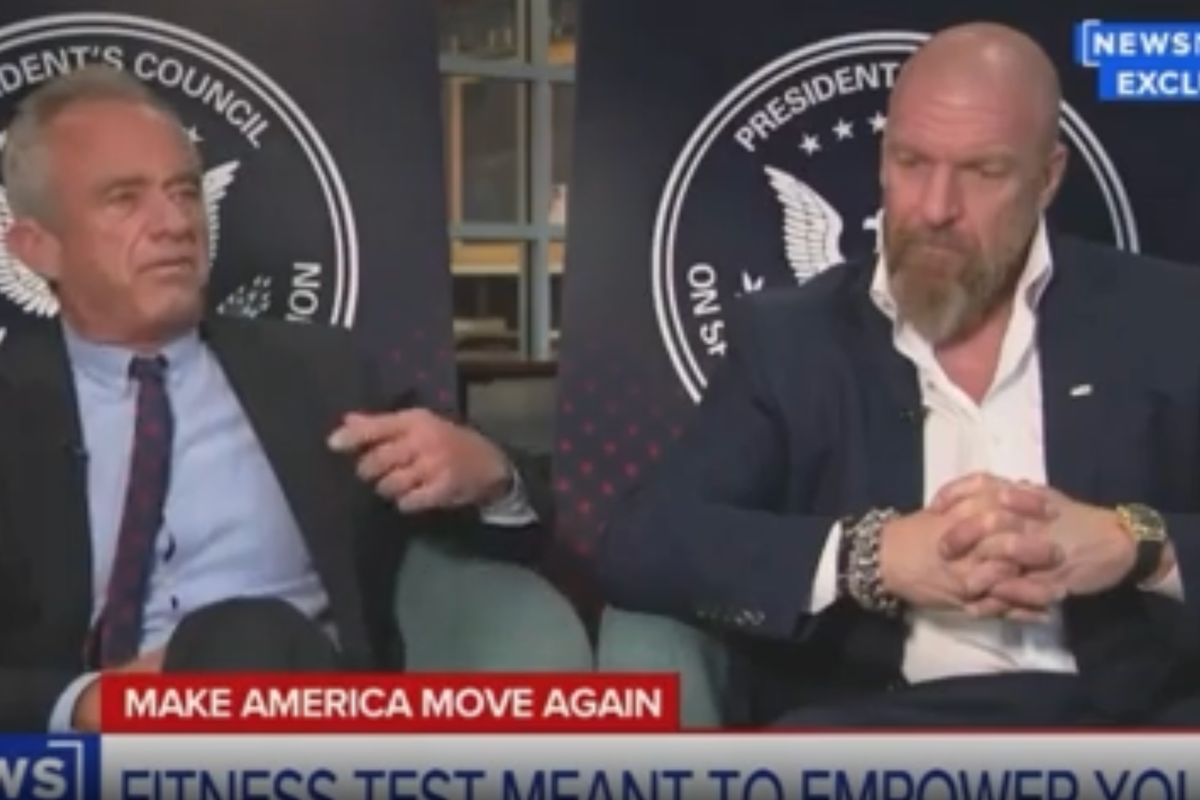
When Health and Human Services Secretary Robert F. Kennedy Jr. stood before a NewsNation camera alongside World Wrestling Entertainment executive Paul Levesque, a predictable media trap snapped shut. Asked how a revived Presidential Physical Fitness Test would protect the self-esteem of less athletic children, Kennedy pointed to the structured drama of professional wrestling. He noted that WWE performers are deeply inspiring because every single one of them has failed and lost fights, yet they find the inner strength to stand back up. Mainstream commentators immediately pounced on the phrasing, mockingly concluding that the nation's top health official genuinely believes professional wrestling matches are unscripted athletic contests.
That surface-level critique entirely misses the point.
The real story is not a trivial debate over whether a politician understands that a Three-Handled Moss-Covered Family Gredunza is choreographed. The true investigative focus belongs on a much more calculated phenomenon. The federal government is actively using the manufactured mythology of corporate entertainment to validate a polarizing physical fitness policy. By examining the mechanics of this partnership, we see how the administration is attempting to address a severe national health crisis through the lens of theatrical grit rather than structural reform.
The Corporate Marriage of Scripted Drama and Executive Orders
President Donald Trump signed an executive order reviving the traditional Presidential Physical Fitness Test, a program originally phased out during the Obama administration in favor of a model less focused on public evaluation. To spearhead the cultural push for this initiative, the administration appointed Levesque, known globally to wrestling fans as Triple H, to serve as the vice chair of the President's Council on Sports, Fitness and Nutrition. This was not a random celebrity endorsement. It was a deliberate integration of a multi-billion-dollar entertainment machine into the bureaucratic apparatus of American public health.
The choice of WWE as a cultural anchor for a federal health initiative reveals a specific strategic logic. For decades, professional wrestling has operated on the concept of kayfabe, the presentation of staged performances as authentic competitions. While the modern audience understands the scripted nature of the business, the emotional mechanics of the storytelling rely heavily on traditional themes of individual triumph over adversity. The underdog gets beaten down, endures immense physical suffering, and eventually overcomes the odds through sheer force of will.
By elevating a WWE executive to a high-ranking advisory position, the administration is attempting to borrow this exact narrative framework. The goal is to reshape the public perception of the fitness test from a cold, institutional metric into a dramatic stage for personal growth. Kennedy's commentary about wrestlers losing fights was not a naive misunderstanding of sports entertainment. It was an explicit adoption of the industry's rhetoric to justify an aggressive, competitive policy framework for school-aged children.
The Illusion of the Controlled Defeat
Applying the internal logic of professional wrestling to public education introduces a profound philosophical contradiction. When Kennedy argued that the beauty of the organization lies in the fact that you lose sometimes and win sometimes, he ignored the fundamental mechanism of the business. In sports entertainment, an athlete does not lose a match because their physical conditioning failed or because their opponent possessed superior skill. They lose because a creative team determined that a defeat would maximize television ratings or prolong a lucrative storyline.
A child failing a pull-up test in a public school gymnasium operates under a completely different reality. There is no creative team booking their redemption arc. A student who falls short of federal fitness standards faces tangible, unscripted social isolation and physical frustration. When public policy filters these real-world outcomes through the lens of scripted television, it shifts the responsibility of systemic failure entirely onto the individual child.
This rhetorical shift serves a convenient political purpose. If failure is merely a character-building plot point in a grander narrative of personal resilience, then the state bears no responsibility for providing the foundational infrastructure required to achieve health. The burden is placed squarely on the shoulders of the child to stand back up and fight again. This perspective ignores the material realities of the modern American environment, where access to recreational facilities, nutritious food, and adequate physical education is deeply unequal.
Dissecting the Scale of the Chronic Disease Crisis
The administration's aggressive push for the physical fitness test is driven by alarming statistical realities that cannot be ignored. Government data indicates that roughly 77 percent of young Americans currently fail to qualify for military service due to a combination of obesity, physical ailments, and chronic health conditions. This is a legitimate national security vulnerability and a catastrophic public health failure. The disagreement among experts is not about the existence of the crisis, but rather the efficacy of the tools being deployed to fix it.
The original physical fitness test was abandoned precisely because longitudinal data suggested it failed to accomplish its stated goals. For many children, the public nature of the testing did not inspire a lifelong commitment to health. It generated deep anxiety, embarrassment, and a lasting aversion to physical activity. The program routinely rewarded children who possessed natural genetic advantages while marginalizing those who required targeted, prolonged assistance.
Reintroducing the exact same testing model under the banner of sports entertainment mythology does nothing to address the root causes of the decline in youth fitness. The structural challenges are vast and well-documented. School districts across the country have systematically reduced physical education budgets over the last two decades to prioritize standardized testing metrics. Suburban designs have heavily restricted walkable environments, forcing children into sedentary lifestyles dictated by vehicular transport. The widespread availability of highly processed food, combined with the economic realities of working-class families, has made nutritional choices a secondary consideration for millions of households.
Faced with these massive structural headwinds, the deployment of motivational slogans about standing back up feels remarkably inadequate. A corporate executive and a federal secretary can praise the virtues of perseverance from a television studio, but their words do not alter the physical reality of an underfunded school district with an asphalt playground and a broken budget.
The Weaponization of Individual Grit
The alliance between the Department of Health and Human Services and WWE represents a broader trend in modern governance, where complex systemic problems are treated as simple failures of individual willpower. This technique relies on high-profile media appearances to create an illusion of decisive action while avoiding the costly, politically difficult work of systemic reform. It is far easier to produce a joint media segment with a famous athlete than it is to challenge the powerful agricultural lobbies that dictate school lunch programs or to secure billions in federal funding for public recreational infrastructure.
The language used during the NewsNation interview is instructive. Levesque noted that the new fitness standards would reward effort rather than just elite success, emphasizing that children should learn to support their peers who struggle. While the sentiment is admirable, it carefully avoids any critique of the institutional environment in which these children are being tested. It frames physical fitness as a moral virtue to be cultivated through mutual encouragement, obscuring the fact that health is a product of material conditions.
This weaponization of grit ensures that the conversation remains focused on individual character. If a child fails the test, the policy framework suggests they simply lack the internal drive of a professional wrestler. If a school shows poor overall scores, the narrative implies that the local community has failed to instill the proper values of discipline and effort. The systemic failures of the food industry, urban planning, and educational funding are cleanly removed from the equation.
Moving Past the Spectacle
A genuine attempt to solve the American health crisis requires moving past the calculated spectacle of media appearances and addressing the material environment that shapes the daily lives of children. The reintroduction of a fitness test, regardless of how much celebrity validation it receives, will only replicate the failures of the past if it is not accompanied by significant structural investment.
True public health initiatives do not rely on the artificial drama of a wrestling ring to teach children how to handle failure. They provide the consistent resources, time, and physical environments necessary for children to build sustainable, lifelong habits of movement and nutrition. Until federal policy shifts its focus from motivational rhetoric to material support, the revival of the Presidential Physical Fitness Test will remain a highly visible piece of political theater, leaving the underlying crisis completely untouched.