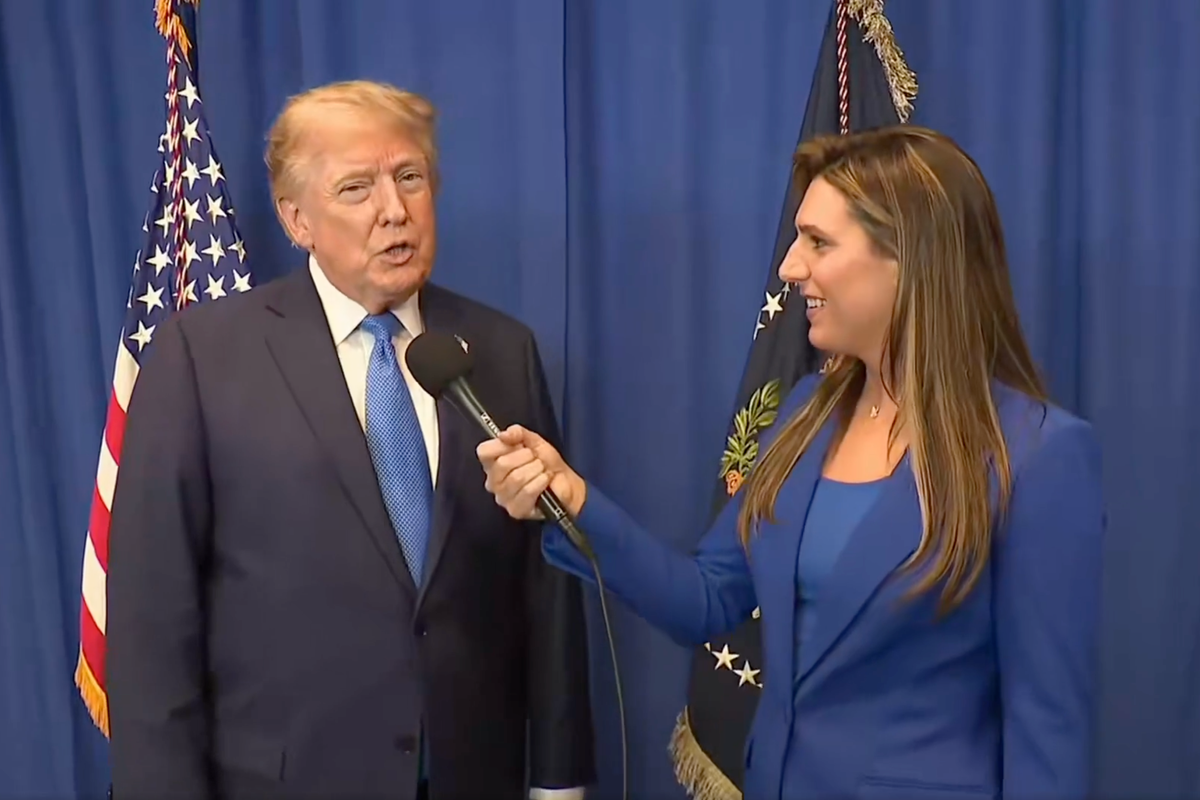
The impending departure of White House Press Secretary Karoline Leavitt at the end of August creates an immediate structural void within the executive branch communication apparatus. When Donald Trump publicly turned to Fox News correspondent Alexis McAdams during an exchange regarding the succession plan and remarked "How about you?", mainstream media outlets framed the interaction as a casual proposition or an off-the-cuff hiring maneuver.
This interpretation misses the operational reality of modern political signaling. Personnel selection in the current executive environment operates not through traditional civil service channels, but through media-first audition loops. Understanding this transition requires deconstructing the vacancy through three analytical lenses: the functional requirements of the press secretary role, the mechanics of public auditions, and the media symbiosis that dictates executive appointments. Recently making waves recently: The Iron Curtain Never Left Just Ask Riga.
The Functional Demands Of The Podium
The White House Press Secretary occupies a unique intersection between statecraft, partisan defense, and theatrical performance. The position demands continuous translation of complex legislative actions—such as tax packages or regulatory overhauls—into simplified, highly defensible soundbites.
The structural tension of the role stems from competing key performance indicators. The primary metric for the administration is message discipline and narrative control. The primary metric for the press corps is factual verification and institutional accountability. When these metrics collide, the press secretary must absorb institutional friction without breaking the core narrative structure. More information into this topic are explored by Reuters.
Leavitt’s tenure demonstrated the baseline requirements for modern administration defense. Success in the briefing room is measured by the ability to deflect institutional critique while feeding the digital ecosystem immediate, high-engagement quotes. Replacements are evaluated not on traditional bureaucratic administrative competencies, but on their bandwidth for televised combat and real-time cognitive resilience.
The Public Audition Framework
Trump’s public engagement with media figures regarding internal vacancies functions as an intentional pressure test. Rather than relying on closed-door executive search committees or vetted human resources pipelines, executive appointments frequently leverage open-air testing environments.
When a correspondent from a favored network is directly queried on live television about stepping behind the podium, several strategic outcomes occur simultaneously:
- Narrative Dominance: The recruitment process itself becomes the dominant news cycle, displacing critical coverage of policy debates or legislative hurdles.
- Immediate Competency Evaluation: The target is forced to react without preparation, revealing their capacity for impromptu message framing under adversarial conditions.
- Audience Signaling: The selection of a prominent cable news face validates the administration's primary communication channel while telegraphic intent is broadcast directly to the core demographic base.
This methodology treats media personnel as pre-screened assets. Because cable news anchors and correspondents have already spent years demonstrating camera presence, visual telemetry, and stylistic alignment with specific ideological audiences, they represent low-risk onboarding candidates compared to traditional academic or bureaucratic speechwriters.
The Cost Function Of Network Integration
The cross-pollination between executive branch communications teams and right-leaning media networks introduces a specific institutional feedback loop. Correspondents covering the administration understand that aggressive interrogation or favorable framing can serve as a direct resume builder.
This creates a dynamic where the boundary between journalistic reporting and executive positioning blurs. For the individual journalist, transitioning from the press corps to the podium represents a massive valuation leap in personal brand equity and future earning potential within conservative media ecosystems. For the administration, hiring from aligned networks guarantees an incumbent familiarity with friendly media formats and reduces the friction of onboarding external operators who lack television fluency.
The vacancy left by Leavitt—who departs to prioritize family commitments after the birth of her second child—cannot be filled by a standard administrative technician. The office requires an operator who understands that every briefing is a televised debate designed to shape public perception rather than an informational exchange with the Fourth Estate.
Monitor the shortlists emerging from executive advisory circles for candidates who combine baseline policy literacy with proven broadcast combat readiness, as the administration prioritizes real-time narrative defense over conventional bureaucratic pedigree.
Trump Quizzes Fox News Right In Front Of Leavitt
This video provides direct footage of the exchange between the administration and the press corps regarding the upcoming press secretary transition.
http://googleusercontent.com/youtube_content/1