The crunch is gone. If you have ever walked on a high-altitude glacier in the sharp air of a Swiss alpine morning, you know that specific sound. It is a crisp, metallic snap under your boot, the sound of water frozen so hard it acts like stone.
Last August, at 11,000 feet above sea level, there was no crunch. There was only squelch.
The ice was gray, slick, and sweating. Underneath the silence of the peaks, you could hear a terrifying chorus: the muffled, relentless roar of a billion tiny streams carving tunnels through the heart of the mountain. The glacier wasn't just melting. It was dissolving.
Matthias Huss, a glaciologist who has spent decades measuring the retreat of the Swiss Alps, stood on the Plaine Morte glacier during the height of the summer heatwave. He didn't look at his instruments with the cold detachment of a laboratory scientist. He looked at the ice the way a doctor looks at a failing organs chart.
The data he gathered was brutal. In a single summer, Switzerland’s glaciers lost a staggering portion of their remaining volume. High-altitude webcams showed bare, dark rock emerging in places that had been buried under permanent ice since the dawn of human civilization. The snow cover that usually acts as a protective blanket, reflecting sunlight back into space, had vanished by June. Without it, the dark, ancient ice underneath absorbed the sun’s fury like asphalt on a highway.
To understand why a melting piece of ice in Central Europe matters to someone sitting in a city thousands of miles away, we have to look past the postcard landscapes. We have to look at the plumbing of an entire continent.
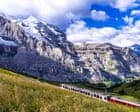
Think of the Swiss Alps as Europe’s water tower. During the spring and summer, these glaciers act as a giant, natural battery. They store winter precipitation as ice and release it slowly, predictably, feeding great river systems like the Rhine, the Rhône, and the Danube.
When a historic heatwave hits the continent, dries out the soil, and bakes the lowlands, these rivers should be replenished by alpine meltwater. It is a beautifully balanced insurance policy.
But consider what happens next when the insurance policy defaults.
When the glaciers melt too fast, too early, the system breaks down. Initially, you get too much water—torrential flows that threaten mountain villages with flash floods and trigger massive rockfalls as the permafrost holding the mountainsides together turns to mud. But then comes the true crisis: the dry season. Once the ice reservoirs are depleted, the rivers drop to historic lows. Cargo ships on the Rhine stall in shallow water, disrupting global supply chains. Nuclear power plants lose the cold water they need for cooling systems. Farmers stare at cracked, dusty fields.
The stakes are entirely human. This is not a story about abstract percentages or distant centuries. It is about whether millions of people will have stable access to drinking water and electricity in the next decade.
The scale of the loss is difficult to comprehend without a metaphor. Imagine a block of ice the size of a standard city skyscraper. Now imagine that block liquefying entirely in a matter of weeks. Multiply that across hundreds of valleys. The sheer volume of water leaving the mountains is reshaping geography in real time. Passing through these valleys today feels less like an alpine vacation and more like walking through a house whose roof has been torn off.
There is a profound sense of grief among the people who live in the shadow of these peaks. Mountain guides are rewriting routes because trails used for generations have collapsed into fields of unstable boulders. Hut keepers, who run the remote wooden shelters nestled high on the ridges, are watching their water supplies vanish as the small local snowfields they rely on dry up completely.
The subject can feel paralyzing. It is easy to look at a sweating giant like the Gorner or the Aletsch glacier and feel a crushing sense of inevitability. The system is so vast, and our individual actions feel so minuscule.
Yet, the scientists tracking this decay refuse to look away. They continue to climb the peaks, drill into the ice, and record the decline, not out of morbid curiosity, but because every fraction of a degree of warming we prevent saves a measurable volume of ice. A glacier is a living record of our climate; if we change the input, we change the survival rate.
As evening fell over the Plaine Morte last August, the temperature failed to drop below freezing. The sweating continued through the dark. A piece of ice the size of a minivan calved off the terminus, crashing into a newly formed milky-green lake below. The sound echoed off the exposed stone walls—a sharp, heavy slap that sounded less like nature changing course and more like a clock ticking down.