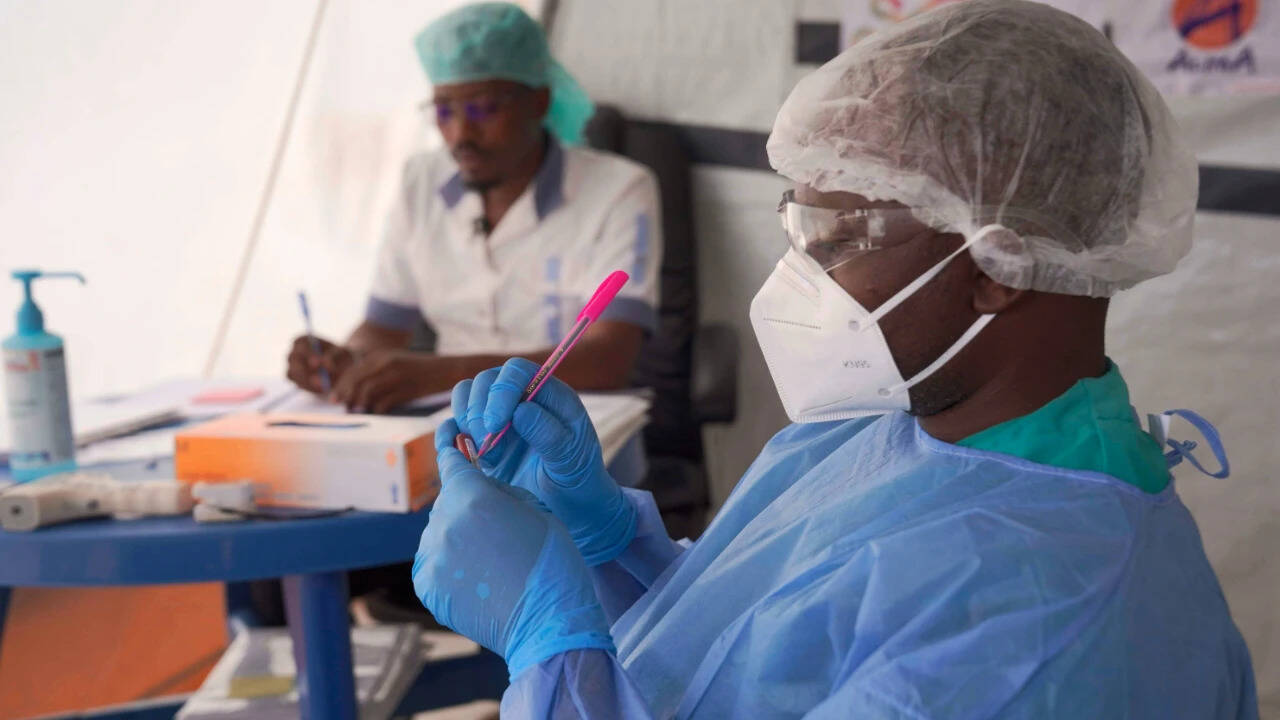
The air inside the small triage room smelled of wet iron and dried eucalyptus. It was four o’clock in the morning, that strange hour when the world feels suspended between yesterday’s exhaustion and tomorrow’s reckonings, and Dr. Omondi stared at a line on a white plastic strip that shouldn't have been there.
Two pink lines.
Not malaria. Not typhoid. Not the ordinary, grinding misery of seasonal fevers that he had learned to diagnose by the slight, characteristic rattle in a patient's breathing before the sun even cleared the Rift Valley. This was something older. Something heavy.
Outside, the market town of Kericho was beginning to stir. Bicycles hummed over gravel roads, tin roofs popped as the equatorial heat began its merciless expansion, and the smell of roasting maize drifted through the windows. The world outside was busy living. Inside, a life was quietly slipping away.
Hours later, the news would cross the wire services in dry, sterile shorthand. Fastest-growing Ebola outbreak: Kenya reports first case, patient dies.
Words like that flatten human suffering into metadata. They turn a man who loved the damp green smell of tea plantations, a man who argued good-naturedly over football matches and worried about his daughter’s school fees, into a statistic. But the numbers do not bleed. They do not gasp for breath as internal walls give way. They do not leave behind a kitchen table where a cup of tea grows cold, untouched, waiting for a hand that will never reach for it again.
To understand what happened when the virus crossed the border, you have to look past the global health bulletins and step into the red zones of human proximity.
Viruses do not march in columns. They do not care about geopolitical lines drawn on colonial maps with rulers and ink. They travel on the back of ordinary affection. They move through the squeeze of a crowded bus seat, the shared gourd at a roadside wake, the tired hands of a relative washing a fevered body because love demands that you do not turn away from the suffering of your own.
Consider the anatomy of an invisible arrival.
When the patient—let us call him Samuel, because a hundred Samuels inhabit these green hills—first felt the chill settle deep inside his bones, he thought it was just the dampness of the rainy season getting into his joints. He was a trader, a man whose work kept him moving along the porous borders where trucks idle for days in long queues of dust and diesel fumes. He had crossed into a zone where the whisper had already become a roar, though the warnings had not yet caught up to the reality on the ground.
By the time he sought help, the virus had already established its brutal architecture inside his bloodstream.
Epidemiologists talk about the basic reproduction number, the mathematical shorthand known as $R_0$, as if it were a weather pattern. They chart curves and exponential growth rates on sleek monitors in Geneva and Atlanta. But on the ground, $R_0$ looks like a grieving sister holding a wet cloth to a dying brother’s forehead. It looks like a nurse working twelve-hour shifts with a cracked plastic face shield, calculating the exact distance between duty and survival.
We have seen this script before. The human memory is a strange instrument, prone to tucking away terror the moment the immediate storm passes. We forget the silence of empty streets during past outbreaks. We forget the strange, medieval dread of not being able to bury our dead with the dignity of touch.
When the diagnosis was confirmed, a tremor went through the regional health office. It was not panic—medical workers rarely have the luxury of panic—it was that cold, sinking realization that comes when a theoretical threat suddenly takes up physical space in the corner of your room.
The response was immediate, drilled into motion by years of regional preparedness protocols forged in the crucible of past African epidemics. Contact tracers mobilized. Names were whispered into notebooks. Faces were matched to memories. Who did he sit with? Who handed him water? Who helped him down from the matatu when his legs finally buckled?
This is where the real battle against a hemorrhagic fever is won or lost. Not in high-tech laboratories thousands of miles away, but in the muddy lanes of villages where health workers walk door-to-door, listening for the tremor in a mother's voice, looking for the telltale flush in a child's eyes. It is detective work of the most intimate, harrowing kind.
Yet, a dangerous narrative always rides alongside the disease: the narrative of panic and othering.
When news breaks of a high-consequence pathogen crossing a frontier, the instinct of the modern world is to wall off, to point fingers, to treat entire populations as vectors rather than victims. Headlines scream about invasions and surges, as if the virus were an invading army marching under a flag.
It is not. It is a biological parasite exploiting our deepest and most beautiful instincts—our willingness to care for one another, to gather in times of sickness and sorrow, to share our spaces and our lives.
To combat it requires more than isolation wards and protective gear. It requires an extraordinary act of social trust. When communities are frightened, they hide their sick. They whisper about symptoms in the dark to avoid the dreaded quarantine camps. Breaking that cycle of fear is harder than developing a vaccine. It requires leaders who tell the unvarnished truth, health workers who listen without judgment, and neighbors who choose solidarity over superstition.
As the sun sets over the Rift Valley, the shadows lengthen across the tea bushes, stretching like long, dark fingers across the red earth.
Inside the isolation unit, the hum of the oxygen concentrator is the only sound breaking the midnight quiet. The first battle has been lost—Samuel’s heart gave out just after dusk, despite every desperate intervention—but the war is happening now, in the quiet spaces between one breath and the next, in the vigilance of a dozen workers tracing a circle around an invisible enemy to ensure it goes no further.
The virus came quietly, carried on the ordinary traffic of human commerce and connection. But it met a wall of human courage, quiet and unheralded, standing watch in the dark.