The mainstream media loves a simple, cinematic narrative. A Ukrainian drone strikes an oil refinery deep inside Russian territory. A spectacular fireball lights up the night sky. Within hours, talking heads declare that the Russian war machine is running on empty, pointing to localized gasoline price spikes and sporadic gas station queues as definitive proof of an impending economic collapse.
It is a comforting story for Western observers. It is also a fundamental misunderstanding of global energy mechanics. Expanding on this theme, you can find more in: The Price of the World's Chokepoint.
The lazy consensus dominating current coverage conflates visible damage with systemic failure. Western analysis treats a massive, continent-sized petrostate like a fragile European manufacturing hub. Having analyzed global energy infrastructure and supply chain constraints for over a decade, I have watched analysts repeatedly make the same mistake: they overestimate the vulnerability of complex infrastructure and underestimate the crude, brutal redundancy built into Soviet-era systems.
The reality is far less satisfying for the armchair generals. The drone campaign against Russian refineries is an operational nuisance, a localized logistical headache, and a brilliant public relations victory. But as a strategy to collapse the Russian domestic fuel market? It is a mathematical impossibility. Experts at Associated Press have also weighed in on this trend.
The Myth of the Crippled Capacity
To understand why the "fuel shortage" narrative is flawed, you must look at the hard numbers of Russian refining capacity versus domestic consumption.
Russia possesses roughly 5.5 million barrels per day (bpd) of refining capacity. Its domestic demand for gasoline and diesel combined sits at roughly 2.5 million bpd.
Do the math. Russia refines more than double the volume of fuel its citizens and military actually consume. The remaining volume is exported to global markets. When a Ukrainian drone knocks out a primary distillation tower (a CDU-12 unit, for instance) at a refinery in Samara or Nizhny Novgorod, Russia does not suddenly run out of gas for its tanks or civilian vehicles. It simply loses a chunk of its export surplus.
Imagine a scenario where a bakery produces 100 loaves of bread a day. The baker’s family eats 40 loaves, and they sell 60 loaves to the village. If a thief breaks in and destroys an oven, cutting production down to 70 loaves, does the baker’s family starve? No. They still eat their 40 loaves. The village simply gets less bread.
This is exactly what is happening in the Russian energy sector. The casualties of these drone strikes are not Russian drivers or military logistics officers; the casualties are the state's export revenues and the corporate bottom lines of state-owned energy giants like Rosneft and Lukoil. The domestic market remains insulated by design.
The Damper Machine and Price Illusions
If there is no true systemic shortage, why do we see long lines at certain Russian gas stations? Why did the Kremlin implement a six-month ban on gasoline exports?
Western commentators point to the export ban as a smoking gun, a sign of panic. It is not panic. It is standard Russian technocratic market manipulation.
Russia governs its domestic fuel market through a highly complex regulatory framework known as the "damper mechanism." This is essentially a government subsidy scheme designed to decouple domestic fuel prices from global oil markets. When global oil prices are high, the Russian government pays domestic refineries a subsidy to sell fuel cheaply at home instead of exporting it for a premium. When global prices drop, the refineries pay the state back.
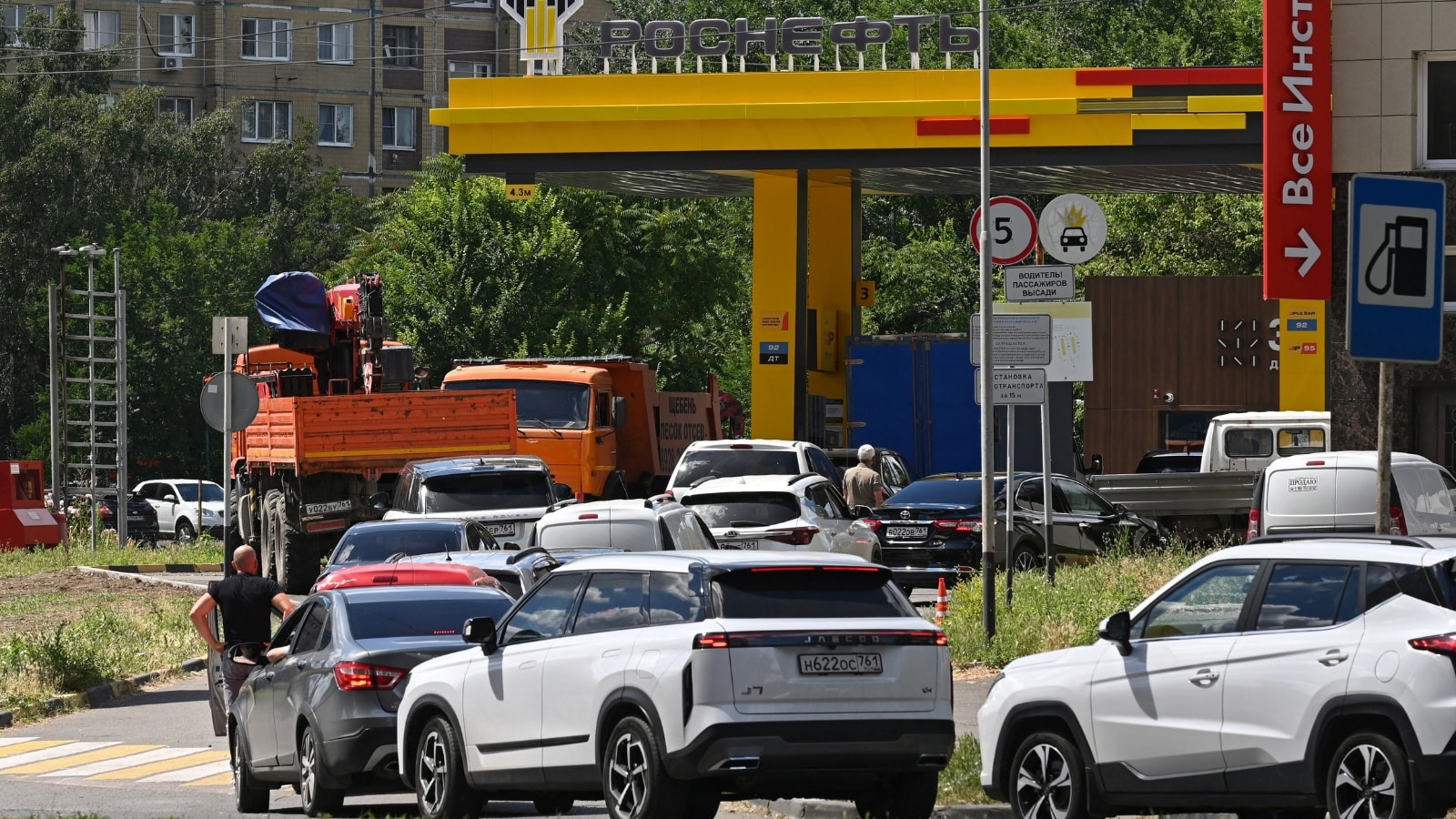
When drones strike multiple refineries simultaneously, it creates a temporary, localized panic. Russian consumers, fed on a diet of social media videos showing exploding oil depots, rush to the pumps to fill up their tanks. This is classic hoarding behavior, not a supply failure.
At the same time, regional logistics networks suffer temporary bottlenecks. Russian fuel does not move primarily via pipelines; it moves via the rail network run by Russian Railways (RZD). If a refinery in the European part of Russia goes offline for repairs, fuel must be rerouted from refineries in Siberia via rail cars. The rail lines are already choked with military cargo moving west. The resulting delay creates temporary, localized gas station outages.
Western journalists see a closed gas station in Rostov and declare a national crisis. They ignore the fact that three days later, a trainload of diesel arrives from Bashkortostan and the queue vanishes.
The Resilience of Low-Tech Engineering
The core flaw in Western analysis is the assumption that Russian refineries are fragile, high-tech ecosystems that cannot survive without Western components. The truth is far more gritty.
While it is true that modern Russian refineries rely on Western-supplied catalysts and software for advanced cracking and hydrotreating units, the primary distillation units—the massive steel towers that do the initial, heavy lifting of separating crude oil into basic components—are remarkably low-tech. They are essentially giant kettles.
Russian engineering excelled at building heavy, over-engineered steel structures during the Soviet era, and that institutional knowledge remains. A primary distillation tower damaged by a 40-pound drone warhead can often be patched, bypassed, or repaired within weeks using domestic steel fabrication facilities.
Furthermore, Russian operators have become masters of cannibalization and improvised air defense. Go to any major industrial site in Western Russia today and you will find improvised anti-drone netting, localized electronic jamming equipment, and pantsir missile systems redeployed from the front lines. The cost of repair is minimal compared to the staggering margins these companies make selling crude on the shadow market.
The Unintended Consequence: Flooding the Market with Crude
Here is the ultimate, counter-intuitive twist that the mainstream media completely misses: by knocking out Russian refining capacity, Ukraine is inadvertently helping to lower global crude oil prices, which directly undermines the efficacy of Western sanctions.
When a Russian refinery cannot operate, the crude oil flowing from the Siberian oil fields does not just stop. You cannot easily turn off an oil well without risking permanent damage to the geological formation. Therefore, that unrefined crude oil must go somewhere.
Where does it go? It goes directly into the export pipelines heading toward Novorossiysk, Primorsk, or Ust-Luga, where it is loaded onto the "shadow fleet" of tankers and shipped to India and China.
By destroying Russian refining capacity, Ukraine forces Russia to export more raw crude oil rather than refined products. This increases the global supply of crude, driving down Brent and WTI prices. Lower global oil prices compress the profit margins of every Western oil producer while doing very little to stop Russia from selling its crude at a discount to hungry Asian economies.
The Kremlin still gets its cash. The global market stays supplied with cheap oil. The only entity truly losing out is the European consumer, who now has to buy refined diesel from India that was made from the very Russian crude Russia was forced to export.
Look at the Right Metrics
Stop looking at videos of burning oil tanks to judge the efficacy of the economic war. If you want to know if Russia is actually running out of fuel, you need to track two specific metrics:
- The price spread between domestic Russian wholesale fuel and retail pump prices: If the wholesale price sky-rockets past the retail cap, refineries stop supplying domestic stations, causing systemic structural shortages. Currently, the Kremlin is managing this spread tightly through the damper mechanism.
- The volume of crude oil exports via sea ports: If sea-borne crude exports drop alongside refining capacity, it means Russia is genuinely struggling to move its energy. If crude exports spike while refining dips, Russia is simply shifting its export mix from product to crude.
The drone campaign is an incredibly brave, tactically impressive feat of asymmetrical warfare. It embarrasses the Kremlin and forces Moscow to expend precious air defense assets far from the front lines. But it is not an economic silver bullet.
Believing that a few dozen drone strikes will immobilize a country with 12 percent of the world's oil production is not analysis. It is wishful thinking. Stop waiting for the Russian economy to collapse at the gas pump. It is not going to happen.