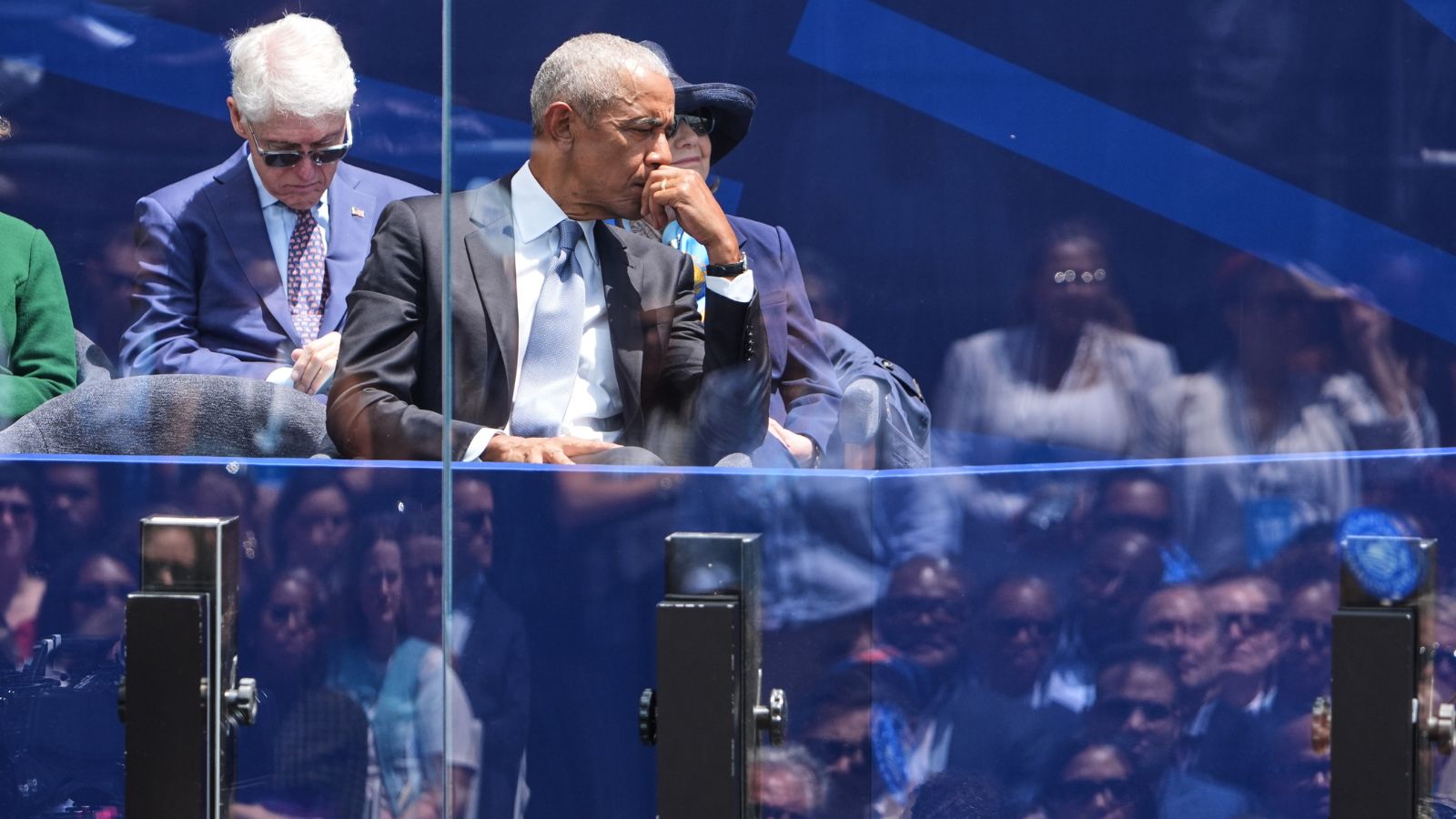
The wind off Lake Michigan does not care about protocol. It sweeps across Jackson Park with the same biting, relentless chill that it did forty years ago, long before secret service details and bulletproof glass became the boundaries of a life. On a gray afternoon, a man stood on a temporary stage built over the dark Midwestern soil. He wore a crisp suit, but his hair was entirely silver now, catching the flat Chicago light.
Barack Obama was looking out at a crowd of familiar faces, old organizers, neighbors, and people who knew him before he belonged to history. He was there to break ground on his presidential center, a monument of stone and glass meant to anchor his legacy. Yet, as he spoke, the grand architecture of the project seemed to melt away. What remained was something fragile. Something human.
When he spoke the words, "She did me wrong," the crowd laughed, recognizing the familiar rhythm of a husband playfully complaining about his wife. But beneath the laughter lay a deeper truth about how legacies are actually built. They are not constructed from policy white papers or legislative victories. They are forged in the quiet, often painful friction of personal relationships, sacrifices, and the heavy debts we owe to those who knew us before the world demanded we become someone else.
The Geography of an Awakening
To understand why a former president gets emotional standing in a windy park, you have to look at the dirt beneath the stage. Chicago’s South Side is not just a location on a map. It is a crucible. When a young, drifting idealist arrived here in the 1980s, he was looking for a home he had never truly possessed. He was a mix of identities, raised in Hawaii and Indonesia, schooled in New York, yet anchored nowhere.
The South Side gave him a floor. It was in the church basements, listening to displaced steelworkers and single mothers, that he learned the true nature of power and vulnerability. He wasn't a leader then. He was an observer, a listener catching the cadences of grief and resilience.
Consider what happens when a person who has reached the absolute apex of global power returns to the exact coordinates where his transformation began. It creates a dizzying psychological loop. The monument he is building is not a celebration of Washington triumphs. It is an olive branch extended back to the community that made him.
The emotional cracked notes in his voice during the launch ceremony weren't performative. They were the sound of a man realizing how much time had passed. The young organizer who drove a dented yellow Honda Civic around these streets is gone, replaced by a historical figure. But the ground stays the same.
The Invisible Architect
Every public myth requires a private anchor. For Obama, that anchor has always been a woman from South Euclid Avenue who understood the neighborhood long before he did. Michelle Robinson did not want a life in politics. She valued stability, privacy, and the quiet dignity of a predictable career. When her husband dragged her into the public square, he wasn't just asking for her support; he was asking her to surrender her life to his ambition.
When he joked that she did him wrong, it was a lighthearted nod to her initial resistance to the project's scale, her sharp wits, and her refusal to treat him like a monument. But anyone watching closely could see the underlying gravity. The line exposed the raw edge of a long marriage lived under a microscope.
Think about the sheer weight of that dynamic. For eight years, she carried the expectations of a nation while trying to protect two young daughters from the distortion field of the White House. Now, returning to Chicago to build a massive center in the very park where she used to walk, the circle was closing.
The emotion at the podium was the manifestation of an unpayable debt. It is the realization that your greatest achievements are built upon the sacrifices of someone who loved you enough to let their own dreams be altered by yours.
The Vanity of Stone
There is a inherent tension in building a presidential library. It is an act of monumentalism, an attempt to freeze a specific era in concrete and glass. Critics point to the displacement of parkland, the gentrification risks, and the sheer ego required to alter a historic city park. These are valid arguments, rooted in the very community organizing principles that Obama once taught.
But look at the project through a different lens. The emotional core of this center isn't about self-congratulation. It is about a desperate desire to prove that the hope of 2008 wasn't an illusion.
In the years since he left office, the political world has fractured into something bitter and unrecognizable to the hopeful crowds that gathered in Grant Park. The optimism that defined his rise feels, to many, like a relic of a simpler, naive time.
The center is an attempt to fight back against that cynicism. By placing this massive institution not in Washington, but amidst the working-class neighborhoods of Chicago, he is trying to make a statement: the ordinary people who created his presidency are the ones who deserve its artifact.
When a man of his stature chokes up on stage, he isn't crying for himself. He is mourning the loss of the world as it was, while stubbornly trying to build a shelter for the world as it could be.
The Final Accord
The speeches eventually ended. The shovels broke the dirt. The cameras clicked, and the politicians moved toward their waiting motorcades.
But as the crowd began to thin, the wind continued to howl through Jackson Park, scattering the fallen leaves across the site of the future museum. The silver-haired man walked off the stage, his hand resting lightly on his wife's back.
In that quiet movement, away from the microphones, the grand narrative of a presidency receded into the background. What remained was just two people from Chicago, standing in the dirt, looking at the space where their youth used to be.


