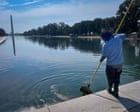
The water does not care about politics. It only mirrors what stands above it, whether that is a cloudless afternoon sky, the cold marble of a monument, or the silhouette of a person holding a can of spray paint in the dark.
When a reflecting pool is perfectly still, it performs a quiet magic. It doubles the world. For a moment, the heavy stone structures we build to cement our history look weightless, floating on a liquid floor. But when that water is fouled, the illusion shatters. The mirror turns into a muddy lens, exposing everything we would rather not see about ourselves.
Now, the pumps are starting up again. The hum is low, a mechanical growl that signals the beginning of a tedious, multi-day chore. Thousands of gallons of water will be sucked away, leaving behind a slimy, exposed concrete basin.
Donald Trump recently announced that five people have been arrested in connection with the latest bout of vandalism that forced this shutdown. Five names entered into a police log. Five individuals who looked at a public space of reflection and saw a canvas for anger.
To understand why this matters, you have to look past the headlines and the predictable social media screaming matches. You have to look at the people who actually clean up the mess.
The Mud and the Midnight Shift
Imagine a worker named Marcus. He is a hypothetical composite of the crews who maintain these public spaces, but his daily reality is entirely real. Marcus does not get to participate in the grand ideological debates of our time. He wears heavy rubber boots, a high-visibility vest, and carries a high-pressure power washer that vibrates so violently his hands go numb after three hours.
When the pool drains, Marcus is the one who descends into the sunken concrete.
The water leaves behind a slick patina of algae, coins tossed by hopeful tourists, lost sunglasses, and, this time, the chemical residue of defacement. The air down there smells like damp earth and stagnant river water. It is exhausting, back-breaking labor. Every square inch of the basin must be scrubbed, rinsed, and treated before the water can be allowed back in.
While the political world uses the incident as ammunition for the next news cycle, Marcus is just trying to get the chemical stains out of the concrete before the sun bakes them into the aggregate permanently.
Consider what happens next when a public space is repeatedly targeted. It changes how we interact with the space itself. Security barriers get closer. Cameras multiply. The open, trusting nature of our shared spaces slowly erodes, replaced by an atmosphere of suspicion. The vandals might think they are making a statement against a system, but the actual tax-paying public is the one left holding the invoice, standing behind a new set of metal barricades.
The Psychology of the Mirror
Why target water?
A wall can be scrubbed. A statue can be sandblasted. But a reflecting pool requires an entire ecosystem to function. It needs a delicate balance of filtration, chemistry, and stillness. To disrupt a reflecting pool is to disrupt a moment of forced pause. You cannot look into a clean pool without seeing yourself. By ruining the water, the vandal ensures that when you look down, you only see their disruption.
The former president’s announcement of the five arrests was delivered with his characteristic rhetorical flourish, framed as a victory for law and order. For his supporters, the arrests are validation that lawlessness is being checked. For his critics, the announcement is viewed through a lens of skepticism or exhaustion.
But the concrete basin remains empty regardless of who you voted for.
The physical reality of the situation is stubborn. It defies spin. The pool requires time to drain, time to scrub, and time to refill. Millions of gallons do not move instantly. The process is an expensive, logistical headache that temporarily robs a city of its centerpiece. Visitors who traveled hundreds of miles to stand at the edge of the water and find a moment of peace are greeted instead by chain-link fencing and the smell of industrial bleach.
The Hidden Cost of Common Ground
We are living in an era where the concept of shared ownership is dying a slow death. Everything must be claimed. Everything must be weaponized. A public park is no longer just a park; it is a battleground for cultural dominance.
When these five individuals allegedly stepped over the line to deface the property, they likely felt a rush of purpose. The modern world rewards spectacle. A viral video of destruction moves faster through the bloodstream of our culture than a lifetime of quiet civic maintenance. We have built an attention economy that treats outrage as currency, and public monuments are the highest-yielding assets on the market.
But the real problem lies elsewhere, far from the glare of the television cameras and the political rallies.
The damage is not just financial, though the cost to drain and clean a massive water feature runs into the tens of thousands of dollars each time. The real damage is a subtle, creeping cynicism. It is the feeling you get when you walk through a beautiful space and realize you are being watched by three different security lenses. It is the realization that we cannot have nice things because someone, eventually, will decide to break them just to prove they can.
The pumps will finish their job. The basin will dry out under the summer heat. Marcus and his crew will spend their shifts bent double, fighting the stains left behind by five people who wanted to be noticed. Then, slowly, the valves will turn again. The water will creep back across the concrete, rising inch by inch until the floor is hidden and the surface becomes perfectly flat.
The reflection will return. The clouds will float across the surface again, and the monument will look weightless once more. But underneath that clean facade, the concrete will bear the faint, invisible scars of the scrub brushes, waiting for the next time the water has to go.